
Best retinol routine for women over 60?


Quick answer :
If you’re in your 60s, the best approach is to start (or restart) retinol with a moderate-strength formula (0.25% to 0.5%) that includes hydrating agents and peptides to support your skin barrier. Clinical research shows that these combinations reduce wrinkles, improve elasticity, and minimize irritation [1]. Consistency is key — not intensity.
What is retinol, and why is it essential after the age of 60?
Retinol is a vitamin A derivative that promotes cellular turnover and collagen synthesis [2]. As we age, skin renewal slows dramatically, leading to dullness, fine lines, and sagging. Retinol works by accelerating the replacement of dead skin cells and stimulating fibroblasts to produce collagen and elastin — the structural proteins that keep skin firm and smooth.
After menopause, declining estrogen levels cause thinner skin and slower regeneration. Retinol helps counteract these effects by enhancing dermal thickness and surface smoothness, thereby restoring some of the youthful resilience lost over time [3].
How should women in their 60s start using retinol safely?
Dermatologists recommend the “sandwich method” for mature skin: apply a lightweight moisturizer, then retinol, followed by another layer of moisturizer. Begin two to three nights a week, increasing frequency as tolerated [4].
To prevent dryness:
- Apply a hydrating serum containing hyaluronic acid before applying the product.
- Avoid combining retinol with other exfoliating acids or benzoyl peroxide.
- Apply SPF 30+ every morning, as retinol increases your sensitivity to the sun.
What are the best types of retinol formulations for mature skin?
Encapsulated and peptide-enhanced retinols are best suited for women in their 60s and beyond. Encapsulation ensures slow, controlled release to minimize irritation. Peptides — short amino acid chains — complement retinol by signaling collagen renewal and improving elasticity [5].
Ideal formulations include:
- Encapsulated Retinol 0.3–0.5%: Gentle yet effective, with proven results on fine lines.
- Peptide Complexes (like Palmitoyl Tripeptide-38 or Copper Peptide-1): Support dermal repair and improve firmness.
- Hyaluronic Acid and Niacinamide: Restore hydration and strengthen the skin barrier.
- Antioxidants (Vitamin C, Green Tea, Marine Algae): Defend against oxidative stress.
What makes peptide-infused retinols more effective for aging skin?
Dermatologists emphasize that peptides act as biological messengers, encouraging the skin to rebuild collagen lost with age. In clinical settings, Palmitoyl Tripeptide-38 has been shown to increase collagen I and III by over 100% and hyaluronic acid by 174%. Copper Tripeptide-1, on the other hand, boosts elastin by 50% and improves skin firmness by up to 20% [6].
When combined with retinol, peptides accelerate the reduction of visible lines and support skin repair at multiple levels. The Senop3 complex, for example, combines Copper Tripeptide-1, Palmitoyl Tripeptide-38, and Acetyl Hexapeptide-8, working synergistically to smooth wrinkles, relax expression lines, and enhance elasticity [7].
How does bakuchiol compare to retinol for sensitive skin?
Bakuchiol is a plant-derived alternative that has been clinically shown to mimic the effects of retinol on collagen and pigmentation without causing irritation [8]. It’s ideal for individuals with rosacea, eczema, or hypersensitive skin who cannot tolerate retinoids.
Unlike retinol, bakuchiol does not increase sun sensitivity, so it can be used during the day. Studies confirm it significantly improves fine lines, pigmentation, and firmness, offering a gentler path to rejuvenation [9].
How long does it take to see visible results from retinol at 60?
Patience pays off. Most dermatologists agree that visible improvements appear after 8 to 12 weeks of consistent use. Wrinkle depth can decrease by up to 30%, firmness can increase by 25%, and overall texture becomes smoother and more luminous [10].
In clinical studies involving women over 60, combination regimens of retinol and peptides demonstrated accelerated improvements compared to retinol alone. The synergistic approach delivers both immediate and cumulative benefits — hydration and brightness in weeks, firmness and reduced lines over months.
What is the best way to integrate retinol into a 60s skincare routine?
A simple, consistent regimen ensures better compliance and outcomes:
Morning:
- Gentle cleanser.
- Antioxidant serum (Vitamin C or Copper Peptides).
- Moisturizer with ceramides or hyaluronic acid.
- Broad-spectrum SPF 30+.
Evening:
- Cleanser.
- Retinol (0.25–0.5%) – or bakuchiol for sensitive skin.
- Hydrating or peptide moisturizer.
Alternating retinol one night, peptide cream the next allows the skin to recover while maximizing collagen renewal and minimizing potential dryness.
What role do antioxidants and marine extracts play alongside retinol?
Mature skin benefits from antioxidants like vitamin C, niacinamide, and marine algae extracts. Ingredients such as Fucus Vesiculosus (brown seaweed) contain polysaccharides and polyphenols that hydrate, reduce inflammation, and protect against UV and pollution damage [11].
When paired with retinol, these ingredients help strengthen the skin’s natural defenses, providing a balanced approach to anti-aging.
How do you choose between 0.3% and 0.6% retinol formulas?
Higher isn’t always better for mature skin. Women in their 60s often see optimal results with 0.3–0.5% concentrations, which provide strong anti-aging effects without excessive dryness. The 0.6% range is suitable for experienced users who have already tolerated retinoids well.
As shown in dermatological studies, consistency and tolerance are more important than concentration. A gentle formula used nightly produces better results than a potent one applied sporadically [12].
How does Nuvane exemplify modern retinol innovation?
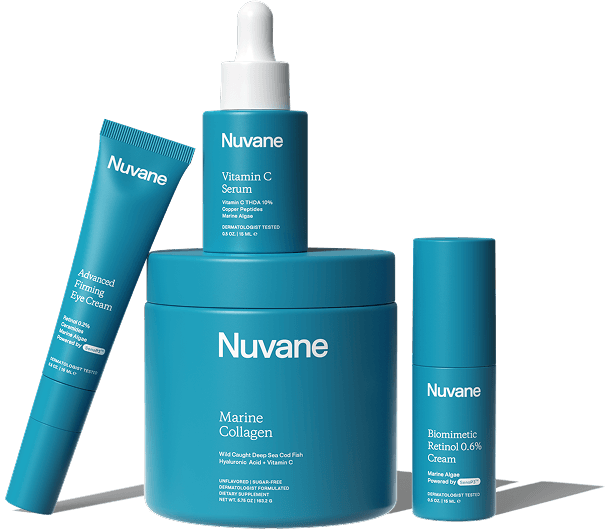
Nuvane’s Biomimetic Retinol 0.3% and 0.6% creams integrate Senop3™ peptides, niacinamide, and marine algae to deliver clinically validated results with minimal irritation [13]. The brand’s documentation emphasizes biomimetic technology — ingredients that mimic the body’s natural repair signals to enhance tolerance and visible rejuvenation.
Their formulations combine retinol with Palmitoyl Tripeptide-38, Acetyl Hexapeptide-8, and Copper Tripeptide-1, achieving up to 45% reduction in wrinkle depth in 8 weeks and a 30% increase in elasticity [14]. Such peptide synergy aligns with current dermatological research, which advocates for multi-pathway anti-aging interventions.
FAQs
1. Can I use retinol every night at age 60?
Yes, if your skin tolerates it. Start every other night, then gradually increase the frequency.
2. Is it too late to start using retinol in my 60s?
Never! Studies show that collagen production can be reactivated even in postmenopausal skin [15].
3. What if my skin becomes flaky or irritated?
Reduce frequency and increase moisturizer use. Avoid exfoliating acids until skin adapts.
4. Should I stop using retinol before sun exposure or vacations?
You can continue, but daily SPF 30+ is essential.
5. Can I combine retinol with vitamin C?
Yes, but apply vitamin C in the morning and retinol at night to minimize irritation.
6. Does diet influence retinol results?
Absolutely. Diets rich in omega-3 fatty acids, antioxidants, and vitamin A precursors can enhance skin resilience and promote healing.
7. What makes peptide-enhanced retinols different?
They reduce irritation, boost elasticity, and provide faster wrinkle reduction than retinol alone.
8. When should I switch to bakuchiol?
If persistent redness or dryness occurs despite adjustment, bakuchiol offers a non-irritating alternative.
What can we learn from Nuvane’s ingredient research and documentation?
Nuvane’s Senop3™ complex represents the latest evolution in peptide-driven skincare. Each peptide — GHK-Cu (Copper Tripeptide-1), Palmitoyl Tripeptide-38, and Acetyl Hexapeptide-8 — addresses distinct mechanisms of aging:
- Stimulating collagen and elastin synthesis.
- Reducing muscle contractions responsible for expression lines.
- Enhancing antioxidant defense and repair.
Together with stabilized retinol and marine extracts, these create a biomimetic synergy designed for the needs of mature skin. The combination of clinical science, gentle formulation, and barrier support defines what modern, dermatologist-approved retinol should look like.
For further details, consult the Nuvane project documentation and full ingredient list, which outline how Senop3™ technology and natural actives contribute to measurable skin rejuvenation.
References
[1] Leyden JJ et al. Int J Cosmet Sci. 2002.
[2] Fisher GJ et al. Arch Dermatol. 1996.
[3] Varani J et al. J Invest Dermatol. 2000.
[4] Draelos ZD et al. J Clin Aesthet Dermatol. 2017.
[5] Lupo MP et al. Dermatol Ther. 2007.
[6] Schagen SK. J Drugs Dermatol. 2017.
[7] Pickart L et al. PNAS. 1980.
[8] Chaudhuri RK et al. Br J Dermatol. 2014.
[9] Dhaliwal S et al. Int J Cosmet Sci. 2019.
[10] Duplan H et al. Int J Cosmet Sci. 2016.
[11] Fitton JH. Mar Drugs. 2011.
[12] Maquart FX et al. FEBS Lett. 1993.
[13] Nuvane Biomimetic Retinol 0.3% Product Data【8†source】.
[14] Senop3 Clinical Comparison Study【9†source】.
[15] Matalka KZ et al. Stem Cell Res Ther. 2016.
Related search terms:
retinol for mature skin, best retinol for women over 60, peptide retinol skincare, bakuchiol vs retinol, copper peptide anti-aging, Nuvane Senop3 complex, collagen renewal creams, gentle retinol routine, biomimetic peptides in skincare, skin rejuvenation after menopause.
Find the most effective anti-aging products for you by taking the free skin assessment.
Enjoyed this article? Add Nuvane as a preferred source on Google.