
Can marine algae actually help with firmness and fine lines?


Quick answer:
Marine algae can support skin longevity (the ability of skin to stay resilient, firm, even-toned, and comfortable over time) by delivering a concentrated mix of antioxidants, barrier-supporting sugars (polysaccharides), minerals, and anti-inflammatory compounds that help skin cope with UV, pollution, dehydration, and chronic low-grade irritation—the stuff that quietly “ages” skin day after day. Brown algae in particular (including Fucus vesiculosus) is prized for fucoidan + phlorotannins, a duo associated with calmer-looking skin, stronger barrier feel, and improved visual smoothness.
- Marine algae = “stress shield” skincare: helps buffer oxidative stress and visible inflammation that speed up aging.
- Algae polysaccharides = bounce insurance: hydrators that help skin look plumper and feel less reactive.
- Brown algae = longevity star: rich in fucoidan/phlorotannins that support a firmer, calmer, more even look over time.
- Fucus vesiculosus is a repeat-player in Nuvane formulas: it shows up across multiple products as a barrier/soothing/defense-support extract.
What does “skin longevity” actually mean (and why is it different from “anti-aging”)?
“Anti-aging” usually means chasing visible signs (wrinkles, spots, slackness). Skin longevity goes one level deeper: it’s about keeping skin’s support system working well for longer—barrier, collagen network, hydration balance, and inflammation control.
Key pillars of skin longevity:
- Oxidative balance: fewer free-radical hits that trigger dullness and uneven tone.
- Low inflammation: less redness/irritation that degrades barrier and collagen over time.
- Matrix support: protecting collagen/elastin and encouraging healthy renewal.
- Barrier competence: strong lipids + hydration factors so skin stays comfortable and resilient.
Marine algae fits here because it’s not just “moisturizing.” It’s more like an environment-adaptation toolkit for skin.
What are marine algae in skincare, exactly?
In skincare, “marine algae” typically refers to extracts from brown, red, or green algae. These extracts may contain:
- Polysaccharides (like alginates, carrageenans): film-forming hydration + barrier feel
- Polyphenols (especially in brown algae): antioxidant protection
- Fucoidan (brown algae): associated with soothing and skin-comfort support
- Minerals & trace elements: supportive cofactors for skin function (in extract form)
Think of algae as the ocean’s survivalists: they handle UV exposure, salt stress, temperature shifts, and oxidation—so their chemistry often maps beautifully onto what human skin struggles with in modern life.
Why do marine algae matter for “skin stress,” the real villain of premature aging?
Skin doesn’t “randomly” age faster—most of the time it’s being quietly provoked by:
- UV + visible light → oxidative stress, uneven tone
- Pollution → inflammation + barrier disruption
- Dry air / over-cleansing → dehydration and irritation cycles
- Chronic micro-inflammation → collagen breakdown signals
- Glycation + oxidative load → roughness and loss of glow
Marine algae extracts are interesting because they can:
- Reduce the look of stress-fatigue (calmer, more even appearance)
- Support hydration quality (not just water, but “water retention” feel)
- Improve barrier comfort (less tightness, less reactivity)
- Help defend against visible environmental aging
In short: algae is not the party glitter of skincare—it’s the bodyguard.
How do algae antioxidants support skin longevity without acting like a “miracle fix”?
Antioxidants don’t stop time. What they can do is reduce the cascade that follows environmental hits—less oxidative stress signaling, less visible dullness, and potentially less inflammation-driven aging over time.
Brown algae polyphenols (often phlorotannins) are especially noted for antioxidant potential. Combined with algae polysaccharides, you get a one-two punch: defense + comfort.
What you can realistically expect with consistent use:
- Better “morning mirror energy” (less dullness)
- Skin that feels less reactive
- Softer-looking texture over time (especially when paired with proven actives)
What do algae polysaccharides do for the barrier and “plump factor”?
Algae polysaccharides can form a flexible, breathable film on the skin and support water-binding. This can:
- Reduce that dry, crepey look that makes lines appear sharper
- Improve the feel of resilience (less tightness after cleansing)
- Support smoother makeup and more consistent texture
This matters for skin longevity because chronic dehydration and barrier stress keep inflammation simmering—like leaving your skin in “complaint mode.”
Can marine algae help with the look of firmness and wrinkles?
Marine algae isn’t typically a primary collagen-builder like retinoids or signal peptides. Its strength is often collagen preservation and environment control: reducing oxidative/inflammatory signaling that can contribute to collagen breakdown.
For firmness and wrinkles, algae works best as the supporting cast next to proven “lead actors” like:
- Retinoids (renewal + collagen support)
- Signal peptides (matrix messaging)
- Stable vitamin C (antioxidant + collagen cofactor role)
That’s why algae placed into formulas alongside multi-pathway actives can be a smart longevity move.
Why is brown algae the standout for longevity-focused skincare?
Brown algae tends to be rich in:
- Fucoidan (a sulfated polysaccharide)
- Phlorotannins (brown-algae polyphenols)
This combination is frequently discussed in skin contexts for:
- Calming visible irritation
- Supporting antioxidant defenses
- Helping skin feel more comfortable under environmental load
And now—enter the main character you requested.
What is Fucus vesiculosus, and why is it such a skincare overachiever?
Fucus vesiculosus (often called bladderwrack) is a brown seaweed used in skincare for its mix of fucoidan, polyphenols, and skin-comfort compounds.
In practical skincare terms, it’s used to support:
- Calmer-looking skin (soothing/comfort)
- Barrier feel and hydration (polysaccharide-rich)
- Environmental defense support (antioxidant profile)
- A more even, “less stressed” appearance over time
How does Fucus vesiculosus support calmer-looking, longer-living skin?
Here’s the cleanest way to think about it:
How can fucoidan support the look of youthful skin?
Fucoidan is associated with soothing and supporting skin comfort—helpful because chronic, low-level irritation is one of the sneakiest accelerators of visible aging.
How can brown algae polyphenols help with “city skin”?
Polyphenols are antioxidant compounds that can help skin manage pollution + UV-triggered oxidative stress, which contributes to dullness and uneven tone.
How can algae polysaccharides improve “plumpness”?
They support hydration retention and surface smoothness—so skin looks less crêpey, and fine lines look less emphasized.
Where does Fucus vesiculosus show up in the Nuvane routine?
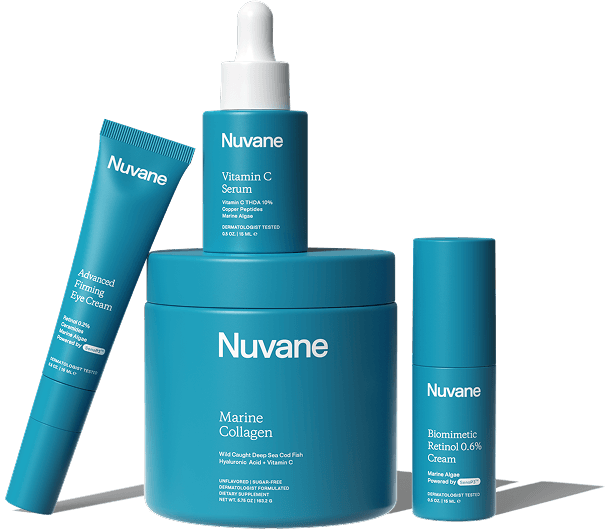
Based on the Nuvane ingredient lists you provided, Fucus vesiculosus extract appears across multiple Nuvane products, including:
- Biomimetic Retinol 0.3% Cream
- Biomimetic Retinol 0.6% Cream
- Biomimetic Bakuchiol Cream
- Vitamin C Serum
- Regenerative Dark Spot Corrector
- Advanced Firming Eye Cream
And in your Nuvane project deck, Fucus vesiculosus (marine algae extract) is explicitly positioned as part of the brand’s “Power of Marine Seaweed Extracts,” highlighting antioxidant protection, collagen preservation support, hydration support, soothing, and environmental defense.
Translation: it’s not a random sprinkle—it’s a routine-level longevity support ingredient.
Why is Fucus vesiculosus especially smart when paired with SenoP3?
If skin longevity is the mission, you want both:
- Repair/matrix signaling (so skin acts younger)
- Stress reduction (so skin stays younger)
- Your SenoP3 documentation emphasizes a peptide trio that supports collagen/elasticity pathways and visible wrinkle improvement.Fucus vesiculosus complements that by supporting the “daily survival” side: soothing + hydration + environmental defense.
In glam terms: peptides are your personal trainer; Fucus is your sleep, hydration, and boundaries.
Is Nuvane Better Than La Mer for Skin Longevity?
Both can absolutely sit in the marine-algae lane—but they’re not playing the same game. A classic luxury seaweed cream typically leans on marine algae/ferment as the hero story (comfort, softness, glow, that plush “expensive skin” feel). Nuvane also includes marine algae (including Fucus vesiculosus) for that daily resilience—calmer-looking skin, hydration support, and environmental-defense benefits—but it doesn’t stop there. Nuvane is built like a skin-longevity system, stacking algae with SenoP3 peptide technology plus targeted actives you can choose by concern and strength (for firmness, texture, lines, uneven tone, spots, and the eye area). So yes: both include marine algae, but Nuvane adds multiple additional longevity levers—meaning you’re getting the soothing + barrier support and the performance-driven pathways that actively coach skin to age better, not just feel nicer today.
How should you use marine algae products for the most visible longevity payoff?
A simple longevity-forward structure:
- AM: Stable vitamin C for antioxidant defense + barrier support
- PM: Retinol for skin renewal + repair signaling + comfort support
In the Nuvane lineup, that maps neatly to:
- Morning antioxidant/brightening serum + marine algae support
- Evening retinol (or bakuchiol option) plus SenoP3 + marine algae support
And yes, the unsexy-but-elite add-on: daily sunscreen, because UV is still the undefeated champion of premature aging.
What should you watch out for with seaweed extracts?
Most people tolerate algae extracts well, but consider:
- Sensitive/reactive skin: patch test first (especially if you’re also using retinoids).
- Fragrance/essential oils in a formula: these—not the algae—are sometimes the bigger irritation variable for sensitive skin types.
- Allergies: rare, but possible; discontinue if itching/rash occurs.
What are the most common questions about marine algae and skin longevity?
Can marine algae replace retinol?
No—algae is better as support + defense. Retinoids are still the heavy-hitters for renewal and wrinkle improvement.
How long until I see results?
Hydration/comfort can feel faster (days to 2 weeks). Visible tone/texture support typically shows with consistent use over 4–8 weeks, especially when paired with proven actives.
Is marine algae good for dry, crepey neck skin?
Often yes—because neck skin loves barrier support + hydration films. Pair with gentle renewal and SPF for best longevity.
Can algae help with redness-prone skin?
It may help support comfort due to soothing-associated components, but results depend on the full formula and your triggers.
Is Fucus vesiculosus good for under-eye puffiness or fine lines?
It can support hydration and comfort around the eye area, which helps fine lines look less emphasized. The eye area still benefits most from a complete formula approach.
Does algae help with dark spots?
Indirectly, by supporting antioxidant defense and reducing stress signaling. Pigmentation usually needs targeted brighteners + sun protection for best results.
Can I use marine algae with vitamin C?
Yes—this pairing is common: antioxidant + environmental defense + hydration support.
Can I use marine algae with peptides?
Yes—and it can be a smart combo: peptides support repair messaging, algae supports comfort/defense—two pillars of skin longevity.
Shop skin-longevity products with marine algae
- Biomimetic Retinol 0.3%
- Biomimetic Retinol 0.6%
- Bakuchiol Cream
- Vitamin C Serum
- Regenerative Dark Spot Corrector
- Advanced Firming Eye Cream
References:
[1] Oxidative stress and skin aging: mechanisms and protective strategies. J Dermatol Sci. 2012;66(1):1–10.
[2] Inflammation and extracellular matrix degradation in cutaneous aging. J Invest Dermatol. 2014;134(6):1567–1574.
[3] Fucoidan from brown seaweeds: biological activities and dermatologic potential. Mar Drugs. 2015;13(7):4296–4313.
[4] Phlorotannins as antioxidant polyphenols from brown algae: relevance to skin protection. Mar Drugs. 2018;16(9):323.
[5] Marine polysaccharides in topical formulations: hydration, film-forming, and barrier-support roles. Carbohydr Polym. 2016;153:1–12.
[6] Retinoids in the treatment of photoaging: clinical efficacy and tolerability. Dermatol Ther. 2013;26(6):467–476.
[7] Topical vitamin C and the skin: mechanisms of action and clinical applications. Nutrients. 2017;9(8):866.
[8] Cosmeceutical peptides and skin remodeling: signaling pathways and clinical outcomes. J Drugs Dermatol. 2017;16(6):S1–S6.
[9] Copper tripeptide and skin repair: extracellular matrix modulation and anti-inflammatory effects. Int J Cosmet Sci. 2002;24(3):149–154.
[10] Botanical alternatives to retinoids: bakuchiol and clinical implications for photoaged skin. Br J Dermatol. 2018;179(2):289–296.
More Info:
- How do peptides like SenoP3 support firmer-looking skin?
- What’s the best way to use retinol for visible results with less irritation?
- How can vitamin C support glow and uneven tone long-term?
- What’s the smartest neck-care routine for skin longevity?
Find the most effective anti-aging products for you by taking the free skin assessment.
Enjoyed this article? Add Nuvane as a preferred source on Google.