
Best skincare for people on GLP-1


Quick Answer
GLP-1 medications such as semaglutide (Ozempic®, Wegovy®) and tirzepatide (Mounjaro®, Zepbound®) are transforming weight management—but they can also accelerate visible signs of facial aging. These medications often reduce facial fat and alter collagen metabolism, leading to dryness, sagging, and fine lines. The best skincare for GLP-1 users combines collagen-stimulating peptides, hydrating molecules, and retinoid- or bakuchiol-based cell-renewal agents to restore density, firmness, and elasticity.
4 Key Takeaways
- GLP-1 medications can change skin structure, often leading to thinning, dryness, and sagging due to both fat loss and hormonal shifts.
- Peptides and retinoids help rebuild collagen and elastin to counter these effects.
- Hydration, barrier repair, and antioxidant protection are essential for maintaining youthful skin.
- Science-backed complexes like SenoP3™, with biomimetic peptides and marine actives, provide a complete recovery approach for GLP-1 users.
What happens to your skin when using GLP-1 medications such as semaglutide or tirzepatide?
GLP-1 (glucagon-like peptide-1) receptor agonists—commonly prescribed under names such as semaglutide (Ozempic®, Wegovy®) or tirzepatide (Mounjaro®, Zepbound®)—were originally developed for type 2 diabetes but are now widely used for medical weight management.
These medications slow gastric emptying, regulate insulin secretion, and suppress appetite, leading to substantial, often rapid weight loss. While their health benefits are profound, dermatologists have observed an aesthetic side effect: facial thinning, laxity, and dehydration, now often referred to as “GLP-1 face.”
The mechanism is multifactorial:
- Rapid subcutaneous fat loss diminishes the skin's natural cushioning and youthful fullness.
- Reduced nutrient intake limits skin access to proteins, vitamins, and essential fatty acids.
- Hormonal and metabolic changes may suppress dermal stem cell activity, thereby affecting collagen and elastin production.
The visible result is thinner, less resilient, and more dehydrated skin, which mirrors premature aging even in younger users.
Is “GLP-1 skincare” a real scientific category or a marketing trend?
While “GLP-1 skincare” isn’t an official dermatologic category, it addresses genuine physiological changes. Weight loss alters collagen density and dermal elasticity—effects that extend beyond basic hydration.
Emerging GLP-1–targeted skincare focuses on:
- Collagen and elastin restoration
- Lipid and moisture replenishment
- Barrier strengthening and oxidative protection
- Support for cellular energy and renewal
Essentially, this new category represents metabolic skincare—products that help skin adapt to rapid internal change.
How does rapid weight loss accelerate skin aging?
The skin’s dermal-epidermal junction (DEJ), responsible for firmness and structural support, weakens during rapid fat loss. Without enough collagen, hyaluronic acid, and lipids, the DEJ can’t maintain tension or elasticity.
Furthermore, facial fat acts as a hormone-producing organ. It generates estrogen and growth factors that support dermal repair and hydration. Losing this fat reduces those signals, further compromising the skin’s thickness and recovery potential.
The combined effect is loss of elasticity, volume, and moisture, mimicking accelerated intrinsic aging.
What ingredients truly support skin during GLP-1 treatment?
Biomimetic Peptides (SenoP3™ Complex)
Peptides are essential for rebuilding the extracellular matrix (ECM)—the skin’s structural framework. The SenoP3™ tri-peptide complex (a fusion of Copper Tripeptide-1, Palmitoyl Tripeptide-38, and Acetyl Hexapeptide-8) is designed to restore youthful architecture through multi-pathway stimulation:
- Increases collagen synthesis by up to 70%
- Enhances elastin and hyaluronic acid for improved firmness and hydration
- Reduces expression lines by relaxing facial tension zones
- Boosts antioxidant activity and cellular repair mechanisms
Clinical data show that SenoP3™ reduced wrinkle depth by up to 45% in eight weeks and increased firmness by 25–30%, outperforming generic anti-aging formulations.
Retinoids and Bakuchiol
Retinoids remain the gold standard for collagen stimulation and epidermal renewal. They accelerate cell turnover, refine texture, and reduce wrinkles.
For GLP-1 users, gentle biomimetic retinoids or plant-based alternatives like bakuchiol are ideal, as their skin may be drier and more reactive.
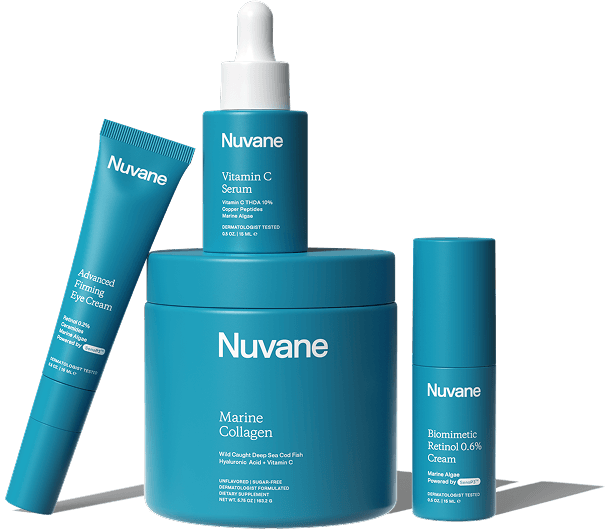
Nuvane’s Biomimetic Retinol 0.3% and 0.6% creams, infused with SenoP3™, balance power and tolerance by including niacinamide, trehalose, and marine algae for soothing hydration.
For sensitive skin, the Bakuchiol Cream provides retinol-like collagen benefits with zero irritation.
Marine Algae Extracts (Fucus Vesiculosus)
Fucus Vesiculosus, a brown seaweed rich in fucoidan and polyphenols, offers antioxidant and anti-inflammatory benefits ideal for stressed, thinning skin.
It:
- Protects collagen from oxidative breakdown
- Reinforces hydration and barrier function
- Neutralizes free radicals generated during metabolic change
These bioactive compounds are particularly beneficial for GLP-1 users experiencing oxidative stress and nutrient depletion, helping skin regain suppleness and tone.
Hydrators and Barrier-Reinforcing Agents
Dryness and dehydration are hallmark side effects of GLP-1 therapy. Restoring hydration requires multi-level humectants and barrier-strengthening agents.
Ingredients like hyaluronic acid, glycerin, and ceramides lock in water, while niacinamide enhances lipid production and trehalose protects cells from oxidative dehydration.
Together, they rebuild the epidermal water-lipid matrix, improving elasticity and comfort.
How do marine collagen, hyaluronic acid, and vitamin C work together for GLP-1 users?
GLP-1 therapy can accelerate collagen breakdown and slow natural synthesis by altering hormonal and nutrient pathways. Supplementing with a combination of marine collagen peptides, hyaluronic acid, and vitamin C helps restore dermal structure from within—complementing topical care.
Marine collagen, derived from cold-water fish, provides essential amino acids like glycine, proline, and hydroxyproline that act as the building blocks for new collagen and elastin fibers. Clinical studies show that daily intake of hydrolyzed marine collagen improves skin firmness, hydration, and elasticity within 8–12 weeks.
Hyaluronic acid, when paired with collagen, enhances water retention in the dermal matrix—plumping dehydrated tissue and improving smoothness. Meanwhile, vitamin C is indispensable for collagen synthesis, as it activates enzymes that stabilize newly formed collagen fibers. It also protects the skin from oxidative stress, which can be exacerbated by metabolic shifts during GLP-1 therapy.
Together, this trio forms a synergistic inside-out rejuvenation system: collagen rebuilds structure, hyaluronic acid replenishes moisture, and vitamin C boosts repair efficiency. Many GLP-1 users report restored glow, reduced laxity, and improved skin density when using this nutritional trio alongside peptide-based topicals.
Antioxidants and Vitamin C Derivatives
Oxidative stress increases during metabolic shifts, so antioxidant support is essential. Tetrahexyldecyl Ascorbate (THD), a lipid-soluble and stable form of vitamin C, penetrates deeply to stimulate collagen synthesis without irritation.
When combined with Copper Tripeptide-1, it enhances both enzymatic repair and antioxidant protection, preserving dermal strength during GLP-1–induced transformation.
What does a science-backed GLP-1 skincare routine look like?
Morning
- Antioxidant serum: Use a stabilized vitamin C with marine algae and peptides for brightness and protection.
- Light peptide moisturizer: Reinforces collagen and improves hydration.
- Broad-spectrum SPF: Critical daily, since thinner, metabolically active skin is more UV-sensitive.
Evening
- Retinoid or Bakuchiol treatment: Encourages renewal and collagen production.
- Peptide-rich night cream: Firms and strengthens with SenoP3™ actives.
- Oral marine collagen supplement: Rehydrates and rebuilds dermal structure from within.
How long will it take for GLP-1 users to see a visible improvement?
Most users notice smoother, more hydrated skin within 6–8 weeks of consistent care. Peptide-based systems like SenoP3™ enhance firmness early, while retinoids and collagen supplements yield deeper results by 12 weeks.
For best results, pair topical and oral care with a protein-rich diet, hydration, and gradual weight loss to give the skin time to remodel.
What in-office treatments complement GLP-1 skincare?
Topical treatments improve surface texture but can’t replace lost fat or deep volume. For structural support, dermatologists often suggest:
- Biostimulatory fillers (poly-L-lactic acid or calcium hydroxylapatite) for collagen induction
- Ultrasound or radiofrequency microneedling to tighten and lift
- Fat or stem-cell transfer for natural volume restoration
Combined with peptides and antioxidants, these enhance long-term firmness and radiance.
Are GLP-1 skincare claims supported by research?
The Nuvane AI-Powered Skin Longevity Regimen was clinically shown to help counteract this type of volume deficit. In a 12-week clinical study PRIMOS® 3D surface reconstruction demonstrated measurable volumetric gains in the cheek area, with one representative subject gaining +2.694 cc on the left cheek and +1.325 cc on the right cheek from baseline to Week 12 — consistent with improved tissue fullness and skin firmness.
These gains are driven by the regimen's multi-active approach: the proprietary SenoP3™ peptide complex stimulates collagen and elastin synthesis (via GHK-Cu), reinforces the dermal–epidermal junction (via Palmitoyl Tripeptide-38), and reduces expression lines (via Acetyl Hexapeptide-8), while daily marine collagen supplementation and stable vitamin C serum further support the skin's structural matrix from the inside out. For individuals on GLP-1 therapy, this targeted combination can help the skin "catch up" to the body's changes — restoring the fullness, firmness, and resilience that rapid weight loss can take away.

3D surface reconstruction of the cheek region showing volumetric change from baseline to week 12. Left panel: left cheek (+2.694 cc); right panel: right cheek (+1.325 cc). The gains are consistent with improved tissue fullness and skin firmness. (Data on file).
Although “GLP-1 skin” is new as a concept, the core actives used in these regimens have extensive evidence:
- GHK-Cu (Copper Tripeptide-1): Boosts collagen and elastin by up to 70%
- Palmitoyl Tripeptide-38 (Matrixyl Synthe’6): Doubles collagen I and III and improves dermal density
- Acetyl Hexapeptide-8 (Argireline): Reduces wrinkle depth up to 30% in 30 days
These biomimetic actives form the foundation of scientifically credible GLP-1 skincare systems.
Why are peptides and marine actives uniquely suited for GLP-1 users?
GLP-1–related aging involves metabolic, hormonal, and structural changes, requiring multi-target repair.
- Peptides signal fibroblasts to regenerate collagen and elastin.
- Marine actives provide antioxidant defense and hydration.
- Antioxidants and vitamin C support enzymatic repair and reduce inflammation.
Together, they offer functional rejuvenation, mimicking natural regenerative pathways—an approach central to Nuvane’s SenoP3™ line.
How do Nuvane’s science-backed formulations address GLP-1 skin?
Each Nuvane formula integrates SenoP3™ biomimetic peptides, marine polysaccharides, and antioxidant botanicals, optimized for GLP-1–related skin changes:
- Retinol 0.3% & 0.6% Creams: Rebuild collagen and smooth fine lines while minimizing irritation.
- Bakuchiol Cream: Gentle retinol alternative for sensitive or post-weight-loss skin.
- Vitamin C Serum: Stable THD Ascorbate paired with copper peptides for firmness and radiance.
- Firming Eye Cream: Combines retinol, caffeine, and peptides to lift and de-puff.
- Dark Spot Corrector: Fades pigmentation with alpha arbutin, retinol, and peptides.
Together, these deliver a complete metabolic recovery protocol for the skin—addressing elasticity, dullness, and dehydration common among GLP-1 users.
FAQs
1. What is “GLP-1 face”?
A term describing facial sagging and volume loss after rapid weight loss from GLP-1 drugs like Ozempic®, Wegovy®, or Mounjaro®.
2. Can skincare alone reverse these changes?
Topicals improve tone and hydration, but can’t replace deep fat loss; combination therapy works best.
3. Which ingredients should GLP-1 users prioritize?
Peptides, retinoids or bakuchiol, niacinamide, hyaluronic acid, vitamin C, and marine extracts.
4. Is it safe to use retinoids with GLP-1 therapy?
Yes, but start with mild strengths (0.3%) and increase gradually.
5. Does slow weight loss protect skin better?
Yes—gradual fat reduction allows the skin to remodel naturally, minimizing sagging.
6. Can men benefit from these products?
Absolutely. Collagen loss and dehydration occur across all genders.
7. What oral supplements help?
Marine collagen peptides, hyaluronic acid, and vitamin C provide synergistic skin support.
8. When should I seek professional treatment?
If sagging or dryness persists despite topical care, consult a dermatologist for personalized in-office options.
Final Thoughts: The Future of Skin Longevity for GLP-1 Users
GLP-1 therapies like semaglutide and tirzepatide have redefined health and aesthetics—but they’ve also created new skincare needs. As science advances, targeted formulas blending biomimetic peptides, marine antioxidants, and stabilized retinoids are helping users maintain youthful, resilient skin even during rapid transformation.
Refer to the Nuvane project documentation and clinical data for in-depth insights into the SenoP3™ peptide complex, a innovation clinically shown to boost collagen, elasticity, and firmness.
References
- Pickart L, Thaler MM. PNAS. 1980;77(7):4586–4590.
- Maquart FX et al. FEBS Lett. 1993;238(2):343–346.
- Blanes-Mira C et al. Int J Cosmet Sci. 2002;24(5):303–310.
- Sederma. Matrixyl® synthe’6™ Dossier. 2012.
- Schagen SK. J Drugs Dermatol. 2017;16(6):51–55.
- Draelos ZD et al. Dermatol Surg. 2006;32(2):235–240.
- Leyden JJ et al. Int J Cosmet Sci. 2002;24(3):149–154.
- Lupo MP, Cole AL. Dermatol Ther. 2007;20(5):343–349.
- Matalka KZ et al. Stem Cell Res Ther. 2016;7(1):1–12.
- Pollard JD et al. J Cell Biochem. 2005;95(4):915–927.
Find the most effective anti-aging products for you by taking the free skin assessment.
Enjoyed this article? Add Nuvane as a preferred source on Google.