
Best cellular senescence treatments: science or hype?


Quick Answer:
Cellular senescence is a real, central process in aging. In animals, removing or quieting senescent cells improves healthspan; in early human studies (including skin), targeted approaches show encouraging but preliminary benefits. The translation of research to everyday skincare and medicine is promising yet incomplete—dose, safety, durability, and who benefits most are still being defined. Treat senescence as a high-priority target within a balanced routine, not a magic switch.
Key Takeaways
- Senescent cells (non-dividing cells that secrete SASP signals) accumulate with age, driving inflammation and tissue decline.
- Animal studies are robust; human evidence is emerging, particularly in select diseases and exploratory skin trials.
- “Senolytics” kill senescent cells, while “senomorphics” calm their SASP; both strategies are being tested for skin longevity.
- Practical wins now: UV avoidance, proven topicals (retinoids, niacinamide), healthy sleep/exercise/nutrition—and evidence-guided, senescence-aware formulas.
What is cellular senescence in plain English?
Goal of this section: Define senescence and why it matters for skin and whole-body aging.
When cells accrue enough stress or damage, they “clock out”—permanently exiting the cell cycle. Instead of multiplying, they enter senescence and release a noisy chemical broadcast called the senescence-associated secretory phenotype (SASP). In the short term, this helps with wound healing and tumor suppression. Long-term, as senescent cells accumulate, SASP fuels chronic inflammation, degrades collagen and elastin, disrupts signaling to neighboring cells, and slows tissue renewal. The skin—constantly hit by UV, pollution, and oxidative stress—is one of senescence’s most obvious stages.
Where did the idea come from, and why do scientists take it seriously?
Goal of this section: Place senescence within the history of aging biology.
In the 1960s, classic cell-culture experiments showed normal human cells divide only ~40–60 times (the “Hayflick limit”). That cap, enforced by damage sensors (such as DNA breaks, telomere loss, and mitochondrial dysfunction), triggers senescence. Today’s “12 hallmarks of aging” map puts senescence in the crossroads: upstream stressors cause it; downstream SASP propagates inflammation, stem-cell exhaustion, and altered intercellular communication. That hub-like role is why the field considers senescence a priority lever—not the only lever—in the field of longevity science.
What does the evidence actually show so far?
Goal of this section: Separate robust results from early signals.
How strong is the animal data?
Very. Genetic “suicide switches” and intermittent drug regimens that selectively reduce senescent cells in mice delay or mitigate cardiovascular, metabolic, musculoskeletal, and cognitive decline. Healthspan consistently improves; lifespan sometimes does, sometimes doesn’t—likely depending on model and timing.
What about humans?
Early, encouraging, and narrow. Small open-label pilots using intermittent senolytics (e.g., combinations used in research settings) reported improved physical function in fibrotic lung disease and reduced senescence burden in diabetic kidney disease—signals, not definitive answers. In skin, a randomized, vehicle-controlled trial of topical rapamycin (a senomorphic) reduced p16^INK4a and improved clinical features in mature skin—exploratory but exciting.
Why do skeptics warn about hype?
Because translation is hard. Not every senolytic “from mice” works in people—one much-watched knee osteoarthritis candidate missed its primary endpoint in phase 2. Senescent cells also do useful jobs (e.g., wound sealing, tumor suppression); carpet-bombing could backfire. We need better targeting, cadence, and long-term safety data.
What are senolytics and senomorphics—are they the same thing?
Goal of this section: Offer clear, working definitions.
- Senolytics are agents designed to selectively kill senescent cells (think: exploiting their survival-pathway dependencies). Research-stage examples include certain kinase inhibitor combinations with flavonoids and natural compounds under evaluation.
- Senomorphics aim to quiet or reprogram SASP (and sometimes restore function) without killing the cell. Candidates span mTOR pathway modulators, peptide signals, and antioxidant/anti-inflammatory actives with senescence-relevant readouts.
For skin longevity, senomorphics are especially attractive, as they calm local SASP, support matrix renewal, and improve barrier function—without the systemic risks associated with full-body senolysis.
Why does senescence matter so much in skin?
Goal of this section: Connect the biology to visible aging.
Skin is an environmental sentinel. UV photons, pollution particles, and glycation stresses constantly push fibroblasts and keratinocytes toward senescence. Senescent fibroblasts secrete MMPs that break down collagen, disrupt elastin architecture, and thin the dermis; SASP cytokines exacerbate redness, dullness, and poor wound healing. That’s why anti-senescence strategies align neatly with what we observe: wrinkles, laxity, enlarged pores, slower healing, and uneven tone.
Which topical strategies show the best evidence today?
Goal of this section: Prioritize practical tools with clinical backing.
Do retinoids still reign—and how do they intersect with senescence?
Yes. Prescription retinoids (and cosmetic retinol) remain the gold standard for treating photoaging, with decades of histological and clinical evidence demonstrating increased collagen I/III, normalized epidermal turnover, and improved wrinkles and texture. Mechanistically, retinoids counter senescence triggers by improving DNA repair signaling, reducing oxidative stress, and up-regulating dermal matrix genes. Start low, go slow, and protect with SPF.
What about niacinamide?
Niacinamide (vitamin B3) supports barrier lipids, reduces redness and blotchiness, and improves fine lines and tone—including in randomized controlled trials. It also intersects with senescence biology by easing oxidative and inflammatory stress that can otherwise drive p16/p21 pathways.
Are peptides relevant to senescence?
Certain biomimetic signal peptides show dermal-matrix stimulation (collagen, elastin, hyaluronan) and senomorphic behaviors in vitro/ex vivo—making them logical “SASP-calming + rebuild” partners. For example, copper tripeptide-1 (GHK-Cu) has long-standing evidence for collagen support and wound repair; palmitoyl tripeptide-38 boosts multiple ECM components; acetyl hexapeptide-8 (a SNAP-25–mimicking hexapeptide) can soften expression lines and has studies suggesting mitochondrial/oxidative-stress benefits relevant to senescence readouts. (See the Nuvane/SenoP3 section below for how these are combined in practice. )
Does vitamin C still matter?
Absolutely. Stable lipophilic forms (e.g., THD ascorbate) penetrate efficiently, acting as co-factors for collagen hydroxylation and serving as antioxidants against UV-induced ROS—both upstream triggers of senescence. Pairing with barrier-supporting niacinamide and peptides can enhance tolerance and outcomes.
What can you do right now—without buying into hype?
Goal of this section: Give a prioritized, evidence-guided plan.
How should I stack my daily routine to be “senescence-aware”?
- AM: Broad-spectrum SPF 30+ every day, plus an antioxidant serum (stable vitamin C) and barrier-supporters (niacinamide, ceramides, humectants).
- PM: Retinoid or a retinol-based night cream titrated to tolerance (2–3 nights/week → nightly). Consider peptide-rich, senomorphic-leaning moisturizers to calm SASP and rebuild matrix.
- Always: Gentle cleansing, avoid chronic irritation (over-exfoliation fuels inflammation → senescence).
Which lifestyle levers most reduce senescence pressure?
- Sleep: 7–9 hours improves repair pathways and inflammatory tone.
- Exercise: Regular aerobic + resistance training counters mitochondrial dysfunction, enhances autophagy, and supports microcirculation for skin nutrients.
- Nutrition: Protein-adequate, phytonutrient-rich eating patterns; limit ultra-processed foods that drive glycation and oxidative stress.
- Metabolic health: Manage glucose swings; high glycation products stress collagen and can push cells toward a senescent phenotype.
Should I take supplements “for senescence”?
Evidence for oral senolytics in healthy individuals is not yet available. Outside of clinical trials, maintain focus on proven options: hydrolyzed collagen peptides (for hydration/elasticity in RCTs), vitamin C sufficiency, and a Mediterranean-style diet.
How does the skin on the neck age, and do senescence-aware strategies differ in this area?
Goal of this section: Translate concepts to a commonly neglected area.
Neck skin has fewer pilosebaceous units, thinner dermis, and more motion-related mechanical stress—conditions that magnify SASP’s impact on collagen and elastin. Add year-round UV exposure (often under-protected), and neck lines, crepiness, and laxity appear earlier than many expect.
Tactics that work:
- Daily SPF to the jawline and below, plus clothing/UPF for outdoor time.
- Retinoid or retinol—applied thinly and gradually; necks are sensitive.
- Peptide + niacinamide moisturizers—to bolster ECM and quell inflammatory noise.
- Gentle exfoliation (PHA/lactobionic or low-% lactic) once or twice weekly to minimize irritation.
- Posture & device hygiene—reduce prolonged neck flexion to limit mechanical creasing.
What emerging “senotherapeutics” for skin should you watch?
Goal of this section: Identify credible frontiers.
- Topical rapamycin (senomorphic): Early randomized data show reductions in p16^INK4a and clinical aging markers in mature skin, a promising and exploratory finding.
- Peptide-forward systems: R&D is investigating peptide triads and complexes that simultaneously suppress SASP and upregulate ECM genes, aiming for senomorphic balance (see SenoP3 below).
- Ex vivo/biomarker-rich trials: Expect more studies that pair clinical grading with molecular readouts (p16/p21, SASP transcripts, mitochondria-related genes) to confirm mechanism—not just cosmetic change.
How does Nuvane—and our SenoP3™ technology—apply this science to real skin?
Goal of this section: Explain the Nuvane approach and where it sits on the evidence ladder.
Nuvane develops senescence-aware skincare designed to calm SASP, rebuild matrix, and improve cellular housekeeping—with SenoP3™, a proprietary tripeptide system: copper tripeptide-1 (GHK-Cu) + palmitoyl tripeptide-38 + acetyl hexapeptide-8. Together, this senomorphic blend is formulated to downshift pro-inflammatory signaling, stimulate collagen I/III and hyaluronic acid pathways, and soften micro-tension that feeds oxidative stress—a multi-pathway defense against wrinkles, laxity, and dullness.
SenoP3’s individual components are supported by literature for ECM stimulation, antioxidant/repair effects, and expression line smoothing. The internal dossier describes synergy across firmness, wrinkle depth, and surface texture compared to generic moisturizers.
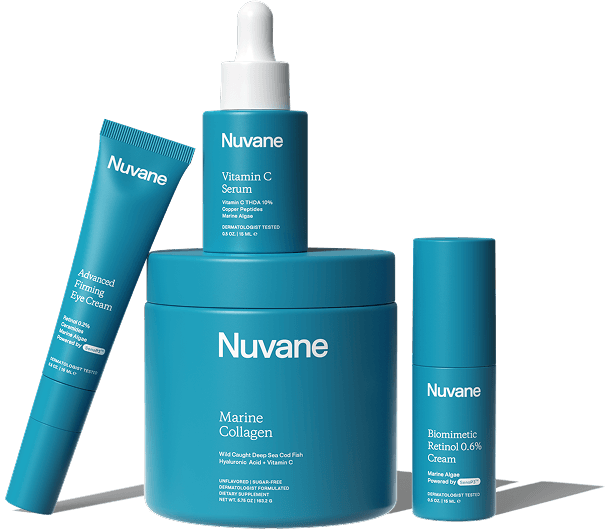
To anchor SenoP3 within complete routines, Nuvane pairs it with retinol or bakuchiol night creams, a stable vitamin C (THD) serum for morning antioxidant support, and targeted formulas like Advanced Firming Eye Cream and Regenerative Dark Spot Corrector—all designed for tolerability and stackable efficacy. The ingredient lists for these products include SenoP3’s peptides alongside niacinamide, hyaluronic acid, trehalose, acetyl glucosamine, marine algae extracts, and other ingredients—reflecting a balanced, evidence-based philosophy.
What this means for you: If you want a routine aligned with senescence biology today, look for formulas that don’t just “plump”—they lower inflammatory tone, re-signal collagen/elastin, and protect against UV/ROS. That’s the rationale behind SenoP3 within Nuvane’s system.
How should you evaluate claims around senescence in skincare?
Goal of this section: Provide a BS-meter that respects the science.
- Ask for human data (ideally randomized or split-face) plus mechanistic biomarkers (p16/p21, SASP panels).
- Beware cure-all framing. Senescence is important, not exclusive; strong routines still include SPF, retinoids, antioxidants, and barrier care.
- Check tolerability windows. Over-irritation increases inflammatory load and can backfire on senescence.
- Look for stackable designs. Peptides + niacinamide + retinoid/vitamin C often outperform any single molecule, especially for neck and peri-orbital skin.
What results timeline is realistic if you target senescence?
Goal of this section: Set expectations.
- Weeks 2–4: Calmer look (less redness/roughness), early texture smoothing from hydration and barrier gains.
- Weeks 6–12: Noticeable improvement in fine lines and tone if you’re consistent with retinoid + peptides + antioxidants.
- Months 3–6: Better resilience, elasticity, and photodamage appearance as the ECM rebuild accrues.
- Ongoing: Gains plateau without SPF; UV breaks collagen faster than any topical can rebuild it.
What are the risks or unknowns?
Goal of this section: Stay balanced.
- Systemic senolytics remain experimental for healthy individuals—insufficient long-term safety/benefit data.
- Over-aggressive topical regimens (high-strength actives layered too quickly) can raise inflammatory burden—counterproductive to senescence goals.
- Heterogeneity matters: Genetics, skin type, and environment determine how much “senescence load” you carry—and how you respond.
How does this tie back to Nuvane’s documentation and ingredient architecture?
Goal of this section: Point to concrete, science-backed building blocks.
Nuvane’s project documentation outlines a complete, AI-guided routine that integrates SenoP3™ peptides with retinol/bakuchiol, niacinamide, THD ascorbate, trehalose, hyaluronic acid, and marine algae—all chosen for mechanistic overlap with senescence biology (anti-inflammatory support, ECM renewal, antioxidant defense). Ingredient lists confirm the presence of these actives across the line, while internal lab and literature summaries describe multi-endpoint improvements (wrinkle depth, firmness, texture) consistent with a senomorphic + rebuild strategy.
Bottom line: The unique strength of Nuvane lies in its SenoP3™ tri-peptide core, layered with gold-standard actives, engineered for tolerance and long-term remodeling—a practical embodiment of “optimistic realism” about senescence.
Frequently Asked Questions (8)
Goal of this section: Provide fast, extractable answers.
How is SASP different from “inflammation” in general?
SASP is a specific secretory program of senescent cells (cytokines, proteases, growth factors) that sustains local, chronic inflammation and matrix breakdown—a targeted subset of the broader inflammatory universe.
Can a cream “kill” senescent cells?
Topicals are more likely to be senomorphic, i.e., they calm SASP and support repair. Full senolysis is a higher bar and currently a research question for localized use.
Will targeting senescence replace retinoids?
No. Retinoids remain foundational. Best practice is both/and: retinoid, antioxidant, barrier, and senomorphic peptides/SPF.
Does neck skin really need its own product?
It needs its own plan: slower titration, richer textures, and relentless SPF. If a neck-labeled product fits these parameters and tolerability needs, great; otherwise, adapt face products thoughtfully.
How long until I see results targeting senescence?
Expect 6–12 weeks for clear texture and fine-line changes, and 3–6 months for shifts in firmness/elasticity, assuming daily SPF use and consistent application.
Are peptides safe to combine with retinoids and vitamin C?
Yes—peptides, retinoids, and stable vitamin C forms can be synergistic when introduced gradually and buffered with barrier support.
Should people with acne or rosacea target senescence?
They should target inflammation and barrier first, then introduce retinoids (as tolerated) and senomorphic peptides. Always patch test sensitive skin.
Can lifestyle changes measurably impact skin senescence?
Yes. Better sleep, regular exercise, UV avoidance, and a balanced diet lower upstream stressors (ROS, glycation, mitochondrial strain) that drive senescent phenotypes.
References (selected, PubMed-style)
[1] GeroScience. “Topical rapamycin reduces markers of senescence and aging in human skin” (2019). PMID: 31761958.
[2] Free Radic Biol Med. “Senolytics and senomorphics: natural and synthetic therapeutics in the clinic and beyond” (2021).
[3] Exp Cell Res. “The limited in vitro lifetime of human diploid cell strains” (1961).
[4] Nature. “Clearance of p16^Ink4a-positive senescent cells delays aging-associated disorders” (2011).
[5] EBioMedicine. “Senolytics in diabetic kidney disease: pilot human study” (2019).
[6] J Invest Dermatol / Br J Dermatol. “Topical retinoids for photoaging: clinical and histologic evidence” (2001–2010).
[7] FEBS Lett. “Stimulation of collagen synthesis by GHK-Cu in fibroblast cultures” (1988).
[8] Int J Cosmetic Sci. “Acetyl hexapeptide-8 anti-wrinkle activity: clinical and mechanistic data” (2002–2013).
[9] Br J Dermatol. “Niacinamide + N-acetyl glucosamine improves hyperpigmentation and fine lines: RCT” (2010).
[10] Int J Cosmetic Sci / J Drugs Dermatol. “Palmitoyl tripeptide-38 increases ECM components; in vivo wrinkle reduction” (2012–2017).
Related Search Terms:
cellular senescence skincare • SASP explained • senomorphic vs senolytic • peptides for skin aging • neck skin crepiness fixes • retinoid tolerance schedule • THD ascorbate benefits • copper peptides ECM • palmitoyl tripeptide-38 collagen • acetyl hexapeptide-8 lines
Section Summaries:
- Definitions: Senescence = permanent growth arrest + SASP; helpful acutely, harmful when chronic.
- Evidence: Animal data strong; human studies early but positive in select settings (including skin).
- Strategies: Prioritize SPF, retinoids, niacinamide; consider senomorphic peptides and stable vitamin C.
- Neck Care: Thinner, motion-stressed skin needs gentler titration and relentless UV protection.
- Nuvane & SenoP3™: Tri-peptide senomorphic core + proven actives; designed for real-world, stackable outcomes.
Final Note — Where to learn more inside Nuvane
For additional details on ingredient concentrations, protocols, and clinical rationale, see the Nuvane project documentation (routines, product line, and R&D summaries) and the full ingredient lists for each formula. These materials outline how SenoP3™ (copper tripeptide-1, palmitoyl tripeptide-38, acetyl hexapeptide-8) integrates with retinol/bakuchiol, niacinamide, THD ascorbate, trehalose, hyaluronic acid, and marine algae to deliver senescence-aware, science-backed results across face, neck, and eye areas.
Find the most effective anti-aging products for you by taking the free skin assessment.
Enjoyed this article? Add Nuvane as a preferred source on Google.