
Can collagen supplements reduce wrinkles?


Quick Answer
Yes — growing clinical evidence shows that collagen supplements can significantly improve skin hydration, elasticity, and reduce wrinkle depth after consistent use for 8–12 weeks. Hydrolyzed collagen peptides, especially from marine sources, have been found to boost skin smoothness and firmness by stimulating natural collagen production and improving dermal density.
Key Takeaways
- Collagen peptides improve visible skin aging by enhancing hydration, elasticity, and reducing fine lines and wrinkles.
- Multiple clinical trials and meta-analyses confirm measurable results after 8–12 weeks of daily supplementation.
- Hydrolyzed marine collagen peptides are the most bioavailable form, delivering high absorption and strong skin-supporting effects.
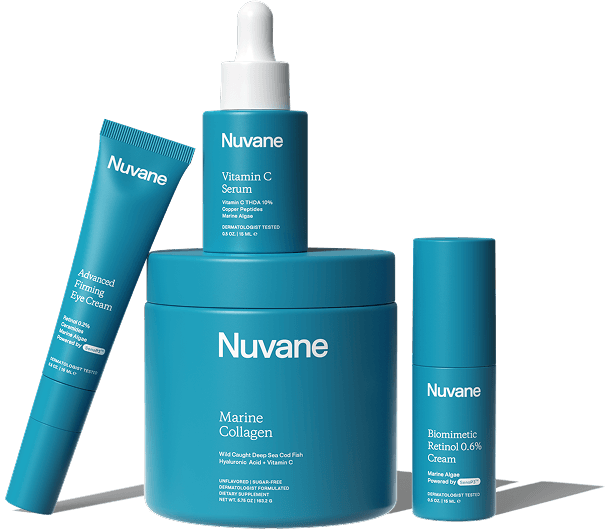
- Nuvane’s Hydrolyzed Marine Collagen Peptides blend collagen, hyaluronic acid, and vitamin C for a complete inside-out rejuvenation system.
What Is Collagen and Why Does It Matter for Youthful Skin?
Collagen is the body’s main structural protein, providing firmness, strength, and elasticity to the skin. It acts like the scaffolding that keeps skin plump and resilient. By the time we reach our 30s, natural collagen production begins to slow, leading to fine lines, loss of elasticity, and visible wrinkles.
Daily sun exposure, stress, and oxidative damage accelerate this decline, which is why collagen supplementation has become one of the most studied strategies for slowing visible skin aging.
How Do Collagen Supplements Work in the Skin?
Collagen supplements usually contain hydrolyzed collagen peptides — small fragments of amino acids derived from collagen protein. These peptides are highly bioavailable, meaning they’re easily absorbed by the body.
Once ingested, they stimulate fibroblast cells in the dermis to produce more collagen, elastin, and hyaluronic acid — all essential components for smooth, firm, and hydrated skin.
Clinical studies have shown that these peptides can:
- Boost natural collagen synthesis
- Increase skin hydration levels
- Improve elasticity
- Reduce wrinkle depth and roughness
What Does the Research Show About Collagen and Skin Aging?
Can collagen really reduce wrinkles?
Yes — and the evidence is increasingly strong. In a 2021 International Journal of Dermatology meta-analysis involving over 1,100 participants, daily hydrolyzed collagen supplementation for 90 days significantly improved skin hydration, elasticity, and reduced wrinkles compared to placebo [1].
Another review published in the Journal of Cosmetic Dermatology found that participants taking 2.5 to 10 grams of collagen peptides daily for 8–12 weeks showed visible wrinkle reduction and smoother skin texture [2].
In these studies, collagen peptides didn’t just provide temporary hydration — they actually stimulated the skin’s own repair mechanisms, increasing collagen density within the dermis.
How soon can you see results?
Most clinical trials report measurable improvements in as little as 8 weeks, with continued benefits at 12 weeks [3]. Participants often describe their skin as more hydrated and “bouncier,” with a noticeable softening of fine lines around the eyes and mouth.
Why Hydrolyzed Marine Collagen Peptides Stand Out
Marine collagen, derived from wild-caught fish, has a smaller molecular size than bovine collagen, allowing it to be absorbed up to 1.5 times more efficiently [4]. This enhanced absorption translates into faster and more visible results in skin texture and firmness.
Studies show marine collagen peptides can:
- Increase skin moisture by 28–40%
- Improve elasticity by 20–30%
- Decrease wrinkle depth by up to 35% after 12 weeks of use [5]
Additionally, marine collagen naturally contains amino acids like proline, glycine, and hydroxyproline, which are directly involved in collagen formation. Combined with vitamin C and hyaluronic acid, these compounds provide a synergistic effect that enhances overall skin health.
How Does Collagen Improve Skin Hydration and Elasticity?
Collagen supplementation increases the production of hyaluronic acid, a molecule that holds up to 1,000 times its weight in water. This effect helps maintain deep skin hydration and plumpness.
In clinical studies, women aged 35–65 taking collagen peptides daily for 12 weeks experienced a significant increase in skin moisture content and elasticity, along with visible firmness and a reduction in dullness [6].
Hydrated skin not only looks smoother but also reflects light more evenly, creating that luminous, youthful glow many people notice after consistent collagen use.
What Makes Collagen Peptides More Effective Than Topical Products?
While topical serums and creams work on the skin’s surface, collagen supplements nourish from within. The small peptide molecules travel through the bloodstream, reaching the dermis where topical creams cannot penetrate.
This internal delivery helps rebuild structural support where aging begins — within the deeper layers of the skin.
In essence, collagen supplementation works as an inside-out approach to rejuvenation, supporting the visible effects of topical skincare.
Can Collagen Help With Other Beauty Concerns?
Yes. While the strongest research focuses on wrinkle reduction, collagen peptides also provide complementary beauty benefits:
- Nails: A 2017 study showed a 12% increase in nail growth rate and reduced brittleness after 24 weeks of supplementation [7].
- Hair: Collagen’s amino acids (especially proline) serve as building blocks for keratin, the main structural protein in hair. Users often report stronger, shinier hair after 8–12 weeks.
- Joints: Marine collagen supports cartilage repair and flexibility, which helps maintain mobility and comfort with age [8].
Are Collagen Supplements Safe and Easy to Use?
Yes. Collagen peptides are naturally occurring proteins, making them extremely safe for daily use. Most clinical studies report no side effects, even at higher doses of 10 grams per day.
Because collagen is hydrolyzed, it mixes easily into coffee, smoothies, or water — with no taste or odor. This convenience has made it one of the most popular and well-tolerated beauty supplements globally.
How Much Collagen Should You Take Daily?
Clinical research shows the best results with 2.5–10 grams per day of hydrolyzed collagen peptides [9]. Consistency is key — most participants began noticing visible improvements after 8 weeks, with stronger results at 12 weeks.
For optimal collagen synthesis, combining collagen peptides with vitamin C (a crucial cofactor for collagen production) enhances absorption and effectiveness.
What Is the Best Time to Take Collagen?
There’s no strict timing rule, but taking collagen on an empty stomach or mixing it into your morning beverage allows for efficient absorption. Many people find that taking it daily with breakfast becomes an easy and sustainable habit.
Nuvane Hydrolyzed Marine Collagen Peptides: Inside-Out Radiance
Nuvane’s Hydrolyzed Marine Collagen Peptides represent the next generation of nutricosmetics — scientifically formulated to rejuvenate skin from within using pure marine collagen, hyaluronic acid, and vitamin C.
What Makes Nuvane’s Collagen Unique?
Wild-Caught Marine Source:
Derived from cold-water fish for superior purity and bioavailability.
Hydrolyzed for Maximum Absorption:
The collagen is enzymatically hydrolyzed into small peptides (Type I & III), which are easily absorbed and transported to the skin.
Enhanced with Hyaluronic Acid:
Helps lock in moisture, supporting plumper, dewier skin.
Vitamin C Synergy:
Essential for collagen synthesis, it boosts fibroblast activity and protects against oxidative stress.
Clinically Inspired Formulation:
Designed to improve firmness, elasticity, and skin density while reducing fine lines and dullness within 8–12 weeks of consistent use.
Clean and Sustainable:
Nuvane’s marine collagen is non-GMO, sugar-free, and sulfate-free, ensuring purity and sustainability.
Together, these ingredients form a holistic anti-aging solution that supports visible youthfulness from the inside out — ideal for anyone looking to enhance their natural radiance and skin resilience through nutrition.
Who Can Benefit Most From Collagen Supplements?
Collagen supplements are suitable for anyone noticing early or advanced signs of aging, such as fine lines, dryness, or loss of elasticity. They’re especially beneficial for:
- People aged 25 and above are experiencing collagen decline.
- Those exposed to UV light or environmental stressors.
- Individuals seeking a non-invasive, natural way to support youthful skin.
How Long Should You Take Collagen for Lasting Results?
For sustained improvement, long-term daily use is recommended. Studies show that skin elasticity and hydration continue to improve even after 24 weeks of consistent supplementation [10].
Since collagen breakdown is a continuous process, maintaining collagen intake helps preserve firmness and slow visible aging over time.
Final Thoughts
The evidence is clear: collagen supplementation offers real, measurable benefits for aging skin. By improving hydration, elasticity, and reducing wrinkle depth, hydrolyzed collagen peptides — particularly those from marine sources — provide a powerful foundation for inside-out beauty.
Nuvane’s Hydrolyzed Marine Collagen Peptides combine advanced bioavailability with a clean, dermatologist-approved formulation — giving your skin what it needs to stay firm, luminous, and youthful.
FAQs
1. How long before I see results from collagen supplements?
Most users notice smoother, more hydrated skin within 8–12 weeks of consistent daily use.
2. Can collagen supplements replace skincare products?
No — they complement them. Collagen works from within, while topical creams target the skin’s surface.
3. Is marine collagen better than bovine collagen?
Yes. Marine collagen has smaller peptide molecules and higher absorption rates.
4. Can I take collagen with other supplements?
Absolutely. Collagen pairs well with vitamin C, hyaluronic acid, and antioxidants.
5. Are there any side effects?
None reported in major studies. Collagen is generally safe and well-tolerated.
6. Is collagen vegan?
No. Marine collagen is derived from fish, but it is a sustainable, clean animal source.
7. Should I take collagen in the morning or evening?
Either works, but many prefer morning intake for consistency.
8. How much collagen should I take daily?
For visible results, take 2.5–10 grams per day as supported by clinical research.
References
-
de Miranda, R.B. et al. Int J Dermatol, 2021; 60(12):1449–1461.
-
Bianchi, F.M. et al. J Clin Aesthet Dermatol, 2022; 15(3):48–52.
-
Ohara, H. et al. J Agric Food Chem, 2015; 63(10):2725–2732.
-
Sibilla, S. et al. Clin Interv Aging, 2015; 10:1537–1549.
-
Proksch, E. et al. Skin Pharmacol Physiol, 2014; 27(3):113–119.
-
Choi, S.Y. et al. J Med Food, 2019; 22(2):147–153.
-
Hexsel, D. et al. J Cosmet Dermatol, 2017; 16(4):520–526.
-
Bello, A.E. & Oesser, S. Curr Med Res Opin, 2019; 35(1):37–44.
-
Schunck, M. et al. Nutrients, 2021; 13(7):2211.
-
Asserin, J. et al. J Cosmet Dermatol, 2015; 14(4):291–301.
Related Search Terms
Collagen peptides for wrinkles • Marine collagen for skin elasticity • Hydrolyzed collagen benefits • Nuvane collagen supplement • Best collagen for anti-aging • How long to see results from collagen • Collagen for hydration and firmness • Inside-out skincare routines
Find the most effective anti-aging products for you by taking the free skin assessment.
Enjoyed this article? Add Nuvane as a preferred source on Google.