
Best ways to diagnose and treat inflammaging

Key Takeaways
- Chronic low-grade inflammation accelerates facial skin aging, leading to wrinkles, sagging, and dullness.
- Inflammaging is triggered by oxidative stress, UV exposure, and disrupted skin barrier function.
- Nuvane’s SenoP3™ peptide complex targets inflammaging by repairing collagen, reducing oxidative stress, and calming microinflammation.
- Regular use of biomimetic retinol, bakuchiol, and antioxidant-rich serums helps counteract inflammaging, resulting in smoother, firmer, and more radiant skin.
Quick Answer: What Is Inflammaging and How Does It Affect Your Skin?
Inflammaging is a fusion of inflammation and aging — a silent, chronic process that gradually damages facial skin cells. This long-term inflammation accelerates collagen breakdown, weakening elasticity and disrupting the skin’s ability to repair itself. Over time, this results in wrinkles, uneven tone, enlarged pores, and a loss of firmness.
Nuvane addresses this root cause of visible aging with SenoP3™, a science-backed tri-peptide system that soothes inflammation, rebuilds dermal structure, and restores youthful skin/
What Exactly Is Inflammaging?
Inflammaging is defined as persistent, low-grade inflammation that develops with age, even in the absence of infection. Unlike acute inflammation (which helps the body heal), inflammaging is subtle and continuous. It releases inflammatory molecules such as IL-1, TNF-α, and reactive oxygen species that damage collagen, elastin, and lipids within the skin barrier
What Causes Inflammaging in Facial Skin?
Several external and internal factors trigger facial inflammaging:
- UV Radiation – Chronic sun exposure increases oxidative stress and free radicals.
- Air Pollution – Triggers the release of cytokines and damages cellular DNA.
- Poor Sleep and stress elevate cortisol, which accelerates collagen loss.
- Skin Barrier Damage – Allows irritants and pathogens to penetrate deeper layers.
- Age-Related Cellular Decline – Mitochondrial dysfunction and senescent cells contribute to the maintenance of inflammatory signaling.
How Does Inflammaging Show Up on Your Face?
The visible effects of inflammaging often appear as:
- Fine lines and deeper wrinkles around the eyes and mouth
- Loss of elasticity and firmness (especially around cheeks and jawline)
- Uneven skin tone, redness, and dullness
- Rough texture or enlarged pores
- Microscopic analysis of inflamed, aging skin reveals decreased collagen types I and III, impaired fibroblast activity, and elevated metalloproteinases (MMPs) that break down connective tissue
Why Does Inflammation Accelerate Wrinkles and Sagging?
When your skin is inflamed, it produces MMP enzymes that digest collagen and elastin. Simultaneously, oxidative stress limits fibroblast regeneration – the very cells responsible for skin firmness. Over time, your skin’s support network weakens, leading to sagging, fine lines, and deeper wrinkles.
Moreover, chronic inflammation slows epidermal turnover, allowing dead cells to accumulate and resulting in a loss of natural radiance. This combination of reduced repair and increased breakdown is the biological hallmark of inflammaging.
How Can You Naturally Reduce Facial Inflammaging?
Addressing inflammaging requires both lifestyle adjustments and targeted skincare:
Step 1: Protect from External Stressors
- Apply broad-spectrum SPF 30+ daily.
- Minimize exposure to pollution and cigarette smoke.
- Maintain a diet rich in antioxidants (vitamin C, omega-3 fatty acids, and green tea polyphenols).
Step 2: Rebuild Collagen and Calm Inflammation
- Utilize bioactive peptides and vitamin C derivatives that stimulate collagen production while mitigating cytokine stress.
- Incorporate bakuchiol or low-dose retinol for controlled cell renewal without irritation.
Step 3: Support the Skin Barrier
- Hydrate daily with hyaluronic acid and niacinamide.
- Avoid harsh exfoliants that disrupt microbiota balance.
How Does Nuvane Target Facial Inflammaging?
Nuvane’s anti-aging system is built around SenoP3™, a complex of three biomimetic peptides clinically proven to restore dermal health, reduce wrinkle depth, and improve elasticity.
What Is SenoP3™?
SenoP3™ combines:
- Palmitoyl Tripeptide-38 – Rebuilds collagen types I, III, and IV, and boosts hyaluronic acid synthesis for plumpness.
- Copper Tripeptide-1 (GHK-Cu) – Reduces inflammatory cytokines, enhances antioxidant defenses, and promotes tissue repair.
- Acetyl Hexapeptide-8 (Argireline) – Relaxes expression lines by modulating neuromuscular tension and oxidative damage.
Together, they deliver a synergistic effect that counters both structural degradation and inflammatory imbalance, two pillars of inflammaging.
Which Nuvane Formulas Are Best for Inflammaging-Prone Skin?
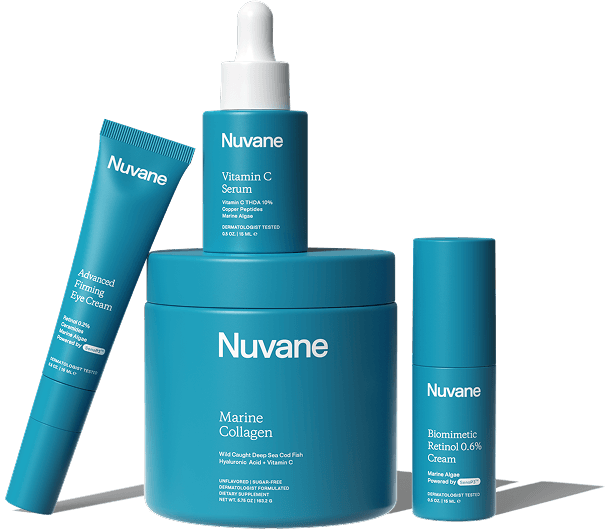
Biomimetic Retinol 0.3% Cream
Ideal for early inflammaging, this formula blends stabilized retinol with SenoP3™, niacinamide, and hyaluronic acid to rebuild dermal density while soothing inflammation.
Biomimetic Retinol 0.6% Cream
For advanced signs of inflammaging, the 0.6% version delivers deeper rejuvenation, supported by Palmitoyl Tripeptide-38 and Camellia oil for improved resilience.
Biomimetic Bakuchiol Cream
A retinol-free, gentle option for sensitive or inflamed skin, featuring Bakuchiol, Copper Tripeptide-1, and Centella Asiatica to restore calm and firmness without irritation.
Vitamin C Serum (THD Ascorbate)
A stable, lipid-soluble antioxidant serum with Fucus Vesiculosus extract, ceramides, and copper peptides to neutralize free radicals and defend against daily oxidative stress
How Long Until You See Results?
Clinical peptide studies demonstrate a visible reduction in wrinkle depth within 4 to 8 weeks, with ongoing improvements in elasticity and hydration by week 12. Nuvane’s biomimetic system is designed for cumulative results — the longer you use it, the more resilient and luminous your skin becomes.
Can Inflammaging Be Reversed?
Yes – while it cannot be completely stopped, its effects can be slowed and partially reversed by restoring dermal communication pathways. Biomimetic peptides like those in SenoP3™ mimic the body’s natural repair messengers, effectively reprogramming the skin to behave more youthfully.
When paired with barrier repair ingredients such as niacinamide, trehalose, and hyaluronic acid, the visible markers of inflammaging – dullness, redness, and laxity – are significantly reduced.
Why Is the Skin Barrier Key in Fighting Inflammaging?
A compromised barrier amplifies inflammation. Nuvane’s use of niacinamide, ceramides, and trehalose reinforces the lipid matrix and microbial balance, creating a calmer environment less prone to inflammatory flare-ups.
Healthy barrier = fewer cytokines = slower inflammaging.
What Role Do Antioxidants and Algae Extracts Play?
Marine algae extracts, such as Fucus Vesiculosus, offer potent antioxidant and anti-inflammatory properties. Rich in fucoidan and polyphenols, they neutralize free radicals, preserve collagen integrity, and improve hydration.
This makes marine bioactives a cornerstone in the Nuvane line, supporting both anti-inflammaging and skin barrier resilience.
Why Nuvane’s Science-Backed Ingredients Stand Out
Every Nuvane formula integrates a multi-pathway correction system, addressing both causes and symptoms of inflammaging:
- Cellular Repair: GHK-Cu and Matrixyl Synthe’6 rebuild the extracellular matrix.
- Oxidative Defense: THD Ascorbate and Fucus algae counteract ROS damage.
- Calming Mechanisms: Niacinamide, Centella Asiatica, and trehalose reduce redness and irritation.
- Barrier Protection: Ceramides and hyaluronic acid lock in moisture and resilience.
FAQs About Inflammaging and Facial Skin
1. At what age does inflammaging typically begin?
Most individuals begin to experience microinflammation in their mid-20s, although visible effects often appear in the 30s.
2. Is inflammaging only caused by sun exposure?
No. UV light accelerates it, but pollution, stress, poor diet, and lack of sleep also contribute.
3. Can sensitive skin develop inflammaging faster?
Yes. A weak barrier allows inflammatory mediators to enter more easily, accelerating skin aging.
4. How is inflammaging different from photoaging?
Photoaging is primarily caused by UV damage; inflammaging refers to the chronic, invisible inflammation underlying multiple aging triggers.
5. Can topical antioxidants reverse inflammaging?
They can significantly reduce oxidative stress and cytokine activity, slowing progression.
6. Are biomimetic peptides safe for daily use?
Yes. They are lab-engineered to mimic natural skin peptides and have strong safety data for long-term use.
7. Should retinol be avoided if I have inflammation?
Low-dose retinol (0.3%) combined with peptides and niacinamide can be safely used, even on mild, inflammation-prone skin.
8. How long should I use Nuvane products to maintain results?
For best outcomes, maintain consistent use for 12 weeks, then continue long-term to preserve barrier and collagen balance.
References
-
Pickart L. & Thaler M.M. (1980). Growth-modulating tripeptide (GHK) and its copper complex. PNAS, 77(7), 4586–4590.
-
Maquart F.X. et al. (1993). Stimulation of collagen synthesis in fibroblast cultures by GHK-Cu. FEBS Letters, 238(2), 343–346.
-
Blanes-Mira C. et al. (2002). Argireline: A synthetic hexapeptide with anti-wrinkle activity. Int. J. Cosmetic Science, 24(5), 303–310.
-
Sederma (2012). Matrixyl Synthe’6: In vitro & in vivo efficacy dossier.
-
Schagen S.K. (2017). Topical peptide treatments with effective anti-aging results. J Drugs Dermatol, 16(6), 51–55.
-
Leyden J.J. et al. (2002). Skin Care Benefits of Copper Peptide Facial Creams. Int. J. Cosmetic Science, 24(3), 149–154.
-
Draelos Z.D. et al. (2006). Effect of a copper tripeptide on wound healing and skin protection. Dermatol Surg, 32(2), 235–240.
-
Lupo M.P. & Cole A.L. (2007). Cosmeceutical peptides: Mechanisms and applications. Dermatologic Therapy, 20(5), 343–349.
-
Duplan H. et al. (2016). Peptides and mitochondrial function in aging skin. Int. J. Cosmetic Science, 38(5), 431–439.
-
Finkley M.B. et al. (2007). Efficacy of copper tripeptide cream for skin elasticity. J. Cosmetic Science, 58(4), 447–449.
Related Search Terms: inflammaging skin, anti-inflammatory skincare, biomimetic peptides, senop3, GHK-Cu, Matrixyl Synthe-6, Argireline, retinol inflammation, bakuchiol sensitive skin, marine algae antioxidants, niacinamide barrier repair.
Find the most effective anti-aging products for you by taking the free skin assessment.
Enjoyed this article? Add Nuvane as a preferred source on Google.