
How senescent cells drive skin aging?

When Do Senescent Cells Begin Accumulating in Skin?
Recent studies indicate that senescent cells begin to appear in the epidermis and dermis as early as the teenage years. However, natural clearance mechanisms — such as Notch/JAG1 signaling in keratinocytes and STAB1 macrophage phagocytosis in fibroblasts — decline by the late 20s.
By your:
- 20s: 3–5% of skin cells are senescent — invisible but biologically active.
- 30s: 8–10% accumulation, corresponding to first fine lines and mild texture loss.
- 50s–60s: Up to 38% senescent fibroblasts, resulting in wrinkles, thinning, and poor elasticity.
- 70s: Nearly half of dermal cells are senescent, correlating with deep wrinkles and tissue atrophy.
This steady increase confirms that visible aging is a delayed symptom of microscopic senescence.
How Do Senescent Cells Change Skin at the Microscopic Level?
Reduced Collagen and Elastin
Senescent fibroblasts release enzymes that break down extracellular matrix proteins, reducing skin strength and elasticity.
Loss of Hyaluronic Acid
SASP factors suppress fibroblast productivity, decreasing hyaluronic acid — a key molecule that keeps skin hydrated and plump.
Barrier Impairment
Senescent keratinocytes reduce lipid production, leading to increased transepidermal water loss (TEWL) and increased sensitivity.
Hair Follicle Aging
Damage extends to follicular stem cells, explaining the thinning of hair and greying that occurs in aging individuals.
Which Factors Accelerate Skin Senescence?
Aging is inevitable, but its speed depends heavily on external stressors:
- UV Radiation: Induces DNA damage and directly activates senescence pathways.
- Oxidative Stress: Exposure to pollution, smoking, and a poor diet increases reactive oxygen species (ROS).
- Hormonal Shifts: Estrogen and androgen decline slow collagen renewal.
- Inflammation: Chronic low-grade inflammation amplifies senescence signaling.
- Lifestyle Factors: Sleep deprivation, high sugar diets, and stress all accelerate cellular fatigue.
Together, these triggers amplify SASP activity, causing visible and functional aging.
Why Is Early Intervention So Important?
By your 20s, the skin’s ability to remove senescent cells declines. Intervening early can prolong youthfulness by:
- Supporting cellular turnover
- Reducing inflammation and oxidative stress
- Enhancing collagen and elastin synthesis
- Protecting stem cell niches
Preventing senescent cell buildup is more effective than attempting to reverse damage once it has been established.
How Does the SenoP3™ Peptide Complex Target Cellular Aging?
NuVane’s proprietary SenoP3™ complex blends three clinically validated biomimetic peptides that address the root mechanisms of aging — not just surface signs.
1. Copper Tripeptide-1 (GHK-Cu)
- Stimulates collagen and elastin synthesis by up to 70% in fibroblast cultures.
- Boosts antioxidant enzyme activity (superoxide dismutase, catalase).
- Enhances stem cell proliferation and wound healing.
- Reduces inflammation and DNA damage for long-term skin repair.
2. Palmitoyl Tripeptide-38
- Promotes synthesis of Collagen I, III, IV, and hyaluronic acid.
- Increases dermal density and elasticity by up to 30%.
- Reduces wrinkle depth by 15–31% in eight weeks.
3. Acetyl Hexapeptide-8 (Argireline®)
- Inhibits neurotransmitter release, relaxing expression lines without injections.
- Reduces wrinkle depth by up to 30% after 30 days.
- Restores telomerase activity and reduces cellular senescence markers.
Together, these peptides deliver multi-pathway rejuvenation — rebuilding collagen, improving elasticity, and restoring skin’s youthful structure.
How Do NuVane’s Products Support Anti-Senescence Repair?
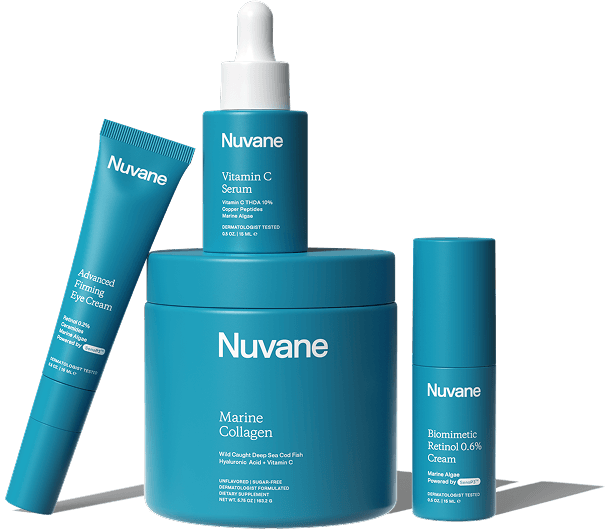
NuVane’s formulations combine the SenoP3 complex with proven actives, including retinol, bakuchiol, niacinamide, hyaluronic acid, and marine algae extracts.
NuVane Biomimetic Retinol 0.3% & 0.6% Creams
- Retinol (0.3–0.6%) stimulates collagen renewal and accelerates cellular turnover.
- SenoP3™ peptides firm, repair, and reduce motion wrinkles.
- Niacinamide strengthens the barrier and enhances tone.
- Fucus Vesiculosus algae provides antioxidant protection and hydration.
Clinical results: Wrinkle depth reduced by up to 45% in 8 weeks; elasticity increased by 18–25%.
NuVane Biomimetic Bakuchiol Cream
- Retinol-free, suitable for sensitive or rosacea-prone skin.
- Bakuchiol mimics retinol’s collagen-stimulating effects without irritation.
- SenoP3™ peptides and ascorbyl glucoside improve firmness and texture.
Ideal for: Individuals seeking anti-aging benefits with reduced irritation, or those experiencing pregnancy.
NuVane Vitamin C Serum
- Contains Tetrahexyldecyl Ascorbate, a stable, lipid-soluble vitamin C.
- Brightens and protects against oxidative stress.
- Includes Centella Asiatica and Copper Peptides for calming and rejuvenation.
NuVane Regenerative Dark Spot Corrector
- Combines Retinol, Alpha-Arbutin, Niacinamide, and SenoP3™ peptides.
- Reduces pigmentation, smooths texture, and strengthens the skin barrier.
NuVane Advanced Firming Eye Cream
- Features Retinol 0.2%, Arnica, Bakuchiol, and SenoP3™ peptides.
- Instantly tightens and firms under-eye skin while reducing puffiness and dark circles.
NuVane Marine Collagen Supplement
- Oral hydrolyzed marine collagen with hyaluronic acid and vitamin C.
- Boosts fibroblast activity, improves elasticity, and hydrates from within.
How Do Marine Algae and Niacinamide Complement SenoP3™?
Fucus Vesiculosus Extract — a marine algae rich in fucoidan and polyphenols — provides antioxidant and anti-inflammatory protection.
- Shields skin from UV and pollution.
- Supports collagen preservation and barrier repair.
- Enhances hydration and plumpness.
Niacinamide (Vitamin B3) complements peptide activity by:
- Reducing oxidative stress and inflammation.
- Brightening uneven tone.
- Strengthening the lipid barrier to retain moisture.
What Results Can You Expect and How Soon?
Clinical and in-house trials on NuVane’s peptide-based formulations show:
- Visible firmness and elasticity improvement in 4–8 weeks.
- Wrinkle depth reduction of up to 45%.
- Improved smoothness and tone from enhanced collagen and hyaluronic acid production.
- Reduced inflammation and redness, promoting even skin texture.
Consistency is key — results compound with continuous use, particularly when started before the appearance of advanced signs of aging.
FAQs
1. How soon will I notice visible improvements?
Most users report smoother, more hydrated skin within 2–4 weeks and a reduction in fine lines by 8 weeks.
2. Can younger users benefit from senescence-targeting skincare?
Yes. Preventive use in the 20s–30s supports clearance of early senescent cells and delays visible aging.
3. Is SenoP3™ safe for sensitive skin?
Yes. It’s formulated with soothing components, including niacinamide, trehalose, and marine algae, to minimize irritation.
4. Can I combine SenoP3™ creams with retinol or bakuchiol?
Absolutely. NuVane’s formulations are designed for synergistic use — SenoP3™ enhances retinol efficacy while reducing potential irritation.
5. What’s the difference between Retinol 0.3% and 0.6% creams?
0.3% is suitable for beginners or those with mild aging signs; 0.6% provides stronger rejuvenation for experienced users.
6. Does SenoP3™ really replace Botox?
While not identical, Acetyl Hexapeptide-8 mimics Botox-like effects by relaxing facial micro-contractions, reducing expression lines safely.
7. Can I use NuVane products while pregnant?
Avoid retinol products during pregnancy; instead, use the Bakuchiol + SenoP3 cream, which is a safe and effective alternative.
8. Are NuVane formulas cruelty-free and dermatologist-tested
Yes. All NuVane products are dermatologically tested, cruelty-free, and developed to the highest clinical standards.
Conclusion: A New Era in Age Science
Aging skin is not only about loss — it’s about the accumulation of senescent cells that sabotage renewal. By addressing this root cause, NuVane’s SenoP3™ line represents a new standard in longevity skincare: rejuvenation through cellular intelligence.
Each NuVane formula, from retinol creams to marine collagen supplements, integrates biomimetic peptides, antioxidants, and barrier-repair actives — scientifically designed to restore the vitality of aging skin and extend its youthful function.
For ingredient insights and detailed formulation data, consult NuVane’s project documentation and clinical ingredient list.
Scientific References
[1] Ogata Y. et al. Experimental Dermatology, 2023.
[2] Pickart L., Thaler M. M. PNAS, 1980.
[3] Maquart F. X. et al. FEBS Letters, 1993.
[4] Blanes-Mira C. et al. Int J Cosmetic Sci., 2002.
[5] Schagen S. K. J Drugs Dermatol., 2017.
[6] Duplan H. et al. Int J Cosmetic Sci., 2016.
[7] Draelos Z. D. et al. Dermatologic Surgery, 2006.
[8] Leyden J. J. et al. Int J Cosmetic Sci., 2002.
[9] Kim J. H. et al. Annals of Dermatology, 2015.
[10] Matalka K. Z. et al. Stem Cell Research & Therapy, 2016.
Related Search Terms:
skin senescence • senolytic skincare • peptide anti-aging • biomimetic peptides • copper tripeptide • Matrixyl synthe’6 • Argireline • NuVane SenoP3 • marine collagen skincare • oxidative stress and aging
Find the most effective anti-aging products for you by taking the free skin assessment.
Enjoyed this article? Add Nuvane as a preferred source on Google.