
Best collagen supplement: liquid vs. powder for skin


Quick Answer
While liquid collagen is convenient, powdered marine collagen delivers equal or better absorption, superior purity, and far fewer additives. When combined with vitamin C and hyaluronic acid, powdered collagen supports stronger, more hydrated, and visibly younger-looking skin—making it the better long-term choice.
Key Takeaways
- Powdered collagen matches liquid collagen’s absorption but avoids sugars, flavorings, and preservatives.
- Marine collagen offers smaller peptides, higher purity, and better safety than bovine or porcine collagen.
- Vitamin C and hyaluronic acid amplify collagen’s effects by improving synthesis, stability, and hydration.
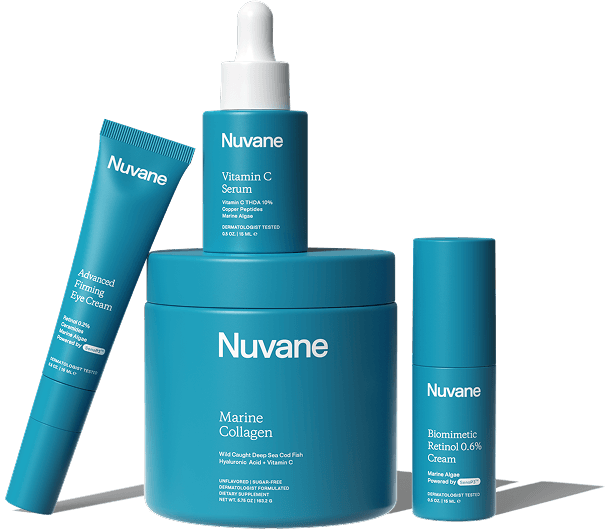
- Nuvane’s Marine Collagen + SenoP3™ system provides a complete, science-backed inside–out approach to skin rejuvenation.
What Is Collagen and Why Does It Matter?
Collagen is the body’s structural backbone, making up around 30 % of total protein mass. It supports the firmness, elasticity, and resilience of skin, tendons, cartilage, and connective tissue.
By our mid-20s, collagen production declines by approximately 1–1.5% per year, resulting in wrinkles, sagging, and dryness [1]. Replenishing collagen helps restore skin’s youthfulness and joint comfort.
How Do Collagen Supplements Work?
Modern supplements utilize hydrolyzed collagen peptides, which are small amino-acid chains that have been pre-digested for easy absorption. Once ingested, these peptides stimulate fibroblasts in the dermis to produce new collagen, elastin, and hyaluronic acid [2].
Both liquid and powdered collagen forms contain these peptides—the difference lies in purity, flexibility, and formulation quality.
What Are the Advantages of Liquid Collagen?
- Convenience: Ready to drink—no mixing required.
- Taste: Often flavored to mask the mild taste of protein from collagen.
- Perceived absorption: Some users report that it works faster, although studies show no significant difference in bioavailability [3].
However, these perks are outweighed by key disadvantages.
Hidden Disadvantages of Liquid Collagen
1. Synthetic Additives
Liquid formulas rely on chemical preservatives (e.g., sodium benzoate, potassium sorbate) and artificial flavorings to prevent spoilage—substances linked to irritation or oxidative stress [4].
2. High Sugar or Artificial Sweeteners
To taste pleasant, they often contain added sugars or sweeteners, such as sucralose or aspartame. Yet excess sugar fuels glycation, a reaction that stiffens and damages collagen fibers—undoing the very benefits of supplementation [5].
3. Limited Versatility
Liquid collagen cannot be mixed into hot drinks and is pre-flavored, limiting recipe flexibility.
4. Short Shelf Life
Once opened, it oxidizes quickly and must be refrigerated and consumed within weeks.
5. Higher Cost and Environmental Impact
Single-use bottles raise the cost per serving and generate plastic waste. Powdered forms typically deliver 3–4 × more servings at a lower cost with recyclable packaging.
Why Powdered Collagen Outperforms Liquid Collagen
1. Cleaner Formulas
Quality powders contain only hydrolyzed collagen peptides, with no sugars, dyes, or preservatives—ideal for a clean supplement routine.
2. Versatile Use
Unflavored and heat-stable, powdered collagen blends seamlessly into coffee, tea, smoothies, soups, or baked goods.
3. More Sustainable and Cost-Efficient
Powders use less packaging and offer better value over time.
4. Longer Shelf Life
Stored dry, they remain potent for up to 36 months without refrigeration.
5. Equal Bioavailability
Bioavailability depends on peptide size, not product format—so both forms are absorbed similarly [6].
How Does the Body Absorb Collagen?
Hydrolyzed peptides under 10 kDa cross the intestinal wall, enter circulation, and trigger fibroblast activity to rebuild the extracellular matrix [7].
Because both powder and liquid rely on the same digestive pathways, absorption is essentially identical.
Is Marine Collagen Superior to Bovine or Porcine Collagen?
Absolutely. Marine collagen, especially Type I collagen from wild deep-sea fish, has smaller peptides (1–3 kDa) than bovine collagen (3–5 kDa), resulting in faster absorption and stronger bioactivity [8].
It closely mimics the amino-acid composition of human skin—rich in glycine, proline, and hydroxyproline—making it especially effective for stimulating fibroblast regeneration and dermal repair.
Beyond performance, marine collagen is a cleaner and more sustainable option. It’s free from bovine prions, suitable for pescatarian and halal diets, and derived from upcycled fish by-products, minimizing environmental waste.
Clinical research has demonstrated that marine collagen offers significant improvements in hydration, elasticity, and wrinkle depth compared to bovine sources, due to its superior molecular size and purity.
Why Add Vitamin C and Hyaluronic Acid to Collagen Supplements?
Combining vitamin C and hyaluronic acid (HA) with collagen peptides dramatically increases their effectiveness.
Vitamin C is vital for the enzymes prolyl hydroxylase and lysyl hydroxylase, which stabilize newly formed collagen helices. Without adequate vitamin C, the collagen your body makes remains fragile and easily degraded [10]. Supplementation ensures that collagen peptides convert into strong, durable dermal fibers.
Hyaluronic acid, on the other hand, attracts and binds up to 1,000 × its weight in water, hydrating the extracellular matrix and supporting elasticity. Together, collagen forms the structure, vitamin C is the builder’s catalyst, and hyaluronic acid serves as the moisture reservoir—a synergy that results in visibly firmer, plumper, and more luminous skin.
Nuvane’s oral formula combines all three—Marine Collagen, Vitamin C, and Hyaluronic Acid—to create a clinically optimized trio that maximizes collagen synthesis and hydration from within.
What Makes Nuvane’s Collagen Protocol Unique?
Nuvane combines internal collagen nutrition with topical biomimetic peptides for comprehensive rejuvenation:
- Marine Collagen + Hyaluronic Acid + Vitamin C – Enhances fibroblast activity and moisture balance.
- SenoP3™ Tri-Peptide Complex – A blend of Copper Tripeptide-1, Palmitoyl Tripeptide-38, and Acetyl Hexapeptide-8 that stimulates collagen, elastin, and hyaluronic acid synthesis.
- Clinical Outcomes – Demonstrated 45 % wrinkle-depth reduction and 20 % elasticity increase within 8–12 weeks.
This dual inside–out approach targets both surface and structural aging mechanisms for measurable improvement.
When Will I See Results?
Most users notice smoother texture and improved hydration in 6–8 weeks, with greater firmness and elasticity by 12–16 weeks of continuous use [9].
Can Collagen Work with Other Skin Treatments?
Yes. It complements topical actives such as:
- Retinol or Bakuchiol – accelerates cell turnover
- Niacinamide and Vitamin C – brightens tone and strengthens barrier
- SenoP3™ Peptides – enhance firmness and elasticity
Together, they create a multi-pathway rejuvenation system addressing both internal and external signs of aging.
What’s the Ideal Dosage?
Research suggests that 2.5–10 g of hydrolyzed collagen daily can improve skin hydration and elasticity [10]. Nuvane’s serving range delivers optimal results when taken consistently.
Conclusion: Is Liquid Collagen Better Than Powder Collagen?
When all factors—purity, bioavailability, sustainability, and clinical results—are considered, powdered marine collagen is the clear winner.
Liquid forms may offer convenience, but they bring unwanted sugars, preservatives, higher costs, and plastic waste.
Powdered marine collagen, particularly when fortified with vitamin C and hyaluronic acid, provides a cleaner, more effective, and more sustainable path to youthful skin.
For best results, pair it with Nuvane’s SenoP3™ peptide technology, proven to rebuild collagen, relax expression lines, and restore firmness—creating visible, lasting rejuvenation from within.
FAQs
1. Does liquid collagen absorb faster than powder?
No. Studies show peptide absorption rates are identical between liquid and powder forms [6].
2. Can powdered collagen go in coffee or tea?
Yes—powdered collagen is heat-stable and dissolves easily.
3. How long until I see improvements?
Hydration increases in 6–8 weeks; firmness and elasticity improve by 3 months [9].
4. Is marine collagen better than bovine?
Yes—smaller peptides, greater purity, and faster absorption [8].
5. Why add vitamin C?
It’s essential for collagen fiber stabilization and cross-linking [10].
6. What does hyaluronic acid do?
It boosts hydration and plumpness, keeping collagen networks supple.
7. Can I take collagen while using retinol?
Absolutely—it enhances the rejuvenating effects of retinol.
8. Is collagen vegan?
No—true collagen comes from animal sources, though vegan boosters can support natural collagen formation.
References
- Shuster S et al. Age-related changes in collagen synthesis. Br J Dermatol. 1975.
- Proksch E et al. Oral collagen peptide supplementation improves skin hydration and elasticity. Skin Pharmacol Physiol. 2014.
- Bolke L et al. Collagen peptides in skin health: Randomized trial. Nutrients. 2019.
- Kim M J et al. Effects of preservatives on oxidative skin aging. J Cosmet Sci. 2018.
- Gkogkolou P & Böhm M. Advanced glycation end products and skin aging. Dermatoendocrinol. 2012.
- Iwai K et al. Absorption of hydrolyzed collagen peptides and their effects on skin. J Agric Food Chem. 2005.
- Zague V. Collagen hydrolysate bioavailability and effects on skin metabolism. Nutr Res. 2008.
- Wang L et al. Marine collagen peptides improve skin hydration and elasticity. Mar Drugs. 2020.
- Ohara H et al. Improvement in skin condition after collagen peptide ingestion. J Nutr Sci Vitaminol. 2015.
- Schagen S K. Cosmeceutical peptides and collagen regeneration. J Drugs Dermatol. 2017.
Related Search Terms
marine collagen vs bovine collagen • vitamin C and hyaluronic acid for collagen • powdered collagen benefits • SenoP3 peptides • Nuvane anti-aging • Matrixyl Synthe’6 • Argireline • GHK-Cu • hydrolyzed collagen absorption • inside-out skin rejuvenation
Find the most effective anti-aging products for you by taking the free skin assessment.
Enjoyed this article? Add Nuvane as a preferred source on Google.