
Best way to spot skin aging early: 14 signs to watch

Quick answer:
- Skin aging happens in stages, not gradually – with key accelerations in the late 20s, late 30s, early 40s, and early 60s.
- Prevention pays off early – sunscreen, vitamin C, and gentle retinoids build the foundation for long-term skin health.
- Correction and support are stage-specific – from peptides in your 30s to advanced retinoids and collagen support in your 40s and beyond.
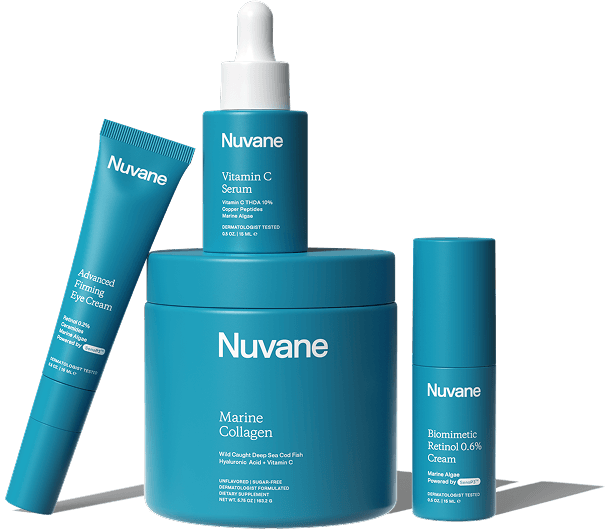
- Nuvane’s science-backed actives—vitamin C, retinol, SenoP3 peptides, collagen supplements, and alpha-arbutin—are specifically targeted to address the biological changes of each decade.
Aging is not a single, long, slow decline—it occurs in noticeable shifts or peaks throughout life. These moments can feel sudden, like waking up one morning and not recognizing the face that stares back at you in the mirror. While the process is universal, understanding when and how these changes occur can help you feel more prepared—and empowered—to age well, both physically and mentally.
Rather than fearing wrinkles or chasing unrealistic ideals, the real goal is to age as gracefully and healthily as possible. That means nourishing your skin, maintaining your confidence, and using both preventative and corrective strategies at the right times.
Based on clinical observations and published research, here are the four major stages of accelerated skin aging, along with guidance on how to approach each one.
Stage 1: Late 20s to Early 30s – The Subtle Shift
What happens
Around age 29–32, many people notice a subtle yet unsettling change: their face begins to appear flatter or longer. The cheeks lose a bit of roundness, the midface looks narrower, and shadows become slightly more visible. These changes are often so subtle that others don’t notice—but you do.
The cause? A gradual decline in collagen (about 1% per year starting in your mid-20s), paired with early volume loss in fat pads located at the sides of the face. This redistribution makes the face appear less “baby-faced” and more mature.
Common signs
- A flatter look to the cheeks or temples
- Slight darkening under the eyes
- Skin feels less plump, especially after weight fluctuations
- First fine lines (often around the eyes or forehead)
What to do
This is the prevention stage. You don’t need drastic measures—small, consistent steps will pay off in the long run.
- Skincare: Introduce a retinoid (retinol or tretinoin) to support collagen production and cell turnover. Pair it with a broad-spectrum sunscreen daily and a gentle antioxidant serum (like vitamin C).
- Lifestyle: Avoid yo-yo dieting, which accelerates volume loss and facial sagging. Stick to balanced nutrition, rich in protein and omega-3s, and maintain a consistent sleep schedule.
- In-office options: Light microneedling (without aggressive heat or radiofrequency) can encourage collagen renewal and subtly improve skin texture.
The key takeaway: Now is the time to lay your foundation. You will thank yourself in the future.
Nuvane Recommendation:
- Morning: Nuvane Vitamin C Serum – brightens and protects against oxidative stress while stimulating collagen.
- Night: Nuvane Biomimetic Retinol 0.3% Cream – combines retinol, Palmitoyl Tripeptide-38, and Acetyl Hexapeptide-8 to gently rebuild collagen and reduce early fine lines.
Stage 2: Late 30s – The First Real Drop
What happens
By the late 30s (ages 38–39), changes are no longer subtle. Many people experience a dramatic realization: “I see my first jowls.” This is the period when ligaments that hold facial structures in place start to loosen. The midface descends slightly, leading to deepening smile lines, a softening of the contours along the jawline, and early sagging around the mouth.
Common signs
- Early jowl formation
- Nasolabial folds (smile lines) appear deeper
- The jawline looks less sharp
- Skin feels less firm overall
What to do
At this stage, topical creams alone are not enough to restore volume or structure. Skincare remains essential, but supportive interventions can help preserve balance.
- Skincare: Continue your retinoid, antioxidant, and sunscreen regimen. Add peptides or growth factor serums to support repair.
- In-office options:
- PRF/PRP (platelet-rich fibrin/plasma): Boosts collagen and strengthens skin tissues, especially under the eyes.
- Strategic fillers: Not to “fill” wrinkles but to restore facial proportions, subtly replacing volume at the cheeks or jawline.
- Energy-based devices (radiofrequency or ultrasound): Encourage tightening and collagen stimulation. These work best when started early.
The key takeaway is that this stage is about maintenance and subtle corrections. Gentle interventions can prevent small changes from snowballing.
Nuvane Recommendation:
- Night: Nuvane Retinol 0.6% Cream with SenoP3™ Bio-Mimetic Peptides – stronger retinol supported by peptides that target cellular senescence and fibroblast repair.
- Oral: Nuvane Collagen + Hyaluronic Acid Supplement – boosts hydration, elasticity, and barrier function from within.
Stage 3: Early 40s – The “Overnight” Shift
What happens
The early 40s, especially around age 44, often feel like a sudden, dramatic turning point. Research shows that cellular aging accelerates at this time, and many people report “waking up one morning and not recognizing themselves.”
This is when skin elasticity loss becomes more pronounced. Fat pads shrink, ligaments loosen further, and the skin itself begins to appear thinner and crepey.
Common signs
- Under-eye bags become more visible
- Lip thinning and loss of definition
- Crepey texture, especially on the neck and décolleté
- The overall “bounce” of skin is reduced
What to do
The instinct here is to panic and do everything at once—but patience and consistency are more effective.
- Skincare: Maintain your foundational products. Add targeted treatments for hydration and firmness, like hyaluronic acid serums or niacinamide.
- In-office options:
- Microneedling with growth factors or polynucleotides: Improves hydration and texture.
- Botox: Prevents deepening of expression lines.
- Light filler: Restores balance in lips, under-eyes, and jawline.
- Combination therapies: Pairing microneedling with energy-based devices or injectables can yield gradual but noticeable improvements.
The key takeaway: At this stage, layer your treatments strategically. Focus on consistency rather than dramatic one-time fixes.
Nuvane Recommendation:
- Morning: Nuvane Vitamin C Serum – antioxidant shield + brightening.
- Night: Nuvane Retinol 0.6% + SenoP3™ Night Cream – restores firmness and smooths crepey texture 【25†source】.
- Eye Care: anced Firming Eye Cream* – with peptides, caffeine, copper tripeptide, and instant tightening actives to reduce puffiness, wrinkles, and dark circles .
Stage 4: Early 60s – The Elasticity Challenge
What happens
By the early 60s, a second scientifically proven acceleration in aging occurs. Skin elasticity is significantly reduced, collagen reserves are low, and volume loss is pronounced. Unlike earlier stages, small interventions no longer go as far. This is when people often start to accept aging as part of life—rightfully so, since reaching this stage is a privilege.
Common signs
- Significant sagging, especially in the lower face and neck
- Eyelid hooding and deeper under-eye bags
- Skin looks thinner and more fragile
- Fine lines and wrinkles are etched more permanently
What to do
Realistic expectations are critical here. While skin can still be improved, results take more time and effort.
- Skincare: Stick with proven basics—retinoids, sunscreen, antioxidants, peptides, and barrier-repair moisturizers. Focus on hydration and comfort.
- In-office options:
- Surgical procedures (facelift, blepharoplasty): Surgery can provide the most dramatic and lasting improvements for those who are open to it.
- Non-surgical devices: Ultrasound, radiofrequency, and laser resurfacing can still improve texture and firmness, though with more subtle results.
- Platismoplasty (neck muscle repair): For patients with prominent neck bands.
The key takeaway: Choose your path—surgical or non-surgical—and set realistic goals. At this stage, skin health and overall vitality matter just as much as aesthetics.
Nuvane Recommendation:
- Morning: Nuvane Vitamin C Serum + barrier-repair moisturizer with ceramides, niacinamide, and hyaluronic acid.
- Night: Nuvane Peptide Treatment Cream (for sensitive skin) or Nuvane Retinol 0.6% Cream with SenoP3™ (for resilient skin)【25†source】.
- Eyvane Advanced Eye Cream* – targets puffiness, wrinkles, and sagging with retinol, peptides, and caffeine.
- Targeted: Nuvane Regenerative Dark Spot Corrector with alpha-arbutin + retinol for hyperpigmentation.
- Oral: Nuvane Collagen Supplement – replenishes hydration and elasticity.
The Psychology of Aging
Beyond skincare routines and treatments, aging has a profound psychological dimension. Each shift can trigger feelings of surprise, worry, or even grief. But it’s essential to remember:
- Aging is a privilege. Every wrinkle tells a story of survival and experience.
- Confidence comes from consistency. Taking small steps consistently is better than drastic interventions.
- Perspective matters. Instead of chasing youth, focus on looking like the healthiest, most vibrant version of yourself at every stage.
Final Thoughts: Aging as a Marathon, Not a Sprint
The four stages of skin aging—late 20s, late 30s, early 40s, and early 60s—highlight that the process doesn’t happen all at once. Each stage has its own unique challenges and opportunities.
By understanding these peaks, you can:
- Start prevention early
- Correct issues strategically
- Maintain realistic expectations
- Approach aging with grace and confidence
The bottom line? Don’t try to do everything at once. Aging well is about pacing yourself, making smart choices, and remembering that the ultimate goal isn’t to erase time—it’s to embrace it while feeling your best.
FAQs:
When should I start using retinol?
Most dermatologists recommend starting in your mid-to-late 20s, when collagen decline begins (~1% per year).
Can I use vitamin C and retinol together?
Yes, but use Vitamin C in the morning (for antioxidant protection) and retinol at night (for repair and renewal).
What is SenoP3™ and how does it work?
It’s Nuvane’s bio-mimetic peptide complex that targets skin senescence, helping fibroblasts behave more like younger cells.
Is 0.6% retinol too strong for beginners?
If you’re new to the product or have sensitive skin, start with 0.3%. Once tolerated, 0.6% provides stronger collagen-boosting effects.
Do collagen supplements really improve skin?
Clinical studies have demonstrated that marine collagen peptides can enhance skin hydration and elasticity, as well as reduce the appearance of fine lines, when taken daily.
Which Nuvane products are best for sensitive skin?
For individuals with sensitive skin or hormonal changes (such as pregnancy or breastfeeding), the Nuvane Bakuchiol Cream is a gentler alternative to retinol.
How long does it take to see results with retinol?
Most people notice smoother texture in 8–12 weeks, with deeper wrinkle and firmness improvements over 6–12 months.
Can eye creams really reduce bags and wrinkles?
Yes. Nuvane’s Advanced Firming Eye Cream combines peptides, caffeine, and retinol to target puffiness, fine lines, and dark circles simultaneously.
What causes sudden changes in the early 40s?
Studies show that cellular aging accelerates around age 44, leading to rapid collagen loss, fat pad shrinkage, and skin laxity.
Is it ever too late to start an anti-aging skincare routine?
Never. Even in the 60s, consistent use of retinol, peptides, antioxidants, and collagen can improve texture, firmness, and comfort.
References
- Fisher GJ, Voorhees JJ. Molecular mechanisms of retinoid actions in skin. FASEB J. 1996;10(9):1002–1013.
- Varani J, Warner RL, Gharaee-Kermani M, et al. Retinoids reverse age-related collagen loss. Am J Pathol. 2000;156(3):865–872.
- Sorg O, Antille C, Kaya G, Saurat JH. Retinoids in cosmeceuticals. Dermatology. 2005;210(3):232–238.
- Pinnell SR, Yang H, Omar M, et al. Topical L-ascorbic acid absorption studies. Dermatol Surg. 2001;27(2):137–142.
- Farris PK. Topical vitamin C in photoaging. Dermatol Surg. 2005;31(7 Pt 2):814–818.
- Schagen SK. Peptide-based anti-aging treatments. J Drugs Dermatol. 2017;16(6):s51–s55.
- Blanes-Mira C, Clemente J, Jodas G, et al. Argireline: anti-wrinkle peptide. Int J Cosmet Sci. 2002;24(5):303–310.
- Maquart FX, Pickart L, Laurent M, et al. Collagen synthesis by GHK-Cu. FEBS Lett. 1988;238(2):343–346.
- Papakonstantinou E, Roth M, Karakiulakis G. Hyaluronic acid in skin aging. Dermatoendocrinol. 2012;4(3):253–258.
- Bissett DL, Miyamoto K, Sun P, et al. Niacinamide and skin barrier repair. Dermatol Surg. 2004;30(7 Pt 2):959–965.
- Chaudhuri RK, Bojanowski K. Bakuchiol as a retinol alternative. Int J Cosmet Sci. 2014;36(3):221–230.
- Dhaliwal S, Rybak I, Ellis SR, et al. Bakuchiol vs retinol trial. Br J Dermatol. 2019;180(2):289–296.
- Ma Z, Wang H, Yang Y, et al. Nicotinamide and NAD+ biosynthesis. Redox Biol. 2021;38:101809.
- Tsukahara K, Nakagawa H, Moriwaki S, et al. N-acetylglucosamine and melanin inhibition. J Dermatol Sci. 2012;67(1):50–53.
- Kameyama K, Sakai C, Kondoh S, et al. Arbutin and melanogenesis inhibition. J Dermatol Sci. 1996;11(3):225–232.
Find the most effective anti-aging products for you by taking the free skin assessment.
Enjoyed this article? Add Nuvane as a preferred source on Google.