
Sensitive skin, meet skin longevity: Bakuchiol vs. Retinol

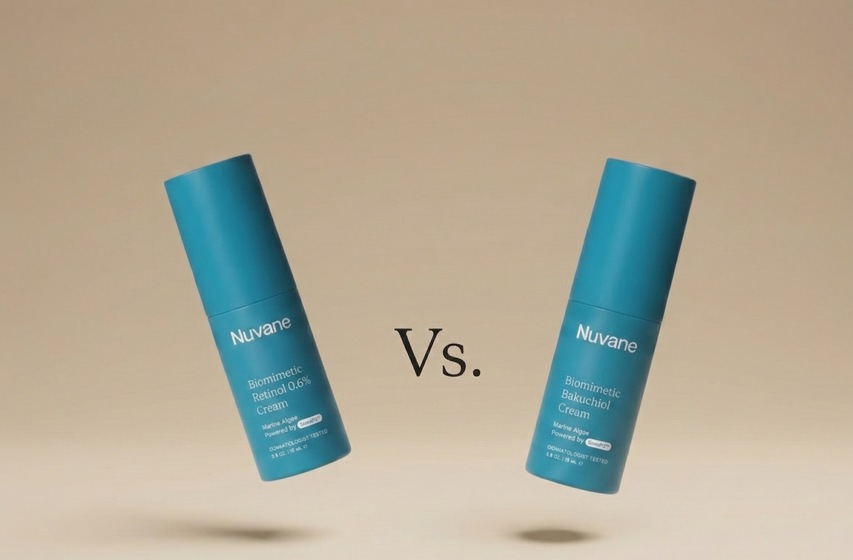
If your skin stings, peels easily, flushes, or you’re rebuilding a damaged barrier, bakuchiol is usually the best first choice because it can improve tone and the look of fine lines with far fewer irritation drawbacks than retinoids. If your sensitivity is mild (or you’re willing to “train” your skin carefully), a low-dose retinol (around 0.3%) is often the best balance of results-to-tolerability—especially when paired with barrier-supporting ingredients and a slow-start protocol. Clinical head-to-head data suggest that bakuchiol can achieve similar results to retinol in visible photoaging outcomes, with better tolerability for many users.
- Bakuchiol is often the gentler vitamin A alternative: retinol-like outcomes, typically less peeling/redness
- Retinol remains the strongest, most studied signaling ingredient for texture and visible aging—if your barrier tolerates it
- Dose and frequency beat hype: a lower strength used consistently often outperforms a higher strength used inconsistently
- Barrier-first routines win: pair actives with hydration, lipids, and daily sunscreen
What is retinol, and why does sensitive skin react to it?
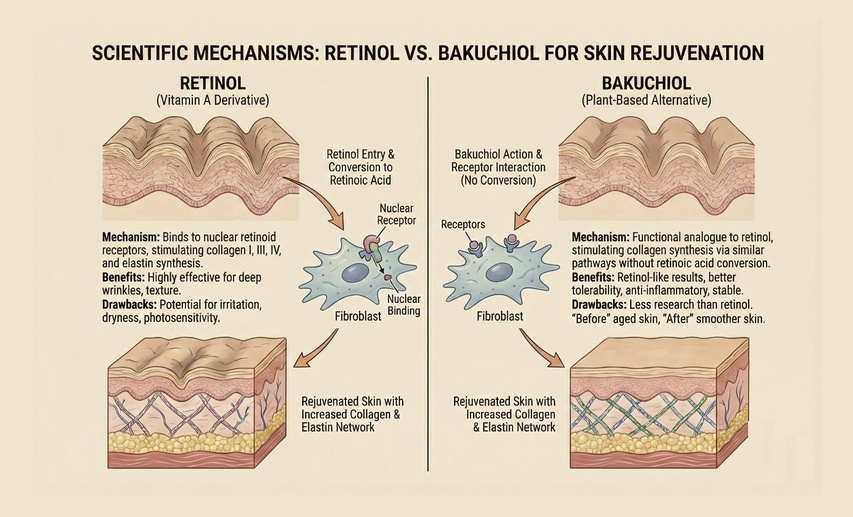
Retinol is a vitamin A derivative that your skin converts into retinoic acid, the form that communicates with skin cells to normalize turnover, support collagen-related pathways, and improve discoloration over time.
Sensitive skin often struggles because retinoids can temporarily disrupt the outer barrier, triggering:
- Dryness and peeling
- Redness and stinging
- Increased reactivity to products that normally feel fine
This is why the adjustment period can feel like a bad trade. For reactive skin, tolerability isn’t a side note—it’s the strategy.
What is bakuchiol, and why is it considered a vitamin A alternative?
Bakuchiol is a plant-derived compound found in the babchi plant. It’s often described as a “functional analogue” of retinol—meaning it can encourage similar visible outcomes (smoothness, firmness, more even tone) without being a retinoid or requiring conversion steps.
For many sensitive-skin users, the appeal is straightforward: you can pursue anti-aging benefits with a lower risk of peeling, burning, or barrier disruption.
What does the clinical evidence say when bakuchiol is compared directly with retinol?
In a well-known head-to-head clinical comparison, both bakuchiol and retinol showed improvements in signs of facial photoaging over a 12-week period. The biggest difference for sensitive skin was tolerability: retinol users reported more scaling and stinging, while bakuchiol tended to be easier to use consistently.
Retinol still has the larger research footprint overall, especially for long-term texture change, acne support, and deeper remodeling signals. Bakuchiol is strongest when your priority is “results without the roller coaster.”
How do retinol and bakuchiol work at the molecular level?
How does retinol signal “youthful behavior” in skin?
Retinoids influence pathways that regulate:
- cell turnover and keratinization (smoother texture, fewer clogs)
- collagen support and wrinkle appearance
- pigment distribution (more even tone over time)
The core idea is that retinoid signaling helps aging skin function more efficiently and in a more organized manner.
How does bakuchiol mimic those outcomes without being a retinoid?
Bakuchiol has been shown to induce retinol-like gene expression changes in skin models, supporting pathways associated with extracellular matrix maintenance and firmness—without relying on retinoid receptors in the same manner. In practical terms, it can deliver many of the visible benefits people want, with fewer barrier penalties for many users.
Why does sensitive skin sometimes age “faster” with the wrong active?
Sensitive skin is often hyper-responsive. If an active repeatedly causes redness, stinging, and barrier disruption, you can end up in a loop:
- Barrier breaks down
- Water loss increases
- Inflammation rises
- Sensitivity worsens
- You stop the active
- You restart and repeat
When inflammation becomes chronic, it can undermine the very collagen-support goals you’re chasing. For sensitive skin, the most effective anti-aging plan is typically one that you can comfortably maintain for an extended period.
What’s the best way to choose between bakuchiol, retinol 0.3%, and retinol 0.6%?
Who should start with bakuchiol?
Choose bakuchiol first if you have:
- Frequent redness or flushing
- Stinging with “normal” products
- Eczema-prone or barrier-impaired skin
- A history of retinoid intolerance
- A preference for low-irritation, daily consistency
Who should consider retinol 0.3%?
Retinol 0.3% is often ideal if you:
- Want vitamin A benefits but fear peeling
- Are new to retinoids
- Have sensitive-but-stable skin
- Are focused on prevention, texture, and early fine lines
Who should consider retinol 0.6%?
Retinol 0.6% is a better fit if you:
- Have already tolerated lower strengths
- Targeting more visible wrinkles or bad skin texture
- Can commit to a careful schedule and barrier support
How should sensitive skin introduce retinol without triggering the “retinol ugly”?
What’s the best beginner schedule?
- Weeks 1–2: 2 nights/week
- Weeks 3–4: 3 nights/week
- Weeks 5–8: every other night if calm
- After: most nights, only if your skin stays comfortable
What is the “sandwich method,” and why does it help?
Apply:
- Moisturizer
- Retinol
- Moisturizer
This buffer intensity reduces the sting and peeling for many sensitive users.
What should you avoid on retinol nights?
Avoid stacking common irritants, especially early on:
- Exfoliating acids (AHA/BHA)
- Scrubs and cleansing brushes
- Multiple actives in one routine
- Fragranced products if you’re reactive
How should individuals with sensitive skin use bakuchiol for optimal results?
Bakuchiol is often easier to use consistently. A simple approach:
What’s a minimal PM routine?
- gentle cleanse
- bakuchiol serum or cream
- moisturizer
What’s a minimal AM routine?
- rinse or gentle cleanse
- hydrating serum if needed
- moisturizer
- sunscreen
Because bakuchiol is chosen for tolerability, daily consistency is usually the biggest success factor.
What about the neck? Do these ingredients also help there?
The skin on the neck is thinner, often drier, and can be more sensitive. That means it benefits from the “low inflammation, high consistency” approach.
What’s the best strategy for a sensitive neck?
- Start lower and slower than your face
- Consider bakuchiol first if your neck tends to burn or rash
- Pair with a lipid-rich moisturizer
- Apply sunscreen to the neck every morning
How do pregnancy, breastfeeding, or “trying” change the decision?
Many people avoid topical retinoids during pregnancy out of an abundance of caution. In this context, bakuchiol is often chosen as a non-retinoid alternative for achieving a glow, tone, and smoother appearance, while keeping routines simple and low-risk.
What’s the smartest 2026 routine approach for sensitive skin to support regenerative aging?
A sensitive-skin regenerative routine prioritizes:
- barrier building (humectants + lipids + soothing support)
- low-inflammation actives (bakuchiol, gentle antioxidants, peptides)
- careful signaling (retinol only if tolerated and introduced slowly)
- daily UV defense (non-negotiable)
What are the most asked FAQs about bakuchiol vs. retinol?
Does bakuchiol work as well as retinol for wrinkles?
In short-term clinical comparisons, bakuchiol can deliver similar visible improvements in photoaging outcomes with better tolerability for many users. Retinol still has a deeper overall research base.
How long will it take to see results from retinol?
Many people notice texture improvements within 4–8 weeks, with more visible wrinkle and tone changes often taking 8–24 weeks or longer, depending on consistency and irritation control.
How long will it take to see results from bakuchiol?
Often 4–12 weeks for glow and texture, with gradual improvements in tone and fine lines, especially with daily use.
Can I use bakuchiol and retinol together?
Many people alternate them (retinol 2–3 nights/week, bakuchiol on off-nights). If you’re highly reactive, avoid using both in the same routine until your barrier is stable.
Is retinol automatically too harsh for sensitive skin?
Not always. Lower strengths, slow schedules, and buffering can make it workable for some sensitive skin types.
Can I use these around my eyes?
The eye area is thinner and reactive. If you try either ingredient, go slowly and stop if irritation persists.
What should I do if I get peeling or burning?
Pause the active, simplify to a gentle cleanser + bland moisturizer + sunscreen, then restart with fewer nights or a lower strength.
Do I need to avoid acids entirely if I use retinol?
You don’t have to avoid them forever, but combining strong acids and retinol on the same night is a common trigger for irritation in sensitive skin. Many sensitive users separate them by days.
How does the Nuvane approach apply this sensitive-skin regenerative logic?
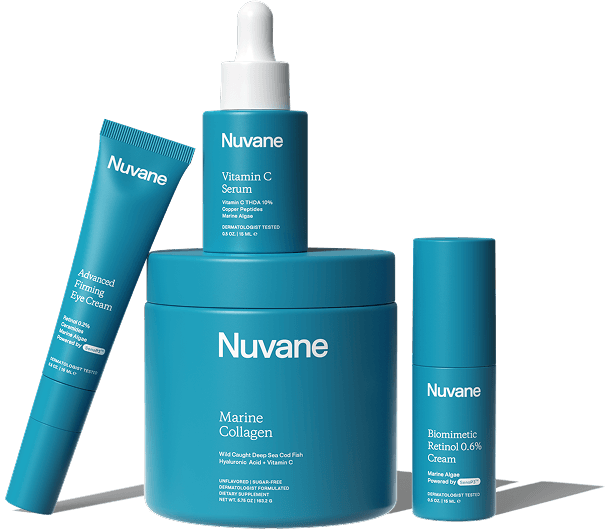
The Nuvane concept aligns with the idea that sensitive skin needs options and progression, not brute force. The system is structured around customized night treatments that let users choose between retinol at different strengths or a bakuchiol-based option, paired with SenoP3 as a peptide-focused strategy for visible anti-aging support.
What makes the retinol options more barrier-aware in formulation style?
The retinol 0.3% and 0.6% approaches are designed to pair vitamin A signaling with supportive ingredients commonly used to reduce irritation risk, such as humectants for hydration, soothing agents, and emollients to help buffer dryness—so results don’t require barrier sacrifice.
What makes the bakuchiol option especially relevant for sensitive skin?
The bakuchiol approach is positioned as a low-irritation pathway that supports firmness and tone while incorporating calming and barrier-supporting ingredients, making it easier for sensitive users to stay consistent.
Why does SenoP3 matter in a vitamin A alternative conversation?
SenoP3 is used as a multi-pathway peptide strategy to support visible firmness and wrinkle appearance without relying solely on retinoid conversion. In a sensitive-skin routine, that can help keep results moving forward even when retinol isn’t tolerated daily.
Related search terms:
Bakuchiol vs retinol sensitive skin, retinol irritation barrier repair routine, bakuchiol clinical trial photoaging, retinol 0.3 vs 0.6 sensitive skin schedule, neck wrinkles retinol vs alternatives, peptide complexes for visible anti-aging, pregnancy skincare retinoids alternatives
Find the most effective anti-aging products for you by taking the free skin assessment.
Enjoyed this article? Add Nuvane as a preferred source on Google.