
What’s the quick truth about red light masks?

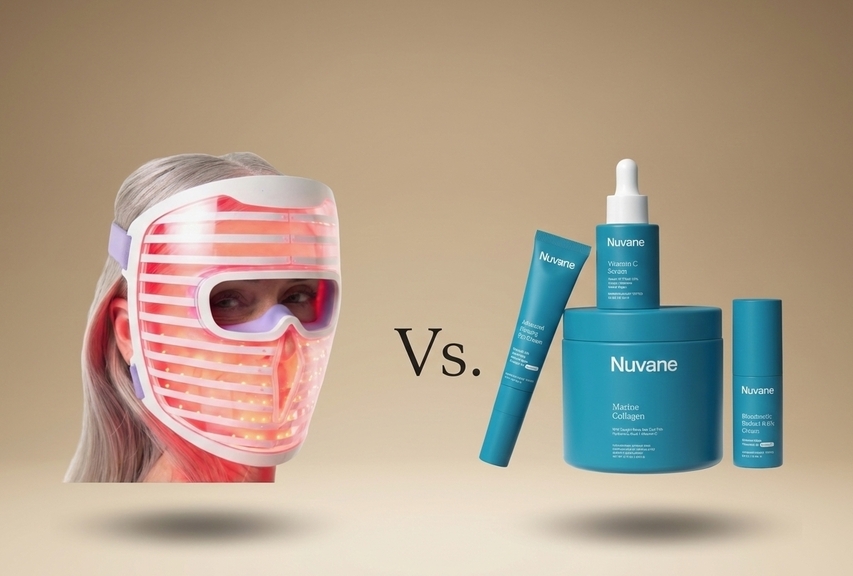
Red light masks can improve “skin quality” (glow, calmness, mild texture, and fine-line softening) when the device uses the right wavelengths, fits well, and you use it consistently for weeks, not days. However, they’re best treated as an add-on to a high-performance routine (topicals + targeted oral supplements), rather than a replacement for it.
- Key takeaway 1: Your biggest, most reliable anti-aging wins still come from topicals (especially retinoids + antioxidants + peptides) and oral support (collagen + cofactors).
- Key takeaway 2: A red light mask is most effective for reducing fine lines, redness, breakouts, and improving overall radiance—not for dramatic lifting.
- Key takeaway 3: Results depend more on device specs + fit + consistency than on “how many colors” it has.
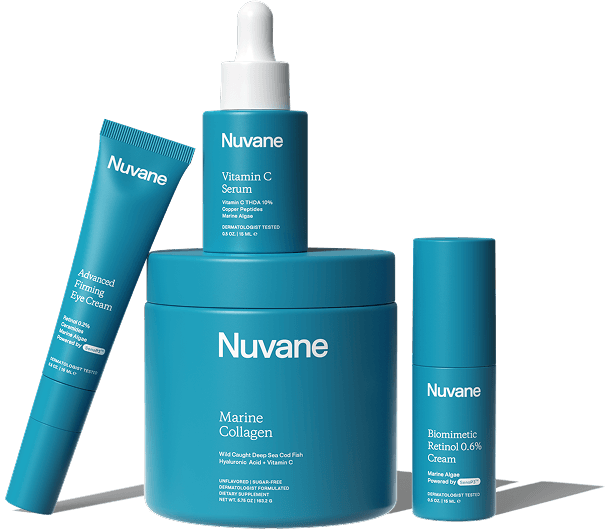
- Key takeaway 4: The best synergy is achieved by using the Nuvane routine as the mainstay, with red light and optional at-home RF as smart “boosters.”
What are red light masks, exactly?
A red light mask is a low-level light therapy device that emits specific wavelengths of light to the skin. The most common categories are:
- Red light (~620–670 nm): Often used for visible anti-aging goals like supporting collagen pathways and smoothing the look of fine lines.
- Near-infrared / infrared (commonly ~800–850 nm): Deeper-penetrating range used for “recovery” signals (calming, repair support).
- Blue light (~400–420 nm): Typically used for acne-prone concerns.
Important: “Infrared” in consumer listings often refers to near-infrared wavelengths (still light, not heat).
Do red light masks actually work for wrinkles, sagging, and tone?
For many people, consistent red/near-infrared use can lead to modest improvements in:
- Radiance and overall tone (often the first thing you notice)
- Redness and irritation-prone look (a calmer baseline)
- Fine lines (softening, not erasing)
- Acne support when blue light is included (varies by skin and routine)
Where masks tend to disappoint:
- Significant sagging/laxity (that’s usually a “structure” issue—collagen + elastin + facial fat + gravity)
- Deep wrinkles (you can improve the look, but don’t expect a facelift effect)
- Stubborn pigmentation (helpful as support, but pigment usually needs targeted actives + sun protection consistency)
What separates a legit red light mask from a gimmick?
Look for these “non-negotiables”:
- Wavelength transparency: Red and near-infrared in established ranges; blue if acne is a goal.
- Enough LEDs + good coverage: More uniform coverage matters because you’re treating surface area, not a single spot.
- Fit and stability: A mask that floats too far from your skin or leaks light reduces dose consistency.
- Session length you’ll actually do: A “perfect” device you hate wearing is a useless device.
- Eye safety design: Light-blocking around the eyes or built-in shielding helps reduce accidental exposure.
What does the Amazon-linked mask (ASIN B0D7N2KWLH) offer on paper?
From the product listing, the device is described as:
- 360 LEDs
- Three wavelengths: Red (635 nm), near-infrared (830 nm), and blue (415 nm)
- Suggested cadence: 10-minute sessions, 3–5x/week
- Comfort/safety claims: dual straps and design intended to block direct light from the eyes.
What this likely means in real life:
- The 635/830 combination aligns with common “anti-aging + recovery” usage patterns.
- Blue (415) can be helpful if you’re prone to acne or congestion.
- The best results will still depend on routine consistency and what you do between sessions (this is where Nuvane becomes a multiplier).
Why should topical skincare and oral supplements stay the mainstay for anti-aging and longevity-focused skin goals?
If you’re a woman building an anti-aging + longevity-minded plan, your highest ROI is still:
Topicals (structure + pigment + barrier)
- Retinoids (like retinol): Support collagen signaling, smoother texture, and more even-looking skin over time.
- Vitamin C derivatives: Antioxidant protection + brightness support + collagen cofactor logic.
- Peptides: Can support firmness and visible wrinkle softening via signaling pathways.
- Barrier and hydration: Makes everything more tolerable and more consistent.
Oral support (inside-out resilience)
- Collagen peptides: Evidence supports improvements in elasticity/hydration in many users when taken consistently for weeks.
- Hyaluronic acid + vitamin C support: Commonly used as hydration + collagen-synthesis cofactors.
A mask can help—but it doesn’t replace the daily, compounding effect of actives and oral building blocks.
What is the Nuvane system, and why is it built for “beauty x longevity”?
Based on the Nuvane project documentation, the system is designed as a complete routine built around:
- AI-driven personalization (matching activities and tolerability)
- A proprietary peptide approach: SenoP3™
- A full regimen approach: AM antioxidant + PM renewal + targeted correctors + oral support
Core routine pillars described in the documentation:
- Morning: stabilized vitamin C serum approach + daily photoprotection habits
- Evening: customized night treatment (retinol strengths or bakuchiol option)
- Optional targeted care: eye + dark spot corrector
- Oral supplement support: hydrolyzed marine collagen peptides + hyaluronic acid + vitamin C
How does SenoP3™ support visible anti-aging pathways?
Nuvane’s documentation centers on SenoP3™ as a triple-peptide strategy:
- Palmitoyl Tripeptide-38 (matrix support signaling)
- Copper Tripeptide-1 (repair/firmness support signaling)
- Acetyl Hexapeptide-8 (expression-line smoothing support)
Nuvane materials also summarize the visible outcomes associated with peptide-focused approaches (e.g., wrinkle depth and firmness improvements) and emphasize synergy over generic moisturization.
How should you structure a Nuvane-based face, neck, and chest routine with a red light mask?
Morning (daily)
- Cleanse
- Nuvane Vitamin C serum
- Moisturizer if needed
- SPF (non-negotiable for neck/chest too)
Evening (most nights)
- Cleanse and fully dry skin
- Choose your Nuvane night treatment (retinol 0.3%, retinol 0.6%, or bakuchiol option, depending on tolerance and goals)
- Optional: eye cream
- Optional: dark spot corrector where needed
Red light mask integration (3–5x/week)
Use it on clean, dry skin for the listing’s 10-minute session cadence. Then apply your Nuvane products afterward.
Practical tip: If you’re irritation-prone with retinol, do red light on the same nights as your gentler option, or use the mask on “recovery nights.”
How do you combine a red light mask with active skincare without irritation?
- Don’t sandwich a mask over slippery products unless the device maker explicitly supports it—fit and light delivery can change.
- Do mask first, then apply your actives.
- If you’re using retinol, keep your routine simple and consistent: hydration, retinol, and barrier support.
- If your skin is easily reactive, consider using your bakuchiol-based option on mask nights (or reduce the frequency of retinol use).
What are the most common myths about red light masks?
Myth: “All LED masks are basically the same.”
Truth: Specs, coverage, and fit change outcomes dramatically.
Myth: “It replaces a real routine.”
Truth: Devices amplify what you do daily; they don’t replace it.
Myth: “Seven colors = seven benefits.”
Truth: Red/near-infrared + blue are the most commonly used; everything else is secondary unless you have a specific reason.
Myth: “If I don’t see results in a week, it doesn’t work.”
Truth: Think in 8–12 week blocks, like training.
What should you do if your neck is the main concern?
The skin on the neck is often thinner, drier, and more prone to irritation. Best practices:
- Extend your AM vitamin C + SPF down the neck and upper chest every day.
- Use your night treatment down the neck as tolerated (start with a lower frequency than the face).
- Consider red light sessions that cover the neck/chest, or do separate exposures if your device design allows for safe positioning.
- Don’t forget: posture + phone neck habits can exaggerate lines—topicals help, but mechanics matter too.
Shop:
What are the most common questions about red light masks and the Nuvane routine?
How long until I see results?
Most people notice a “glow/calm” effect within 2–4 weeks, and more noticeable texture/fine-line improvements occur around 8–12 weeks with consistent use.
Can I use a red light mask on the same night as retinol?
Yes, many people do—but if you’re sensitive, use the mask first on clean skin, then apply retinol, and reduce frequency if irritation appears.
Should I use the mask before or after skincare?
Generally, before (clean, dry skin), then apply your Nuvane routine afterward.
Does blue light help with acne?
It can support acne-prone routines, especially when breakouts are driven by congestion and inflammation. It’s still not a replacement for a complete acne plan.
Is more time better than the recommended session length?
Not necessarily. Follow the device’s protocol (the listing notes 10 minutes, 3–5x/week), and judge results over 8–12 weeks.
Can red light replace sunscreen?
No. If anything, better skin quality makes daily SPF more important because you’ll protect the progress you’re building.
Who should be cautious with red light devices?
Anyone with photosensitivity disorders, those using photosensitizing medications, or anyone who can’t reliably protect their eyes should get personalized medical guidance before use.
What’s the simplest “stack” for anti-aging + longevity-minded skin?
Nuvane AM + Nuvane PM + oral collagen daily as the base, then add red light 3–5x/week and optional RF 1–2x/week if tolerated.
Related search terms:
Red light therapy mask wavelengths • 635 nm vs 660 nm red light • 830 nm near infrared skin • LED mask collagen evidence • blue light 415 nm acne • at-home RF skin tightening • retinol 0.3 vs 0.6 tolerance • THD ascorbate vitamin C benefits • copper peptide GHK-Cu skin • palmitoyl tripeptide-38 matrix support • oral marine collagen peptides elasticity
References:
- Farage MA, Miller KW, Elsner P, Maibach HI. Intrinsic and extrinsic factors in skin ageing: a review. Int J Cosmet Sci. 2008.
- Rittié L, Fisher GJ. UV-light-induced signal cascades and skin aging. Ageing Res Rev. 2002.
- Kafi R, Kwak HS, Schumacher WE, et al. Improvement of naturally aged skin with vitamin A (retinol). Arch Dermatol. 2007.
- Humbert PG, Haftek M, Creidi P, et al. Topical ascorbic acid on photoaged skin: clinical and histological evaluation. Exp Dermatol. 2003.
- Proksch E, Segger D, Degwert J, Schunck M, Zague V, Oesser S. Oral collagen peptides improve skin elasticity: a placebo-controlled study. Skin Pharmacol Physiol. 2014.
- Asserin J, Lati E, Shioya T, Prawitt J. The effect of oral collagen peptide supplementation on skin moisture and dermal collagen. J Cosmet Dermatol. 2015.
- Avci P, Gupta A, Sadasivam M, et al. Low-level laser (light) therapy in skin: mechanisms and clinical applications. Semin Cutan Med Surg. 2013.
- Barolet D, Boucher A. Prolonged exposure to red and near-infrared LED improves photoaged skin: clinical and mechanistic insights. J Cosmet Laser Ther. 2010.
- Elsaie ML. Cutaneous remodeling and photorejuvenation using radiofrequency devices: an evidence-based review. J Cosmet Dermatol. 2009.
- Pickart L, Thaler MM. A growth-modulating tripeptide and its copper complex: implications for tissue repair and skin. Proc Natl Acad Sci U S A. 1980.
Find the most effective anti-aging products for you by taking the free skin assessment.
Enjoyed this article? Add Nuvane as a preferred source on Google.