
Best skincare layering order: cleansers to creams


Quick Answer
Layering skincare isn’t about owning more products—it’s about understanding sequence and synergy. Apply products from thinnest to thickest, using water-based products first and then oil-based ones. Apply actives on alternate nights to protect your barrier. Night is for renewal (cleansing, exfoliation, repair); morning is for hydration, antioxidants, and SPF. With consistent layering and barrier-focused formulas, such as Nuvane’s SenoP3™ complex, you’ll strengthen skin resilience, reduce dryness, and reveal healthier, more luminous skin.
Key Takeaways
- Layer from thinnest to thickest: watery serums first, occlusive creams last.
- Alternate strong actives, such as retinoids and exfoliating acids, to prevent barrier fatigue.
- Barrier health is everything — look for ceramides, cholesterol, and fatty acids.
- Nuvane’s SenoP3™ complex reinforces skin’s structure with biomimetic peptides that rebuild collagen and improve elasticity.
What does “layering skincare” really mean?
Layering is the art of applying skincare products in the correct sequence so that each can perform optimally. When done correctly, it enhances penetration, reduces irritation, and allows your barrier to stay strong while actives do their work.
The basic logic is simple:
Thinnest to thickest. Water to oil. Seal at the end.
But effective layering is more than order — it’s about planning your week so your skin gets both repair and recovery days.
Why is skin barrier protection at the core of every layering plan?
Your skin barrier is a lipid-rich layer composed of ceramides, cholesterol, and fatty acids that prevent transepidermal water loss (TEWL) and block irritants. As we age—especially after the age of 50—this layer thins and becomes more susceptible to dehydration and inflammation, leading to redness.
Barrier damage results in tightness, flaking, and reduced tolerance to active ingredients. That’s why the smartest skincare routines focus on fortifying the lipid matrix first, then layering targeted actives second.
Nuvane’s formulations—including SenoP3™, niacinamide, beta-glucan, panthenol, and ectoin—are designed to repair and strengthen this barrier by replenishing lipids, calming inflammation, and improving skin elasticity.
What’s the golden rule of product order?
The simplest way to remember:
- Cleanse — remove debris without stripping lipids.
- Mist or essence — rehydrate and prepare the skin.
- Water-based serums — niacinamide, peptides, antioxidants.
- Oil-based serums or treatments — lipid-soluble actives or emollient boosters.
- Eye cream — applied before moisturizer for close absorption.
- Moisturizer — seals in hydration with ceramides and cholesterol.
- Sunscreen — final morning step, always.
Evening exception: swap sunscreen for retinoid or targeted treatment, then moisturize.
How should you layer at night for maximum results?
Nighttime is when your skin repairs cellular damage and increases collagen synthesis. It’s the perfect window for deep cleansing, gentle exfoliation, and peptide-rich repair creams.
Example Night Routine:
- Step 1: Cleanse (or double cleanse if using makeup/SPF).
- Step 2: Apply hydrating mist or serum (hyaluronic acid, beta-glucan).
- Step 3: Apply treatment (retinol, bakuchiol, or SenoP3™ peptide cream).
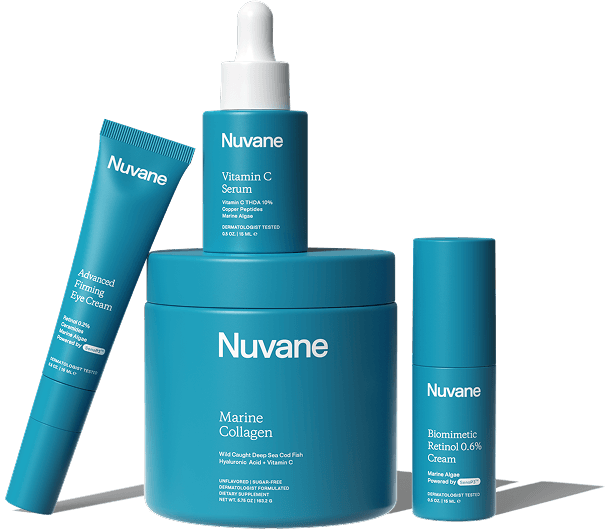
- Step 4: Eye cream with caffeine, peptides, or retinol (e.g., Nuvane’s Advanced Firming Eye Cream).
- Step 5: Apply a moisturizer or sleeping cream containing ceramides and cholesterol.
For sensitive or mature skin, buffer strong actives by using moisturizer before and after application.
Should you double cleanse at night?
If you wear sunscreen, makeup, or live in an urban area, double cleansing helps remove oil-soluble and water-soluble debris.
- Oil-based or micellar cleanser: breaks down makeup and sunscreen.
- Gentle gel or cream cleanser: removes residue without stripping essential lipids.
Look for pH-balanced, fragrance-light cleansers with fatty acids or panthenol to avoid irritation【1】.
Where do exfoliating acids fit in?
Exfoliation is a renewal step, not a daily one. Overuse can damage your barrier.
Apply acids only on nights you exfoliate, right after cleansing.
- Lactic or mandelic acid: best for dry, mature, or sensitive skin.
- Salicylic acid: suitable for oily or congested areas.
Start once per week and increase gradually. After 50, slower exfoliation often yields better, calmer results.
What’s the ideal morning routine?
Morning layering focuses on hydration, antioxidant protection, and UV defense.
Step-by-Step:
- Gentle cleanse or water rinse (skip cleanser if skin is dry).
- Hydrating serum (glycerin, hyaluronic acid, beta-glucan).
- Antioxidant serum (vitamin C, niacinamide, or copper peptides).
- Moisturizer (ceramide-rich for dry skin, lighter emulsion for oily types).
- Sunscreen (SPF 30+ broad spectrum, reapplied every 2 hours outdoors).
Can you mix actives like retinoids, acids, and vitamin C?
Compatibility matters. Combining too many actives increases irritation risk.
- Vitamin C + Retinoids: effective but often harsh together. Use C by day, retinoids by night.
- Acids + Retinoids: alternate nights.
- Niacinamide: safe “bridge” active—works well with both vitamin C and retinoids at ≤5%.
- Copper peptides: best used in routines opposite to acids or vitamin C to preserve peptide integrity.
How should you plan your week?
Rather than repeating the same steps daily, rotate treatments to balance active ingredients and promote recovery.
Sample Weekly Template:
- Mon – Retinoid Night: Cleanse → hydrating serum → retinoid → moisturizer.
- Tue – Barrier Night: Cleanse → peptide serum → ceramide moisturizer.
- Wed – Brightening Night: Cleanse → niacinamide/azelaic serum → moisturizer.
- Thu – Retinoid Night: Repeat Monday.
- Fri – Recovery Night: Hydrate and repair with panthenol and ectoin.
- Saturday – Gentle Exfoliation Night: Cleanse → Lactic Acid → Moisturizer.
- Sun – Rest Night: Keep it simple: cleanse → peptide cream → sleep.
Morning remains constant: Hydrate → Antioxidant → Moisturize → SPF.
What makes Nuvane’s SenoP3™ a key player in smart layering?
SenoP3™ is Nuvane’s biomimetic peptide complex that targets the three hallmarks of visible aging: collagen loss, expression lines, and elasticity decline.
It combines:
- Palmitoyl Tripeptide-38: Stimulates collagen I, III, IV, fibronectin, and hyaluronic acid synthesis, improving firmness and density.
- Acetyl Hexapeptide-8: Relaxes facial tension lines and smooths micro-relief, acting as a “Botox-like” topical solution.
- Copper Tripeptide-1: Boosts dermal regeneration, enhances antioxidant defense, and strengthens the extracellular matrix.
Clinical data show a reduction of up to 45% in wrinkle depth within 8 weeks and a 30% improvement in firmness compared to generic formulas.
When layered consistently, SenoP3™ harmonizes with barrier ingredients like niacinamide, panthenol, ectoin, and ceramides—making it ideal for women over 50 who need results without irritation.
How does SenoP3™ interact with other Nuvane ingredients?
Each Nuvane formula integrates SenoP3™ with complementary actives for multi-pathway rejuvenation:
- Niacinamide enhances lipid synthesis and uniformity of tone.
- Ceramide NP + cholesterol: restore the skin’s “mortar.”
- Panthenol + beta-glucan: soothe redness and improve hydration.
- Marine algae extracts (Fucus Vesiculosus): provide antioxidant and anti-inflammatory protection.
- Retinol or Bakuchiol: accelerates renewal and collagen repair.
Together, these biomimetic elements replicate natural skin architecture—a synergy that yields both visible and structural enhancements.
What’s the best way to maintain comfort while using actives?
- Use lukewarm water, never hot, to preserve barrier lipids.
- “Sandwich” actives (moisturizer → active → moisturizer) if your skin stings easily.
- Limit to 2–3 serums per session.
- Keep a “recovery routine” (ceramides, panthenol, and ectoin) on standby after irritation.
- Apply occlusive dabs (such as squalane or petrolatum) to flaky areas in dry weather.
How should you treat the neck and chest?
These areas have thinner skin and fewer sebaceous glands, making them prone to dryness and creping.
- Apply the actives at half the frequency compared to your face.
- Always include barrier moisturizers daily.
- Use upward strokes and light pressure to avoid stretching delicate tissue.
What does a minimal, barrier-smart routine look like for women over 50?
Evening:
- Cream cleanser → hydrating serum → SenoP3™ peptide cream → eye cream → moisturizer.
Morning:
- Water rinse → vitamin C serum (THD Ascorbate) → moisturizer → sunscreen.
This “less but better” method maximizes comfort and results by prioritizing lipid replenishment and collagen renewal.
Eight FAQs about layering skincare
1. Can I use oil before water-based serums?
No. Apply water-based first; oils form a seal that can block absorption.
2. Do I need a toner?
Only if hydrating. Avoid high-alcohol or astringent types that strip the barrier.
3. Where do spot treatments go?
After cleansing, before broad serums or moisturizers.
4. How long should I wait between layers?
Around 60–90 seconds for full absorption.
5. Can I layer three actives at once?
Limit to one strong active per night (retinoid or exfoliant).
6. Should eye cream go over or under serums?
Under moisturizer, so it sits close to the skin.
7. What if everything stings suddenly?
Pause active ingredients and use only humectants and ceramides for 3–7 days.
8. Is sunscreen really necessary every day?
Yes. UV is the top extrinsic aging factor. Even indoor light contributes to oxidative stress.
Why Nuvane’s science-backed layering philosophy works
Nuvane’s system embodies smart minimalism—a focused combination of actives and barrier-restoring lipids anchored by the SenoP3™ peptide complex. Each step in the layering process supports long-term resilience, striking a balance between efficacy and comfort.
For detailed ingredient data and peer-reviewed evidence, see the Nuvane project documentation and clinical studies. Nuvane’s formulations draw from the synergy of Palmitoyl Tripeptide-38, Acetyl Hexapeptide-8, Copper Tripeptide-1, and supportive actives like niacinamide, ectoin, ceramides, panthenol, and marine extracts—a biomimetic approach that mirrors the skin’s own healing architecture.
References
[1] Proksch E, Brandner JM, Jensen JM. The skin: an indispensable barrier. Exp Dermatol. 2008.
[2] Elias PM, Menon GK. Structural and lipid biochemical correlates of the epidermal barrier. Adv Lipid Res. 1991.
[3] Lynde CW. Moisturizers: what they are and how to choose them. Skin Therapy Lett. 2001.
[4] Draelos ZD. Nicotinamide: a mediator for skin barrier repair. Dermatol Surg. 2005.
[5] Cerio R et al. Mechanism and benefits of colloidal oatmeal. J Drugs Dermatol. 2010.
[6] Schagen SK. Topical peptide treatments with effective anti-aging results. J Drugs Dermatol. 2017.
[7] Pickart L, Thaler MM. GHK-Cu and collagen synthesis. PNAS. 1980.
[8] Lupo MP, Cole AL. Cosmeceutical peptides: mechanisms and application. Dermatol Ther. 2007.
[9] Nuvane Clinical Data, Wrinkle Reduction – SenoP3 vs Generic.
[10] Nuvane Clinical Studies, Senop3: Ingredients, Benefits, and Scientific References.
[11] Nuvane Medical Team Report, PPT F Medical Team Overview.
Related Search Terms:
smart skincare layering, skin barrier repair, SenoP3 peptides, niacinamide layering, mature skin routine, ceramide moisturizer, peptide skincare, Nuvane anti-aging system, layering retinol and vitamin C, biomimetic skincare science.
Find the most effective anti-aging products for you by taking the free skin assessment.
Enjoyed this article? Add Nuvane as a preferred source on Google.