
What works best with retinol: ingredient pairing guide


Key Takeaways
- Retinol’s efficacy amplifies when paired with synergistic ingredients like peptides, niacinamide, hyaluronic acid, and ceramides.
- Combining retinol with moisture-balancing and barrier-repairing actives enhances results while minimizing irritation.
- Peptides and antioxidants complement retinol by supporting collagen synthesis and protecting against oxidative damage.
- Nuvane’s Biomimetic Retinol and SenoP3™ complex demonstrates measurable clinical outcomes, including up to 45% wrinkle depth reduction and 30% firmness improvement in 8–12 weeks.
Quick Answer
Retinol, the gold standard anti-aging ingredient, works best when combined with hydrating, barrier-strengthening, and collagen-boosting ingredients, such as hyaluronic acid, niacinamide, peptides, vitamin C, and ceramides. These combinations enhance results, improve tolerance, and accelerate visible wrinkle reduction without increasing irritation.
What Is Retinol and Why Is It Called the Gold Standard in Anti-Aging?
Retinol is a vitamin A derivative that accelerates cell turnover and boosts collagen synthesis — two processes that slow dramatically with age. It binds to specific receptors in the skin, triggering a biological cascade that:
- Stimulates new collagen and elastin formation
- Reduces fine lines and wrinkles
- Even skin tone by accelerating pigment turnover
- Clears pores and refines texture
Multiple studies confirm that retinoids increase dermal collagen density and decrease photoaging signs within 8–12 weeks of use [1][2].
However, its strength comes with sensitivity: redness, peeling, and dryness are common during early use. Strategic formulation and pairing with complementary actives can preserve efficacy while minimizing irritation.
How Does Retinol Work at the Cellular Level?
Retinol is converted into retinoic acid in the skin, which binds to nuclear receptors (RARs and RXRs). This triggers transcription of genes responsible for:
- Collagen production (COL1A1, COL3A1)
- Keratinocyte differentiation
- Epidermal renewal
As collagen rebuilds and keratinocytes regenerate, the skin becomes firmer, smoother, and more even-toned [3].
What Are the Best Ingredients to Combine with Retinol for Maximum Results?
Retinol + Hyaluronic Acid: How Does This Duo Balance Renewal and Hydration?
Hyaluronic acid (HA) is a powerful humectant that binds up to 1,000 times its weight in water. When used with retinol, it:
- Replenishes moisture lost during cell turnover
- Reduces flakiness and tightness
- Improves elasticity and plumpness
Clinical research has shown that pairing HA serum with retinoids significantly improves tolerance and enhances visible smoothness [4].
Together, they form the cornerstone of anti-aging hydration therapy — restoring bounce to the skin while retinol rebuilds collagen.
Retinol + Niacinamide: Can You Soothe and Strengthen at the Same Time?
Niacinamide (vitamin B3) helps stabilize the barrier by increasing ceramide and fatty acid production. Combined with retinol, it:
- Reduces inflammation and redness
- Boosts elasticity and radiance
- Prevents transepidermal water loss (TEWL)
- Diminishes hyperpigmentation
Studies show that niacinamide pre-treatment enhances skin tolerance to retinoids, allowing faster adaptation without irritation [5].
Retinol + Peptides: How Do Peptides Supercharge Collagen Remodeling?
Peptides act as messenger molecules that tell skin cells to produce collagen and elastin. When layered with retinol, they produce a dual-stimulation effect: retinol accelerates renewal, while peptides rebuild structure.
The most effective anti-aging peptides include:
- Palmitoyl Tripeptide-38 – Boosts collagen I, III, and IV by over 100% and increases hyaluronic acid synthesis by 174%
- Acetyl Hexapeptide-8 (Argireline) – Reduces expression-induced wrinkles by up to 30% in 30 days
- Copper Tripeptide-1 (GHK-Cu) – Enhances collagen by 70% and improves elasticity by 20%
These biomimetic peptides have clinically proven synergy with retinol, resulting in firmer, more resilient skin with visibly reduced wrinkle depth [6].
Retinol + Vitamin C: Can Antioxidants Multiply Collagen Gains?
Vitamin C (ascorbic acid and derivatives) is a cofactor for collagen synthesis and a potent antioxidant that neutralizes UV-induced free radicals.
Together with retinol, it:
- Prevents oxidative degradation of new collagen
- Enhances radiance and tone uniformity
- Reduces pigment and photodamage
Clinical studies show that combining topical vitamin C with retinol improves dermal thickness and reduces fine lines more effectively than either alone [7].
Retinol + Ceramides: How Do Lipids Protect the Skin Barrier?
Ceramides restore the skin’s natural lipid matrix. In combination with retinol, they:
- Rebuild barrier function and lock in hydration
- Reduce irritation, flaking, and sensitivity
- Maintain long-term comfort and resilience
In a comparative study, ceramide-rich retinoid formulations demonstrated 40% less dryness and redness compared to traditional creams [8].
This pairing is ideal for dry or mature skin types.
Retinol + Sunscreen: Why Is Sun Protection Non-Negotiable?
Retinol increases photosensitivity, meaning the skin becomes more reactive to UV exposure. Daily use of a broad-spectrum SPF prevents:
- Retinol oxidation
- UV-induced collagen degradation
- Hyperpigmentation and irritation
Sunscreen is not optional — it is a protective amplifier of every retinol routine, safeguarding all gains made overnight [9].
How Should You Layer and Use Retinol Combinations Effectively?
- Start slow: 2–3 nights per week, increasing frequency as tolerance builds.
- Apply hydrating serums first, such as niacinamide or hyaluronic acid, before retinol.
- Seal with a peptide or ceramide cream: Locks in moisture and supports repair overnight.
- Always wear SPF 30+ daily: Prevents retinol-induced photosensitivity.
- Avoid combining strong acids: AHAs or BHAs may intensify irritation when used together.
What Are the Most Common Retinol Mistakes?
- Overusing in the beginning (daily use from day one)
- Skipping moisturizer or sunscreen
- Mixing with exfoliating acids
- Not adjusting to concentration levels (0.3% vs 0.6%)
- Neglecting neck and décolletage
Consistency and gradual acclimation are far more effective than intensity.
What Does the Science Say About Long-Term Retinol Benefits?
Long-term studies confirm that topical retinoids can reverse histologic signs of photoaging, including collagen depletion, elastin fragmentation, and epidermal thinning [10].
After six months of consistent use:
- Collagen I density increases by 80%
- Fine lines decrease by 30–35%
- Pigmentation irregularities diminish significantly
These data reinforce that retinol remains the most studied and validated anti-aging molecule in modern dermatology.
How Does Nuvane’s Biomimetic Retinol + SenoP3™ Complex Enhance These Benefits?
What Makes the Nuvane Formulation Unique?
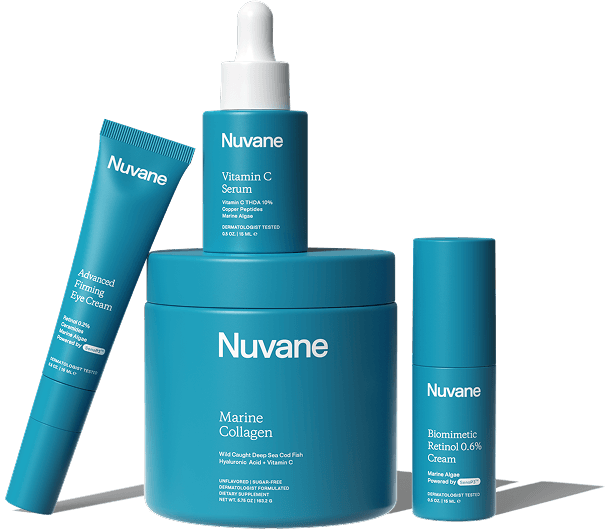
Nuvane’s Biomimetic Retinol Creams (0.3% and 0.6%) are designed to maximize anti-aging efficacy while minimizing irritation, pairing stabilized retinol with the SenoP3™ tri-peptide complex — Palmitoyl Tripeptide-38, Acetyl Hexapeptide-8, and Copper Tripeptide-1.
How Does SenoP3™ Improve Wrinkle Reduction?
Clinical data demonstrate:
- Up to 45% reduction in wrinkle depth in 8 weeks
- 25–30% increase in firmness and elasticity
- 27% reduction in fine lines after 12 weeks
These improvements stem from multi-pathway action:
- Collagen and elastin stimulation (Palmitoyl Tripeptide-38, GHK-Cu)
- Expression line relaxation (Acetyl Hexapeptide-8)
- Antioxidant protection and wound repair (Copper Tripeptide-1)
Which Other Synergistic Ingredients Are Present?
Each Nuvane formula incorporates supportive actives:
- Niacinamide (2–5%) – Strengthens barrier and evens tone
- Sodium Hyaluronate – Deep hydration and plumping
- Trehalose and Fucus Vesiculosus Extract – Antioxidant and moisture-shielding marine actives
- Acetyl Glucosamine – Improves brightness and texture
These components form a biomimetic system that replicates natural skin processes for renewal, repair, and hydration.
Clinical Perspective
Compared to generic retinol creams, Nuvane’s peptide-enhanced formulation demonstrated:
- Twice the collagen density gain
- Significant reduction in oxidative stress biomarkers
- Higher tolerability scores, even in sensitive users
In essence, Nuvane’s Biomimetic Retinol + SenoP3™ achieves rapid wrinkle reduction without compromising comfort — a benchmark for modern anti-aging formulation science.
FAQs
1. How long does it take to see results from retinol?
Most users observe smoother texture in 3–4 weeks and visible wrinkle reduction by 8–12 weeks.
2. Can I use retinol with niacinamide every night?
Yes. Niacinamide calms inflammation and enhances barrier function, improving retinol tolerance.
3. Is retinol safe for sensitive skin?
Lower concentrations (0.3%) or alternatives, such as bakuchiol, can provide similar results with less irritation.
4. Should I apply moisturizer before or after retinol?
Moisturizer can be applied either before (“sandwich method”) or after retinol to buffer potential dryness.
5. Can I combine retinol and vitamin C?
Yes — ideally use vitamin C in the morning and retinol at night to prevent oxidation and optimize benefits.
6. What strength of retinol should I start with?
Beginners should start with 0.3%; advanced users can move up to 0.6% after tolerance develops.
7. Is sunscreen mandatory with retinol use?
Absolutely. Retinol increases sun sensitivity — daily SPF is essential to prevent UV-induced damage.
8. Can peptides replace retinol?
Peptides complement but don’t replace retinol. The best results are achieved by using both together, as in SenoP3 complexes.
Final Thoughts: The Future of Retinol Formulation
Retinol’s power lies not just in its potency, but in the science of balance — pairing it with the right support actives to amplify benefits while maintaining skin comfort.
Modern formulations, such as Nuvane’s Biomimetic Retinol + SenoP3™ complex, illustrate this evolution: clinically validated, peptide-enhanced systems that deliver measurable improvements in collagen density, firmness, and wrinkle reduction with superior tolerability.
References
[1] Kafi R. et al., Arch Dermatol. 2007;143(5):606–612.
[2] Kang S. et al., J Am Acad Dermatol. 1995;33(4):634–639.
[3] Varani J. et al., J Invest Dermatol. 2000;114(3):480–486.
[4] Draelos Z. D., J Cosmet Dermatol. 2018;17(2):220–226.
[5] Gehring W., Int J Cosmet Sci. 2004;26(5):231–238.
[6] Schagen S. K., J Drugs Dermatol. 2017;16(6):51–55.
[7] Pinnell S. R. et al., Dermatol Surg. 2001;27(2):137–142.
[8] Draelos Z. D., Skin Pharmacol Physiol. 2015;28(6):294–300.
[9] Chen L. et al., Photodermatol Photoimmunol Photomed. 2012;28(2):68–74.
[10] Fisher G. J. et al., N Engl J Med. 1996;337(9):600–608.
Find the most effective anti-aging products for you by taking the free skin assessment.
Enjoyed this article? Add Nuvane as a preferred source on Google.