
Best moisturizers for aging skin: why it gets drier


Quick Answer
Your skin’s Natural Moisturizing Factor (NMF) is a collection of naturally occurring molecules—like amino acids, urea, PCA, and lactic acid—that maintain hydration and barrier integrity. With age, NMF levels decline due to slower cell turnover, environmental stress, and lipid loss. Repairing NMF requires replenishing these key molecules using biomimetic actives, peptides, ceramides, and humectants such as those in the Nuvane system, powered by SenoP3™, a clinically proven triple-peptide complex that enhances hydration, collagen renewal, and barrier function.
4 Key Takeaways
- NMF is essential for hydration, softness, and barrier protection—its loss leads to dryness and accelerated aging.
- Aging, UV exposure, and harsh cleansers reduce NMF and weaken the skin’s natural defense.
- Replenishing NMF requires biomimetic molecules—amino acids, PCA, ceramides, peptides, and humectants like hyaluronic acid and glycerin.
- Nuvane’s SenoP3™ peptide complex and marine algae actives help rebuild NMF and restore skin resilience through clinically validated mechanisms.
What Exactly Is the Skin’s Natural Moisturizing Factor (NMF)?
NMF is the skin’s internal “hydration reservoir.” Found in the stratum corneum, it consists of amino acids, lactic acid, urea, PCA, and sugars that collectively attract and hold water. It functions synergistically with the lipid barrier to maintain smooth texture and flexibility.
Key Components of NMF
- Amino acids – the largest component, derived from filaggrin breakdown, vital for water-binding.
- Lactic acid & urea – humectants that attract water into corneocytes.
- PCA (Pyrrolidone Carboxylic Acid) – a natural derivative of glutamic acid that strongly binds moisture.
- Sugars (trehalose, maltose, glycerin) – stabilize hydration and protect against oxidative stress.
- Minerals (sodium, potassium, calcium) – maintain osmotic balance.
How Does NMF Keep Skin Youthful and Resilient?
NMF works through three biological functions:
- Hydration – binds atmospheric and dermal water, ensuring suppleness.
- Barrier function – supports lipid organization to prevent transepidermal water loss (TEWL).
- Elasticity & texture – keeps corneocytes soft and compact, resulting in smoother skin.
As NMF diminishes, barrier permeability increases, allowing irritants to penetrate and water to escape—creating the visible signs of dullness, roughness, and dryness.
Why Does NMF Decline With Age?
The degradation of NMF is multifactorial:
1. Reduced Filaggrin and Amino Acid Synthesis
Aging slows keratinocyte differentiation, decreasing filaggrin—the protein that generates NMF amino acids.
2. Environmental Damage
Chronic UV exposure and pollution degrade filaggrin and lipids, altering skin pH and reducing hydration.
3. Lipid Depletion
Sebaceous activity declines, reducing ceramide, fatty acid, and cholesterol synthesis—key partners in NMF stability.
4. Lifestyle Accelerators
Smoking, stress, and poor nutrition accelerate oxidative damage, further suppressing NMF production.
How Can You Repair the Natural Moisturizing Factor?
Restoration requires mimicking and replenishing NMF components with targeted actives. The most effective formulas combine humectants, emollients, barrier lipids, and peptides—the foundation of the Nuvane system.
Which Ingredients Rebuild NMF and Barrier Integrity?
1. Amino Acids
Arginine, serine, glycine, and proline replenish the amino acid fraction of NMF.
-
Improve water-binding capacity.
-
Support skin pH balance and healing.
Present in Nuvane Biomimetic Retinol 0.6% Cream, they promote balanced hydration and resilience.
2. PCA (Sodium & Potassium PCA)
Biomimetic molecules that replicate natural humectant activity—increasing hydration by up to 50%.
3. Lactic Acid (AHA)
At low concentrations, it exfoliates and hydrates, improving desquamation and moisture retention.
4. Urea
Softens corneocytes and enhances water-binding. Used in many dermatologist-developed barrier formulations.
5. Hyaluronic Acid (HA)
A cornerstone humectant that attracts 1,000x its weight in water.
Nuvane formulas use multi-molecular sodium hyaluronate to penetrate both superficial and deep layers.
6. Ceramides
Crucial lipids that seal in moisture and repair microfissures.
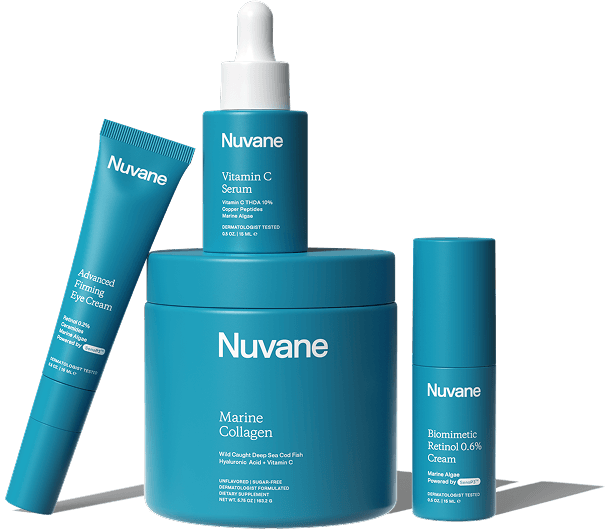
Ceramide NP is featured in Nuvane’s Vitamin C Serum and Advanced Eye Cream, helping to reinforce the skin's barrier structure.
7. Trehalose and Sugars
Trehalose is a stress-protective disaccharide that stabilizes cellular hydration.
Nuvane employs trehalose across all regimens, preventing oxidative moisture loss.
8. Panthenol (Pro-vitamin B5)
Deeply hydrating and anti-inflammatory, restoring flexibility in compromised skin.
9. Essential Fatty Acids
Omega-3 and -6 lipids strengthen the hydrolipid barrier, preventing TEWL and improving smoothness.
What Role Do Peptides Play in NMF Restoration?
Modern formulations integrate biomimetic peptides that signal cells to regenerate NMF-related structures—particularly collagen, elastin, and glycosaminoglycans.
SenoP3™: The Tri-Peptide Breakthrough
SenoP3™ combines Palmitoyl Tripeptide-38, Acetyl Hexapeptide-8, and Copper Tripeptide-1, creating a multi-pathway rejuvenation system that not only reduces wrinkles but enhances the hydration matrix by stimulating collagen and hyaluronic acid synthesis.
Mechanisms:
- Palmitoyl Tripeptide-38: Boosts collagen I, III, and IV, hyaluronic acid by up to 174%, and fibronectin by 100%.
- Acetyl Hexapeptide-8 (Argireline): Reduces muscular micro-contractions that lead to expression lines.
- Copper Tripeptide-1 (GHK-Cu): Stimulates collagen and elastin while improving antioxidant enzyme activity.
Together, these peptides strengthen dermal structure and indirectly support NMF retention by improving barrier integrity and hydration channels.
How Does Nuvane Integrate NMF-Repairing Science?
Nuvane’s formulations are designed to mimic the skin’s biology, targeting the decline of both NMF and collagen synthesis.
Each product synergistically reinforces the hydrolipid layer and replenishes humectant reservoirs.
1. Biomimetic Retinol 0.3% & 0.6% Creams
Contain Retinol + SenoP3™ peptides, niacinamide, trehalose, and hyaluronic acid for deep renewal, hydration, and antioxidant protection.
2. Biomimetic Bakuchiol Cream
A retinol-free alternative enriched with bakuchiol, copper peptides, centella asiatica, and marine algae—ideal for sensitive or dehydrated skin.
3. Vitamin C Serum
Formulated with THD Ascorbate, ceramide NP, trehalose, and copper peptides—protects against oxidative NMF degradation and enhances dermal hydration.
4. Advanced Firming Eye Cream
Combines SenoP3™, retinol, niacinamide, and ceramides, restoring elasticity and minimizing moisture loss around delicate eye skin.
5. Regenerative Dark Spot Corrector
Pairs retinol, α-arbutin, and SenoP3™ peptides to even tone while maintaining hydration and barrier balance.
6. Marine Collagen Supplement
Nutritional support with hydrolyzed marine collagen, hyaluronic acid, and vitamin C, improving fibroblast activity and hydration from within.
Lifestyle Strategies to Maintain Healthy NMF
To sustain NMF restoration:
- Hydrate internally: Consume 2–2.5 liters of water daily.
- Use gentle, pH-balanced cleansers: Avoid sulfates and alcohol-based toners.
- Protect from UV and pollution: Broad-spectrum SPF and antioxidants daily.
- Balance indoor humidity: Maintain 40–60% humidity.
- Eat for your skin: Include omega-rich fish, nuts, seeds, and vitamin C foods.
How Long Until You See Results?
Clinical peptide and retinol studies suggest visible improvement in hydration and smoothness within 2–4 weeks, and measurable NMF and collagen restoration within 8–12 weeks.
Can Peptides and Humectants Replace Moisturizer?
No. While peptides and humectants attract and rebuild hydration, you still need an occlusive moisturizer (with ceramides and lipids) to lock in moisture and prevent TEWL—a core design principle of Nuvane’s barrier-support creams.
When to Use NMF-Replenishing Formulas
- Morning: Apply Vitamin C Serum followed by moisturizer and SPF.
- Night: Use Retinol or Bakuchiol cream to trigger overnight regeneration.
- Supplemental: Take marine collagen peptides daily to support dermal hydration.
How Does Nuvane’s Science Compare to Generic Moisturizers?
Generic moisturizers often rely on occlusive emollients that temporarily mask dryness.
In contrast, Nuvane’s biomimetic approach rebuilds intrinsic moisture mechanisms via SenoP3™ peptides and marine-derived actives, offering structural and functional rejuvenation rather than surface hydration.
FAQs
1. What causes my skin to lose moisture even when I use creams?
Loss of NMF and barrier lipids makes the skin unable to hold water—moisturizers alone can’t replace missing natural humectants.
2. Can peptides really hydrate the skin?
Indirectly, yes—by stimulating collagen, elastin, and hyaluronic acid synthesis, peptides improve water retention capacity.
3. Is NMF restoration suitable for sensitive skin?
Yes. Use Bakuchiol + SenoP3™ and ceramide-rich formulas that mimic skin’s natural composition.
4. How do I know if my NMF is depleted?
Symptoms include tightness, dullness, flakiness, and irritation—especially after cleansing.
5. Can retinol damage the skin barrier?
Not when buffered with trehalose, niacinamide, and peptides—as done in Nuvane’s biomimetic retinol line.
6. Should I combine NMF-repair creams with exfoliants?
Use gentle exfoliants like lactic acid (5–10%) to remove dead cells, but avoid overuse, which may worsen dehydration.
7. How often should I use NMF-replenishing products?
Daily—hydration molecules require consistent replenishment due to natural TEWL cycles.
8. Can oral collagen improve NMF?
Yes—marine collagen peptides increase fibroblast activity and hyaluronic acid content, supporting long-term moisture balance.
PubMed-Style References
- Rawlings AV, Harding CR. Moisturization and skin barrier function. Dermatol Ther. 2004;17(Suppl 1):43–48.
- Verdier-Sévrain S, Bonté F. Skin hydration: a review on its molecular mechanisms. J Cosmet Dermatol. 2007;6(2):75–82.
- Rawlings AV, Scott IR, Harding CR. Filaggrin and its role in skin barrier function. Int J Cosmet Sci. 1994;16(2):67–76.
- Schagen SK. Topical peptide treatments with effective anti-aging results. J Drugs Dermatol. 2017;16(6):51–55.
- Blanes-Mira C et al. Argireline: a synthetic hexapeptide with anti-wrinkle activity. Int J Cosmet Sci. 2002;24(5):303–310.
- Maquart FX et al. Stimulation of collagen synthesis in fibroblast cultures by GHK-Cu. FEBS Lett. 1993;238(2):343–346.
- Draelos ZD. New treatments for restoring impaired skin barrier. Dermatol Clin. 2012;30(1):99–108.
- Leyden JJ et al. Skin care benefits of copper peptide facial creams. Int J Cosmet Sci. 2002;24(3):149–154.
- Lupo MP, Cole AL. Cosmeceutical peptides: mechanisms of action and applications. Dermatol Ther. 2007;20(5):343–349.
- Elias PM. Stratum corneum defensive functions: an integrated view. J Invest Dermatol. 2005;125(2):183–200.
Related Search Terms
NMF repair • skin barrier restoration • peptides for hydration • SenoP3 peptides • Nuvane skincare • amino acids for dry skin • ceramide moisturizer • hyaluronic acid hydration • marine collagen peptides • biomimetic skincare
Find the most effective anti-aging products for you by taking the free skin assessment.
Enjoyed this article? Add Nuvane as a preferred source on Google.