
Best skincare strategies to avoid the menopausal beauty dip

What’s the Quick Answer?
Menopausal skin often becomes drier, thinner, less springy, and more easily irritated because falling estrogen is linked to lower collagen, weaker barrier function, and reduced moisture retention. The smartest routine is not the harshest one; it is the one that protects the skin barrier first, then adds collagen-supporting actives, antioxidant protection, pigment care, and stress-aware habits in a measured, skin-friendly way. Research consistently links menopause with reduced collagen, skin thinning, dryness, and slower repair, while stress can further impair barrier function and healing.
- Menopause can accelerate visible skin aging, with collagen decline especially noticeable in the early postmenopausal years.
- The first fix is barrier support: gentle cleansing, hydration, moisturization, and restraint with exfoliation.
- The most helpful actives are usually retinoids or retinol alternatives, stable vitamin C, niacinamide, peptides, and pigment-correcting ingredients used consistently rather than aggressively.
- Stress and sleep disruption are not side plots. They can worsen inflammation, barrier dysfunction, and visible skin fatigue.
Why Does Menopause Suddenly Show Up on Your Face?
What is menopausal skin, exactly?
Menopausal skin is skin responding to hormonal change, especially declining estrogen. That hormonal shift affects collagen content, elasticity, hydration, sebum balance, wound repair, and overall resilience. Translation: the face that used to bounce back after a rough night may now hold a grudge.
Why can skin look “tired” almost overnight?
Because several changes tend to land at once. Skin may become drier, more fragile, more uneven in tone, and less firm, while fine lines become easier to see because the skin is holding less moisture and structural support. Studies and reviews on menopausal skin consistently describe thinning, dryness, laxity, and impaired healing as part of this transition.
Is the collagen-loss conversation actually real?
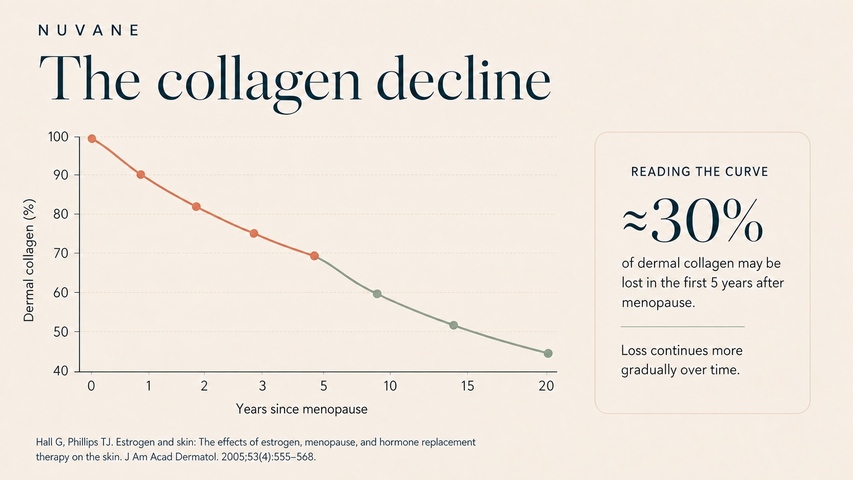
Yes, and unfortunately it is not beauty-marketing theater. Reviews of estrogen-deficient skin report that women can lose up to about 30% of dermal collagen in the first five years after menopause, followed by continued yearly decline after that. That drop helps explain the sudden “Where did my firmness go?” energy.
Why Does Stress Make Menopausal Skin Even Moodier?
What does stress do to skin during menopause?
Stress does not politely stay in the nervous system. It spills into the skin. Research shows psychological stress can impair epidermal barrier function, disturb healing, and worsen inflammatory signaling. In practical terms, stressed skin is often drier, slower to recover, and more reactive.
Does cortisol really affect collagen and repair?
Evidence supports the broader idea that stress-related glucocorticoid activity can interfere with repair pathways, inflammatory signaling, barrier recovery, and extracellular matrix function. That means your routine may work better when your skin is not being ambushed by chronic stress, poor sleep, and nonstop over-treatment.
What Should You Fix First When Menopausal Skin Starts Acting Different?
Why is the barrier the first priority?
Because a compromised barrier makes every other product feel louder, stingier, and less effective. Menopausal skin is often more vulnerable to moisture loss and irritation, so the barrier has to be the opening act, not the afterthought. Expert reviews on menopausal skin care emphasize gentle cleansing, avoiding irritants, and using products that support hydration and barrier integrity.
What does a barrier-first routine look like?
Keep it elegant, not chaotic:
- Use a gentle, non-stripping cleanser.
- Apply hydrating ingredients onto slightly damp skin.
- Lock that hydration in with a moisturizer.
- Be restrained with exfoliation.
- Wear sunscreen every morning, because UV remains one of the fastest ways to worsen pigment and collagen loss.
Think of it as rebuilding the walls before redecorating the penthouse.
Which Ingredients Actually Help Menopausal Skin Look Better?
Why do peptides matter more now?
Peptides are signaling molecules that can support the skin’s extracellular matrix, including collagen-related pathways. Reviews on anti-aging peptides note that certain topical peptides have shown benefits for wrinkles, firmness, and skin texture. For menopausal skin, that matters because the issue is not only dryness; it is structural decline.
How does stable vitamin C fit in?
Vitamin C is useful because it helps defend against oxidative stress and supports collagen-related skin benefits. Stable oil-soluble forms, including tetrahexyldecyl ascorbate, are increasingly discussed for their penetration and tolerability advantages in modern cosmetic formulations. That makes them especially appealing when skin is suddenly less tolerant of drama.
Is retinol still worth it during menopause?
Yes, usually, but with manners. Retinoids remain among the best-supported topical options for photoaging and wrinkle improvement, yet mature or menopausal skin may need slower introduction and better buffering to avoid irritation. The winning strategy is rarely “more.” It is “consistent enough to work, gentle enough to keep using.”
What if retinol feels too intense?
Bakuchiol is often discussed as a gentler option for people who want anti-aging support with better tolerability. In a randomized double-blind comparison, bakuchiol improved photoaging parameters with less scaling and stinging than retinol. It is not identical to retinol, but for sensitive skin, it can be a very attractive peace treaty.
Where do niacinamide and pigment correctors come in?
Niacinamide is valuable because it supports barrier function and can help improve uneven tone and overall skin quality. For spots and discoloration, ingredients such as alpha-arbutin are commonly used in brightening routines to target uneven pigmentation more gently than older, harsher approaches.
How Should You Build a Menopause-Friendly Routine Without Overdoing It?
What should the morning routine include?
Morning should be about defense and glow:
- gentle cleanse if needed
- antioxidant serum
- moisturizer if your skin wants it
- broad-spectrum sunscreen on face, neck, and chest
This is the shift from “treat everything at once” to “protect what you’re trying to preserve.” Antioxidant support plus daily sun protection is especially helpful for dullness, uneven tone, and collagen preservation.
What should the evening routine include?
Evening is when you earn your results:
- cleanse gently
- apply retinol or a gentler active a few nights a week
- increase slowly as tolerated
- moisturize generously
- use targeted pigment or eye products only where needed
That last point matters. Menopausal skin usually responds better to precision than to product pile-ons.
How Do You Handle Dark Spots, Thin Skin, and Tired Eyes?
Why are dark spots suddenly more obvious?
Because cumulative sun exposure, slower renewal, and hormonal shifts can all make uneven tone look more stubborn. Menopausal skin may also feel less luminous overall, so spots stand out more against a duller background.
What helps with tired-looking under-eyes?
The eye area is already thin, and with age it becomes less forgiving. A well-balanced eye treatment typically focuses on hydration, mild collagen support, and puffiness management rather than brute force. That means using active ingredients carefully and respecting the area’s lower tolerance threshold.
Can supplements help from the inside out?
Oral collagen peptides have some clinical support for improvements in skin elasticity and hydration in certain populations, although outcomes vary by formulation and study design. They are best viewed as supportive, not magical. Skin still needs topical care, sun protection, and a functioning barrier.
What Lifestyle Habits Keep Menopausal Skin From Sliding Into a Slump?
Does sleep matter that much?
Absolutely. Skin repair is not a daytime hobby. Poor sleep often overlaps with higher stress, worsened inflammation, and a more fatigued appearance. Menopause can disrupt sleep significantly, so treating sleep as part of skin care is less indulgence and more strategy.
Does exercise help skin?
Regular movement can support circulation, stress regulation, and overall metabolic health, which indirectly benefits skin. It is not a serum replacement, but it is one of the least glamorous and most effective beauty habits around.
What else supports the glow?
Eat enough protein, stay hydrated, keep alcohol modest if it worsens flushing or dehydration, and stop attacking your face with every trending acid on the internet. Menopausal skin tends to reward consistency over chaos.
Why Can a Personalized Routine Work Better Than a Generic One?
Why does personalization matter more during menopause?
Because menopausal skin does not read a script. One person’s main issue is dryness. Another’s is laxity. Another’s is pigmentation. Another’s is all three, plus sensitivity. A personalized routine lets you adjust active strength, frequency, and product mix to the skin you actually have, not the one a generic shelf assumes you have.
How does Nuvane approach this?
According to Nuvane’s project documentation, the brand positions its system around AI-driven customization, image-based skin analysis, and personalized treatment matching rather than one-size-fits-all routines. The documentation also describes a regimen that can include stable vitamin C, customized night treatments, targeted eye and pigment care, and optional marine collagen support.
What Makes Nuvane’s Ingredient Strategy Especially Relevant for Menopausal Skin?
Which science-backed ingredients stand out in the Nuvane documentation?
Nuvane’s project documentation and ingredient lists highlight a layered strategy built around SenoP3, retinol or bakuchiol options, stable vitamin C, niacinamide, hyaluronic acid, alpha-arbutin, marine algae, and marine collagen support. The internal materials describe SenoP3 as a tri-peptide complex built from palmitoyl tripeptide-38, acetyl hexapeptide-8, and copper tripeptide-1, aimed at wrinkle softening, firmness, and skin resilience.
Why is that ingredient mix well suited to this life stage?
Because menopausal skin rarely has just one complaint. It wants help with barrier stress, visible laxity, dullness, fine lines, uneven tone, and sometimes irritation all at once. In the uploaded ingredient list, Nuvane’s formulas combine structural-support ingredients like peptides with barrier and hydration helpers such as glycerin, ceramide NP, sodium hyaluronate, niacinamide, acetyl glucosamine, and soothing botanical extracts, while also offering targeted actives for brightness and renewal.
Which Nuvane options map best to common menopausal concerns?
From the uploaded materials:
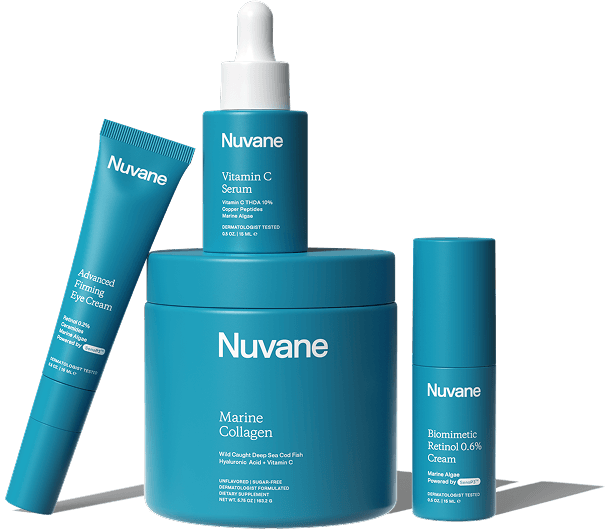
- the vitamin C serum uses tetrahexyldecyl ascorbate with barrier-supportive and antioxidant ingredients for morning brightness and defense
- the retinol creams offer two strength levels for different tolerance profiles
- the bakuchiol cream offers a gentler retinol-alternative path
- the dark spot corrector pairs pigment-focused ingredients with renewal support
- the eye cream targets firmness, fine lines, and the look of fatigue
- the marine collagen formula adds an inside-out support option
That is the real appeal here: not a single hero product, but a system designed to meet menopausal skin where it is on any given Tuesday.
What Should You Remember Most About Menopause and Skin?
What is the big-picture takeaway?
Menopause changes skin, but it does not doom it. The goal is not to fight your face like it betrayed you. The goal is to work with biology more intelligently: protect the barrier, support collagen, manage pigment, respect sensitivity, and stop confusing “strong” with “effective.”
Good skin in midlife is not about pretending hormones are not changing. It is about updating the routine so your skin has a better chance of thriving through the transition.
What Are the Most Common Questions About Menopausal Skin?
1. Does menopause always make skin dry?
Dryness is very common, but not universal. Lower estrogen is associated with reduced moisture retention and barrier changes, so many women notice more dryness than they did before.
2. Can you still use retinol during menopause?
Usually yes, but many people do better with lower frequency, lower strength, and stronger moisturization around it. Retinoids are effective, but menopausal skin may be less tolerant of aggressive use.
3. Is bakuchiol a good option for sensitive menopausal skin?
It can be. Clinical comparison data suggest bakuchiol can improve photoaging with fewer irritation complaints than retinol in some users.
4. Why do my dark spots look worse now?
Uneven tone can become more noticeable because of cumulative UV exposure, slower renewal, and lower overall radiance. Menopause can make the contrast more obvious even if the spots did not appear overnight.
5. Do peptides really do anything?
Some peptides have meaningful evidence for improving wrinkles, firmness, and skin texture, though not all peptide products are created equal. Formula design matters.
6. Can stress make skincare work less well?
Stress can impair barrier recovery, worsen inflammation, and affect repair pathways, so yes, chronically stressed skin may be harder to calm and improve.
7. Should you change your whole routine at menopause?
Not necessarily. Usually the smarter move is to simplify, strengthen the barrier, and upgrade your actives thoughtfully rather than throw everything out at once.
8. Is personalized skincare worth it in midlife?
It often is, because skin concerns become more varied and tolerance becomes more individual. Matching strength, frequency, and ingredient mix to the person can reduce irritation and improve consistency. Nuvane’s model is built around that premise.
Which References Support This Topic?
What does the evidence base include?
[1] Hall G, Phillips TJ. Estrogen and skin: the effects of estrogen, menopause, and hormone replacement therapy on the skin. J Am Acad Dermatol. 2005.
[2] Brincat M, et al. Skin collagen changes in postmenopausal women receiving different regimens of estrogen therapy. Obstet Gynecol. 1987.
[3] Duarte G, Trigo ACM, de Oliveira Filho J. Estrogen-deficient skin: the role of topical therapy. Int J Womens Dermatol. 2019.
[4] Nikolaidis A, et al. Skin, hair and beyond: the impact of menopause. Climacteric. 2022.
[5] Choi EH, et al. Psychological stress deteriorates skin barrier function by activating 11β-hydroxysteroid dehydrogenase 1 and the HPA axis. Sci Rep. 2018.
[6] Altemus M, et al. Psychological stress impairs epidermal permeability barrier homeostasis. Arch Dermatol. 2001.
[7] Berson DS, et al. Topical tretinoin for treating photoaging: a systematic review of randomized controlled trials. Clin Cosmet Investig Dermatol. 2022.
[8] Dhaliwal S, et al. Prospective, randomized, double-blind assessment of topical bakuchiol and retinol for facial photoageing. Br J Dermatol. 2019.
[9] Schagen SK. Topical peptide treatments with effective anti-aging results. Cosmetics. 2017.
[10] Sivamani RK, et al. Open-label topical application of tetrahexyldecyl ascorbate and acetyl zingerone for photoaging and pigmentation concerns. J Cosmet Dermatol. 2024.
What should readers also search for?
menopausal skin care, perimenopause skin changes, dry skin during menopause, collagen loss after menopause, best skin care for women over 50, retinol for menopausal skin, bakuchiol for mature skin, dark spots after menopause, peptides for mature skin, vitamin C for uneven tone, skin barrier repair in menopause, stress and skin aging
Which Other Nuvane Articles Should You Read Next?
What are four relevant follow-up reads?
- What’s the best anti-aging skincare routine if I want results?
- The complete guide to skin longevity ingredients
- How to build a skincare routine in 2026?
- Your best skin yet: the science of glowing through your 50s
Disclaimer: This article is for informational purposes only and is not medical advice. Persistent irritation, rapidly changing pigmentation, severe flushing, or other significant skin changes should be evaluated by a qualified healthcare professional.
Find the most effective anti-aging products for you by taking the free skin assessment.
Enjoyed this article? Add Nuvane as a preferred source on Google.