
Next-generation peptide complexes for skin longevity

Key points:
- Peptides work with your biology, not against it — they signal fibroblasts to produce more collagen and elastin rather than simply masking lines on the surface.
- Different peptides do different jobs — collagen-stimulating peptides rebuild structure, neuromodulating peptides soften expression lines, and copper peptides support repair and antioxidant defense.
- Combining them is more effective than using one alone — the SenoP3™ complex pairs Palmitoyl Tripeptide-38, Acetyl Hexapeptide-8 (Argireline), and Copper Tripeptide-1 (GHK-Cu) to target wrinkles, firmness, and skin resilience simultaneously.
- Results build over 8–12 weeks — expression lines can soften within 2–4 weeks, while deeper collagen remodeling continues over roughly three months of consistent use.
- Peptides suit most skin types and are generally well tolerated, making them a good option for people who can't use stronger actives every night.
What exactly are peptides, and why does your skin respond to them?
This section explains what peptides are at a biological level and why they penetrate and signal so effectively.
Peptides are short chains of amino acids — the same building blocks that make up larger proteins such as collagen, elastin, and keratin. In the skin, they function as natural messengers. When collagen breaks down with age or sun exposure, the resulting fragments act as signals, telling your fibroblasts (the cells that build connective tissue) that repair is needed. Synthetic peptides are designed to mimic these "repair" signals and deliver them on demand.
This is what separates peptides from many other ingredients. Rather than sitting on the surface and masking a concern, a well-formulated peptide talks to your cells and asks them to do more of what they did easily in your twenties. Because peptides are small, they can move through the skin barrier more readily than large intact proteins, which is why applying collagen directly to the skin does little while a matrikine-mimetic peptide can measurably shift collagen production.
The category has grown quickly for a simple reason: it is both effective and gentle. Peptides tend to be well tolerated even by sensitive or reactive skin, and they pair well with actives like retinol, vitamin C, and niacinamide. For anyone who wants science-backed results without the irritation that can come from stronger single ingredients, peptides have become a foundational tool.
Why is skincare shifting from "anti-aging" to "skin longevity"?
This section covers the market and mindset shift that has made multi-peptide complexes so relevant.
The way people think about aging skin is changing. For decades the goal was narrow — chase individual wrinkles. Today, both dermatologists and consumers are moving toward a skin longevity model that prioritizes keeping skin healthy, resilient, and functioning well over time rather than only softening lines after they appear.
That shift shows up across every age group. Mature consumers increasingly favor "slow-aging" routines that protect overall skin health. Younger consumers — Gen Z and Millennials — are moving from repair toward prevention, adopting peptides and antioxidants in their late twenties to preserve collagen before it declines. Across the board, there is growing demand for ingredients that support the skin's own processes and address the root causes of aging rather than surface symptoms.
At the same time, buyers now expect proof. Vague promises no longer sell; people want clinical data, transparent ingredient lists, and clean, sustainable formulations. This is where next-generation peptide complexes fit so naturally — they are grounded in published mechanisms, they can be formulated cleanly, and lab-synthesized peptides carry a smaller environmental footprint than many traditionally sourced actives.
What is SenoP3™, and how is it different from a single peptide?
This section introduces Nuvane's proprietary complex and explains the logic of combining three peptides.
SenoP3™ is Nuvane's proprietary triple-peptide complex, built on a simple idea: skin aging happens on several fronts at once, so the most effective response should too. Instead of relying on one peptide, SenoP3™ combines three complementary ones — Palmitoyl Tripeptide-38, Acetyl Hexapeptide-8 (Argireline), and Copper Tripeptide-1 (GHK-Cu) — each chosen for a distinct, well-researched mechanism.
Think of it as addressing three questions your aging skin is asking. How do I rebuild lost structure? How do I stop etching in new expression lines? How do I repair and defend myself day to day? Each peptide in the trio answers one of those questions, and together they cover far more ground than any single ingredient could on its own.
How does Palmitoyl Tripeptide-38 rebuild the skin's scaffold?
Palmitoyl Tripeptide-38 — known commercially as Matrixyl Synthe'6® — is a matrikine-mimetic signal peptide. It mimics natural matrix messengers that instruct fibroblasts to rebuild the extracellular matrix (ECM), the support network that keeps skin firm and smooth. It is designed to stimulate six key building blocks: collagen types I, III, and IV, plus fibronectin, laminin-5, and hyaluronic acid.
The laboratory data behind it is striking. In vitro studies reported increases of roughly 105% for collagen I, 104% for collagen III, and 42% for collagen IV after five days of twice-daily application. In a placebo-controlled study of 25 women aged 42 to 70 who applied a 2% concentration twice daily for two months, forehead wrinkle volume and depth fell by about 31% and 16% respectively. On your face, that better "support architecture" translates into improved firmness, smoother texture, and reduced wrinkle depth with consistent use.
How does Acetyl Hexapeptide-8 (Argireline) soften expression lines?
Acetyl Hexapeptide-8, better known as Argireline, works through a completely different route. It mimics part of SNAP-25, a protein in the SNARE complex that helps nerve endings release the neurotransmitters that trigger muscle contraction. By gently interfering with that release machinery, it reduces the repetitive micro-contractions that etch crow's feet, forehead lines, and frown lines over time.
In clinical testing, a 5% Argireline formulation reduced wrinkle depth by roughly 17% after about 15 days, with the optimal cosmetic range generally placed between 5% and 10%. Importantly, topical Argireline is not an injectable neuromodulator — it won't "freeze" the face. Instead it delivers a subtle, cumulative smoothing effect, and because it acts on muscle signaling rather than collagen synthesis, it tends to show visible results faster than the other peptides in the trio.
How does Copper Tripeptide-1 (GHK-Cu) support repair and resilience?
Copper Tripeptide-1, or GHK-Cu, is the "recovery" arm of the complex. It delivers copper ions that are essential for lysyl oxidase, the enzyme that cross-links collagen and elastin fibers to give skin its strength and bounce-back. Beyond that, GHK-Cu is one of the most studied regenerative peptides in dermatology, with published work linking it to wound-repair signaling, antioxidant defense, and gene-expression patterns associated with healthy tissue maintenance.
In a well-known comparison study, a GHK-Cu cream increased collagen in 70% of treated women — outperforming both vitamin C cream (50%) and retinoic acid (40%) in that trial. Its dual role — strengthening the existing matrix while supporting the skin's repair machinery — makes it the natural complement to the structure-building and line-relaxing peptides alongside it.
Why is a multi-peptide complex more effective than a single peptide?
This section explains the synergy that makes SenoP3™ more than the sum of its parts.
Skin aging is not one process but several overlapping ones — ECM breakdown, weakening of the dermal-epidermal junction, repetitive expression creasing, and declining repair capacity. Targeting only one of these leaves the others unaddressed. A single collagen-stimulating peptide can rebuild structure but does nothing for expression lines; a neuromodulating peptide can soften movement lines but won't strengthen the matrix underneath.
SenoP3™ is designed around that reality. Argireline calms expression-driven creasing, Palmitoyl Tripeptide-38 rebuilds the collagen and hyaluronic acid scaffold, and GHK-Cu reinforces and repairs — three mechanisms working in parallel. The result is a coherent strategy that both softens existing signs of aging and helps prevent new ones, which mirrors the modern understanding that lasting results require intervention at multiple levels rather than a single surface fix.
There is also a practical benefit to this approach: each peptide can be used at a sensible, well-tolerated concentration while still contributing to the overall effect. You get broad coverage without piling on a single high-strength active that might irritate the skin.
How is SenoP3™ built into Nuvane's products?
This section connects the science above to the specific Nuvane formulations that use it.
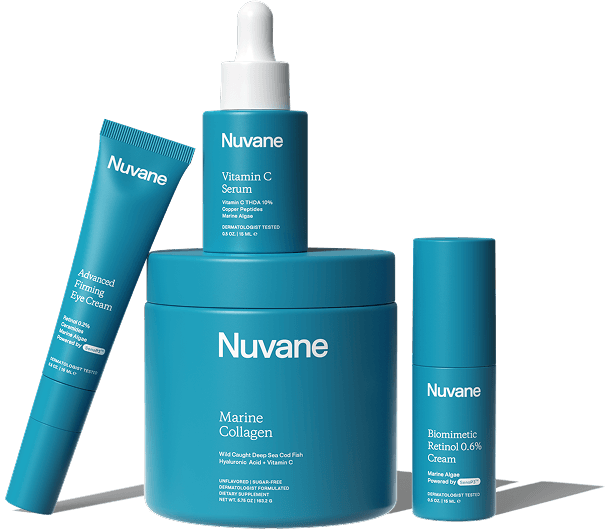
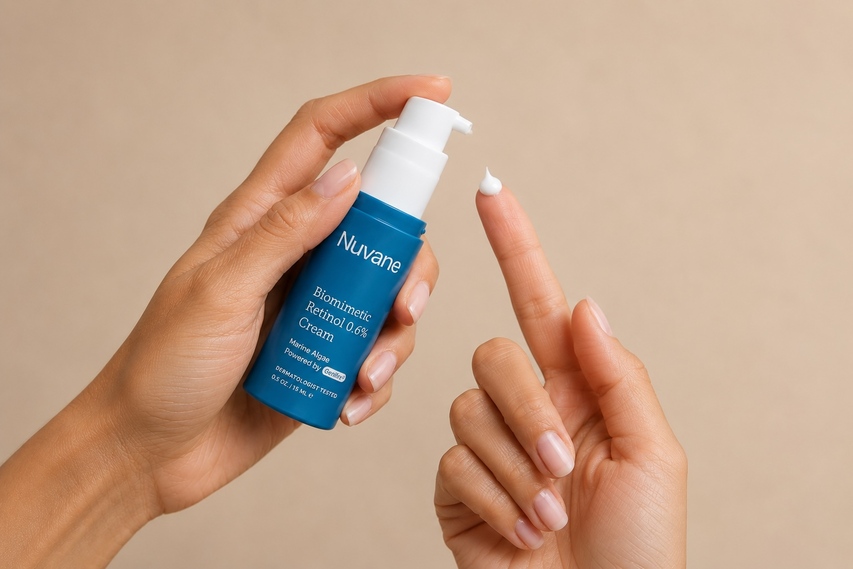
At Nuvane, SenoP3™ isn't a standalone serum — it's a core technology woven through the routine, paired with other evidence-based actives so the peptides work in a supportive environment. The Biomimetic Retinol Cream (available in 0.3% and 0.6% strengths) combines stabilized retinol with SenoP3™, niacinamide, trehalose, marine algae, and hyaluronic acid, so collagen-building retinoid activity and peptide signaling reinforce each other while humectants keep the barrier comfortable.
For those who prefer a retinol-free option, the Biomimetic Bakuchiol Cream pairs bakuchiol with peptides, a vitamin C derivative, Centella asiatica, and marine algae for a gentler route to firmer skin. The Regenerative Dark Spot Corrector brings SenoP3™ together with alpha arbutin, retinol, and niacinamide to target tone and texture at once, while the Firming Eye Cream uses a low-dose 0.2% retinol with SenoP3™ and caffeine for the delicate expression-line zones where Argireline's smoothing effect is most useful. Rounding out the system, the Advanced Vitamin C Serum (stable THD ascorbate with copper peptides and ceramides) and the Oral Marine Collagen Supplement support the skin from the outside and within. The philosophy throughout is consistent: use peptides as implementations of proven biology, formulated for tolerability and real-world results.
Key takeaways: what should you remember about peptides?
- Peptides are signals, not fillers — they instruct your skin to rebuild collagen and repair itself rather than masking concerns temporarily.
- The future is multi-peptide — complexes like SenoP3™ outperform single peptides by targeting structure, expression lines, and repair at the same time.
- Each peptide has a job — Palmitoyl Tripeptide-38 rebuilds the matrix, Argireline softens expression lines, and GHK-Cu strengthens and repairs.
- Consistency matters more than concentration — expect early smoothing in 2–4 weeks and meaningful firmness and wrinkle improvement around 8–12 weeks.
- Peptides play well with others — they layer safely with retinol, vitamin C, and niacinamide, and suit most skin types including sensitive skin.
What are the most common questions about peptides and SenoP3™?
Do topical peptides actually work, or is it marketing?
Well-formulated peptides have real, published evidence behind them — collagen-stimulating peptides like Palmitoyl Tripeptide-38 show measurable increases in matrix proteins and reductions in wrinkle depth in human testing. The key words are "well-formulated": concentration, stability, and delivery all matter, which is why a thoughtfully built complex outperforms a random peptide added for label appeal.
How long before I see results from a peptide complex?
Expression-line peptides like Argireline can produce visible smoothing within 2–4 weeks because they act quickly on muscle signaling. Collagen-building peptides work more slowly, with the most meaningful firmness and texture changes appearing around 8–12 weeks of consistent daily use.
Can I use peptides with retinol?
Yes, and they're a natural pairing. Retinol and peptides both support collagen through different mechanisms, so they complement each other well. If your skin is easily irritated, apply them on alternate nights or buffer with a moisturizer.
Is Argireline the same as Botox?
No. Argireline is a topical peptide that gently and gradually reduces the biochemical signaling behind repeated expression creasing. It produces a subtle, cumulative softening — it does not paralyze muscles or deliver the dramatic, immediate effect of an injectable neuromodulator.
Are copper peptides safe for sensitive skin?
Most people tolerate GHK-Cu well, and it's often chosen precisely because it's gentle and supports barrier repair. As with any active, tolerance depends on the overall formula and how many other actives you're layering, so a patch test is always sensible.
Can younger people use peptides preventively?
Absolutely. Because peptides support the skin's natural collagen and repair processes without harsh side effects, they're a sensible preventive choice from the late twenties onward — which is a big reason younger consumers are shifting from repair to prevention.
Do I apply peptides before or after moisturizer?
Generally apply peptide treatments to clean, dry skin, then follow with moisturizer. If you're sensitive, you can apply after a light moisturizer to buffer, accepting slightly reduced penetration in exchange for comfort.
References
- Skibska A, Perlikowska R. Signal Peptides — Promising Ingredients in Cosmetics. Curr Protein Pept Sci. 2021;22(10):716-728. PMID: 34382523
- Lintner K, Gerstein F. A serum containing vitamins C & E and a matrix-repair tripeptide reduces facial signs of aging. J Cosmet Dermatol. 2020;19(12):3262-3269. PMID: 33103342
- Blanes-Mira C, Clemente J, et al. A synthetic hexapeptide (Argireline) with antiwrinkle activity. Int J Cosmet Sci. 2002;24(5):303-310. PMID: 18498523
- Pickart L, Margolina A. Regenerative and Protective Actions of the GHK-Cu Peptide in the Light of New Gene Data. Int J Mol Sci. 2018;19(7):1987. PMID: 29986520
- Pickart L. The human tri-peptide GHK and tissue remodeling. J Biomater Sci Polym Ed. 2008;19(8):969-988. PMID: 18644225
- Reddy B, Jow T, Hantash BM. Bioactive oligopeptides in dermatology. Exp Dermatol. 2012;21(8):569-575. PMID: 22775993
- Errante F, Ledwoń P, et al. Cosmeceutical Peptides in the Framework of Sustainable Wellness. Front Chem. 2020;8:572923. PMID: 33195071
- Schagen SK. Topical Peptide Treatments with Effective Anti-Aging Results. Cosmetics. 2017;4(2):16.
- Farwick M, et al. Fifty-five-residue peptides and matrix stimulation in human skin (Matrixyl Synthe'6 data on file, Sederma). Int J Cosmet Sci. 2011.
- Gorouhi F, Maibach HI. Role of topical peptides in preventing or treating aged skin. Int J Cosmet Sci. 2009;31(5):327-345. PMID: 19570099
Related search terms
next-generation peptides skincare, best multi-peptide complex, SenoP3 peptide complex, Palmitoyl Tripeptide-38 benefits, Matrixyl Synthe'6 results, Argireline vs Botox, copper peptides GHK-Cu for skin, peptides for collagen production, do peptides work for wrinkles, peptides vs retinol, best anti-aging peptides 2026, peptides for skin longevity, how long do peptides take to work, peptide serum for fine lines, biomimetic peptides skincare
Find the most effective anti-aging products for you by taking the free skin assessment.
Recommended ReadMore info:
- Best copper peptides (GHK-Cu) for aging skin and hair?
- Best biomimetic peptides vs. traditional anti-aging
- Can topical Argireline really mimic Botox?
- SenoP3™: a breakthrough in skincare and longevity
- What are the most asked questions about Nuvane ingredients?
Find the most effective anti-aging products for you by taking the free skin assessment.
Enjoyed this article? Add Nuvane as a preferred source on Google.