
Why are Gen Z and Millennials shifting from repair to prevention?


Key takeaways:
- Prevention feels safer than repair for Gen Z and Millennials: fewer “fix-it-later” surprises, more daily control.
- Ingredient literacy is up—people want mechanisms (barrier, pigment, collagen signals), not vague “glow.”
- Social media accelerated the shift—but it also created overuse problems (too many actives, not enough sunscreen).
- The smartest prevention routine is simple and consistent: sunscreen + antioxidant support + a tolerable night signal (retinoid or retinoid-alternative) + peptides where they make sense.
Why are Gen Z and Millennials shifting from repair to prevention?
Quick answer: Because prevention fits how younger consumers think about wellness: small habits now to avoid bigger interventions later. Add ingredient literacy (people want how it works), social media’s “start early” messaging, and the reality that UV damage and inflammation compound over time—and you get a generation prioritizing prevention over repair.
Prvenetion and longevity skincare are here to stay:
- Prejuvenation is preventative aging care, not panic-aging care: it’s about supporting skin function early and consistently.
- “Collagen banking” is a metaphor, not a literal collagen savings account—protect + signal + repeat is the real strategy.
- The barrier era is here: younger users are learning that irritated skin doesn’t “age better,” it just complains louder.
- Sunscreen is the main character—many social routines still underuse it, which is the plot twist nobody asked for.
What does “repair versus prevention” actually mean in skincare terms?
Repair-focused skincare is what you do when the concern is already established: visible lines that stick around, persistent uneven tone, rough texture and laxity.
Prevention-focused skincare (often called prejuvenation) is what you do earlier: protect from avoidable damage (UV and oxidative stress), keep the barrier steady, and use well-studied signals to support long-term texture and firmness—before concerns fully settle in.
Why does prevention feel more “wellness-coded” to Gen Z and Millennials?
Younger demographics grew up with the language of compounding habits: movement, sleep, hydration, strength training, mental health hygiene—little things done consistently. Skincare slid neatly into that category.
Prevention skincare offers:
- Predictability: fewer “surprise” changes later
- Control: daily actions feel empowering (and trackable)
- Identity: routines are part self-care, part community, part content
And yes, it also offers the dopamine hit of “I’m doing something.” (As long as that something isn’t using nine actives at once.)
How did social media turn prevention into the default setting?
Social platforms made skincare education wildly accessible—fast, visual, and relentlessly repeated. Research and commentary also point out a downside: many popular routines are complicated, pricey, and potentially irritating, with sunscreen often missing from daytime steps.
So social media did two things at once:
- Normalized prevention (start earlier, protect more)
- Normalized overdoing it (stacking actives because “more steps = more results”)
Prevention is the good part. Overuse is the cautionary subplot.
Why is ingredient literacy pushing younger consumers toward prevention?
Today’s shoppers don’t just ask “Will this make me glow?”
They ask:
- What supports the skin barrier?
- What reduces oxidative stress?
- What influences collagen signaling or dermal remodeling?
- What helps regulate pigment without triggering irritation?
This is exactly why prevention is winning: mechanisms like barrier support and UV defense are meaningful even when you’re not trying to “fix” something dramatic.
It’s also why terms like “prejuvenation” and “collagen banking” became popular—these labels package complex biology into a simple storyline.
What is collagen banking and why does it show up in the prevention conversation?
“Collagen banking” is often described as protecting collagen early and supporting collagen-friendly signals over time. Some industry coverage frames it as maintaining collagen during peak collagen years, while other coverage critiques the term as more marketing than science if taken literally.
Here’s the evidence-aligned interpretation:
- You can’t stockpile collagen like a pantry item.
- You can protect what you have (especially from UV) and support healthier remodeling signals with sustained habits.
Collagen banking, when it’s not being dramatic, is basically: protect + signal + repeat.
Why does prevention hit differently for the face, neck, and chest?
The neck and chest often show aging sooner because they’re:
- Heavily sun-exposed
- Lower in oil gland density than the face
- Commonly skipped in daily SPF and active steps
Prevention-minded users are finally connecting the dots: if you’re doing a beautiful routine from forehead to chin, but ignoring the neck and chest, the contrast will eventually become… noticeable. (And not in a fun way.)
Which prevention ingredients are the most evidence-aligned?
Why are retinoids considered prevention cornerstones?
Retinoids have deep clinical history for improving features of photoaged skin, supporting dermal remodeling, and improving the appearance of fine lines and texture over time with sustained use. [1–4,8]
How do peptides fit into prevention routines?
Peptides are short amino acid chains that can act as signals; some topical peptides have literature support for anti-aging outcomes depending on peptide type and formulation. [5–7,9]
Why do antioxidants matter so much in prevention?
Oxidative stress contributes to visible photoaging, and antioxidants are widely discussed for their preventive value (especially alongside UV protection). [10]
What does a realistic prevention routine look like for Gen Z and Millennials?
What is the simplest prevention morning routine?
- Gentle cleanse (or rinse)
- Antioxidant step (vitamin C or another well-tolerated antioxidant)
- Moisturizer (optional)
- Broad-spectrum sunscreen (face + neck + chest)
What is the simplest prevention night routine?
- Cleanse
- “Signal” nights: retinoid 2–3 nights/week to start, then build
- “Reset” nights: barrier moisturizer; optional peptides
This style also helps reduce irritation from over-stacking actives—an issue flagged in social-media-driven routines. (theguardian.com)
What mistakes make prevention backfire for younger skin?
Why is doing too much too soon the number one mistake?
Because inflamed, chronically irritated skin is not a prevention flex—it’s a barrier breakdown. And barrier breakdown can mean more sensitivity, more redness, and a routine you quit because it feels like punishment.
Why does skipping sunscreen undo the whole strategy?
Because UV exposure is one of the biggest accelerators of visible aging and collagen breakdown pathways. Sunscreen is the keystone habit; everything else is scaffolding.
Why can prevention trends turn into perfection pressure?
Some reporting and research note that youth skincare content can reinforce unrealistic ideals and encourage excessive routines with little benefit. (theguardian.com)
Prevention should feel like self-care—not self-surveillance.
How long does prevention take to show results?
- 2–4 weeks: hydration consistency, smoother feel, brighter look (often from consistency + antioxidants)
- 6–12 weeks: more realistic visible texture and fine-line changes (especially with retinoids/peptides) [1–4,8–9]
- 3–12 months: the compounding payoff—fewer new lines settling in, better resilience, more even tone with consistent SPF + actives
What are the most common FAQs about shifting from repair to prevention?
Is prevention skincare only for people in their 20s?
No. Prevention helps at any age because you’re always protecting skin from avoidable stressors.
Do I need a retinoid if I’m focusing on prevention?
Not strictly, but retinoids have strong support for long-term texture and fine-line improvement with sustained use. [1–4,8]
Can peptides replace retinoids?
They can complement retinoids, and some people prefer peptides when they’re reactive. But “replace” is a stretch—retinoids have deeper clinical history. [1–4,8–9]
What’s the safest “prevention starter pack”?
Sunscreen daily + gentle cleanser + simple moisturizer + one antioxidant. Add stronger actives slowly.
Why does my skin get irritated when I try prevention routines from social media?
Because many routines layer multiple actives and fragrances, and some content underuses sunscreen—leading to irritation or sensitization. (theguardian.com)
Should teens be using strong anti-aging actives?
Often unnecessary. A simpler routine (gentle cleansing + sunscreen) is frequently more appropriate for very young skin; overuse can irritate. (theguardian.com)
How do I know if prevention is “working” if I’m not fixing a big problem?
Look for fewer new concerns developing, steadier tone and texture, and less sensitivity over time—not just next-day “plump.”
Is collagen banking real or marketing?
As a literal concept, it’s easy to overstate. As a metaphor for protecting collagen and supporting healthy signals early, it can be a useful routine framework.
How does Nuvane support a prevention-first mindset?
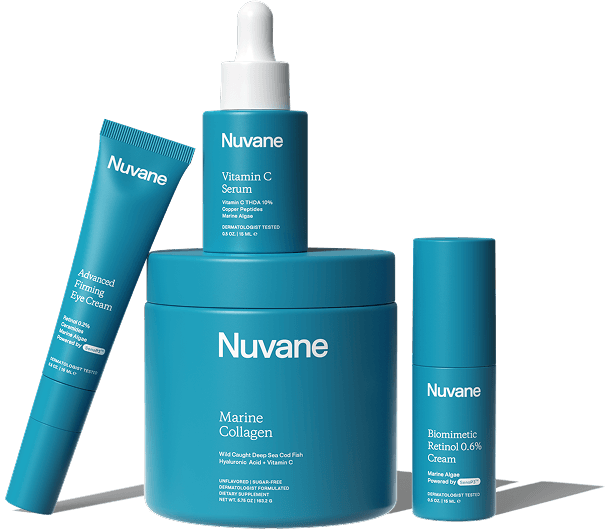
Nuvane is a skincare system featuring AI-driven personalization, a proprietary anti-aging complex (SenoP3), and a routine that includes a morning serum and night creams (retinol- and bakuchiol-based), plus optional targeted products and an inside-out supplement approach.
What is SenoP3 and why does it fit prevention?
SenoP3 is a triple-peptide complex combining Palmitoyl Tripeptide-38, Acetyl Hexapeptide-8, and Copper Tripeptide-1, positioned to stimulate collagen/elastin, relax expression lines, and support repair for firmer texture.
The SenoP3 comparison deck also presents wrinkle depth and firmness outcomes over an 8-week window (as stated in the materials).
Which Nuvane ingredients align with prevention searches?
From the ingredient list document and the Nuvane deck, prevention-aligned pillars include:
- Retinol options (0.3% and 0.6%) with peptide support and barrier-friendly components
- Bakuchiol as a retinoid-alternative pathway for sensitive users
- Stable vitamin C (Tetrahexyldecyl Ascorbate) plus ceramide support and copper peptide inclusion in the morning serum concept
- Marine algae (Fucus Vesiculosus extract) positioned for antioxidant/soothing support
More info:
- How to Start Retinol Without Irritation
- Prejuvenation Routine Basics for Busy People
- Peptides Explained: What SenoP3 Signals and Why It Matters
- Neck and Chest Skincare: The Prevention Zone Everyone Forgets
References:
- Kafi R, et al. Improvement of naturally aged skin with vitamin A (retinol). Arch Dermatol. 2007;143(5):606–612.
- Fisher GJ, et al. Long-term treatment of photoaged human skin with topical retinoic acid improves epidermal atypia and thickens collagen band in papillary dermis. J Am Acad Dermatol. 2005;53(5):769–774.
- Mukherjee S, et al. Retinoids in the treatment of skin aging: an overview of clinical efficacy and safety. Clin Interv Aging. 2006;1(4):327–348.
- Griffiths CEM, et al. Molecular and clinical changes in photoaged skin after topical retinoic acid. N Engl J Med. 1993;329:530–535.
- Pickart L, Thaler MM. Growth-modulating tripeptide (GHK) and its copper complex. Proc Natl Acad Sci U S A. 1980;77(7):4586–4590.
- Maquart FX, et al. Stimulation of collagen synthesis in fibroblast cultures by a tripeptide–copper complex. FEBS Lett. 1993;238(2):343–346.
- Blanes-Mira C, et al. A synthetic hexapeptide with antiwrinkle activity. Int J Cosmet Sci. 2002;24(5):303–310.
- Lupo MP, Cole AL. Cosmeceutical peptides: mechanisms of action and application. Dermatol Ther. 2007;20(5):343–349.
- Burke KE. Photoaging: the role of oxidative stress and the value of antioxidants in prevention and treatment. J Drugs Dermatol. 2012;11(7):742–747.
- Gilchrest BA. Skin aging and photoaging: an overview. J Am Acad Dermatol. 1989;21(3 Pt 2):610–613.
Find the most effective anti-aging products for you by taking the free skin assessment.
Enjoyed this article? Add Nuvane as a preferred source on Google.