
Why Your Wrinkle Routine Stopped Working After 45


You wear sunscreen every morning. You drink your water. You bought the vitamin C serum, the drugstore retinol, maybe a collagen powder too. And yet the lines around your eyes, across your forehead, and between your brows look deeper this year than last.
You didn't do anything wrong. Your skin changed the rules. Somewhere in your mid-40s, wrinkles stop being a single-cause problem and become a multi-pathway one, and a routine built for 35-year-old skin can't keep up. Here's what's happening underneath, and what a 12-week clinical study showed about a routine designed for skin over 45.
Key Takeaways
- After about age 45, wrinkles are driven by several pathways at once: slowing collagen production, accumulating senescent ("zombie") cells, falling estrogen, glycation, and repeated muscle movement.
- Adult skin loses roughly 1% of its dermal collagen per year, and women can lose up to 30% of skin collagen in the first five years after menopause [3][4].
- Most routines target only one or two of these pathways, which is why results plateau even when you're consistent.
- Multi-target formulas that combine a retinoid with signaling, copper, and neuro-relaxing peptides address more of the wrinkle biology at the same time.
- In a 12-week IRB-supervised study of Nuvane's AI-matched SenoP3™ regimen in women aged 35–65, 86.8% showed expert-graded improvement in fine lines, with 0% worsening [11].
Why do wrinkles suddenly get worse after 45?
This section explains the biological shift that happens in your mid-40s and why it changes what your skin needs.
Wrinkles get noticeably worse after 45 because several aging processes that were running quietly in your 30s and early 40s reach a tipping point together. Collagen production slows, the cells that make collagen become less responsive, and hormonal support for skin begins to decline. The result is thinner, less elastic skin that can no longer bounce back from the creases you make every day.
Collagen is the protein scaffold of your dermis, the deeper layer of skin that gives it thickness and firmness. Classic research shows that dermal collagen declines by roughly 1% per year in adulthood [3]. That sounds small, but by your early 40s it adds up to a meaningful loss of structural support. At the same time, fibroblasts (the collagen-producing cells) become less active and produce less new collagen in response to the same signals [2].
Your mid-40s are also when perimenopause is in full swing for most women. Estrogen helps maintain skin thickness, collagen content, and hydration. Once it starts to fluctuate and fall, collagen loss accelerates sharply. Studies estimate that women lose about 30% of skin collagen in the first five years after menopause [4], and the slide often starts years earlier.
Layer on top of this decades of cumulative UV exposure, which breaks down collagen through enzymes called matrix metalloproteinases (MMPs) [8], and you can see why lines that once faded overnight start to stay.
What does "doing everything right" actually cover?
Here we look at the typical good-skin routine and which aging pathways it does and doesn't reach.
A typical "good" routine covers protection and hydration well, but often only lightly touches repair and renewal. That gap is exactly where wrinkles over 45 come from. Each habit you've built is valuable, but each one addresses a single piece of the puzzle.
- Daily sunscreen prevents new UV damage, which is essential, but it doesn't rebuild collagen you've already lost.
- Hydrating serums and moisturizers plump the surface temporarily, softening the look of fine lines for hours rather than remodeling the dermis.
- Vitamin C offers strong antioxidant protection and supports collagen synthesis, but on its own it's one signal among many.
- A low-strength or unstable drugstore retinol can help, but many formulas lose potency with air and light exposure, or are used too inconsistently to remodel collagen.
- Good sleep and nutrition support repair, but they can't fully offset hormonal and cellular changes.
The common thread is that each step targets one mechanism. After 45, wrinkle formation runs on at least five mechanisms simultaneously. A routine that addresses one or two will produce some improvement, then plateau, which is exactly the "I'm doing everything and nothing's changing" experience so many of my patients describe.
What are the 5 biological drivers behind wrinkles after 45?
This section breaks down the specific mechanisms that a complete wrinkle routine needs to address.
Wrinkles after 45 come from five overlapping drivers: collagen decline, cellular senescence, hormonal change, glycation, and repetitive muscle contraction. Understanding each one makes it clear why a single active ingredient rarely produces dramatic results at this stage.
1. Slowing collagen and elastin production
Fibroblasts in aging skin produce less collagen and elastin and respond less to growth signals [2]. The dermis gradually thins, and fine lines deepen into set wrinkles. Ingredients that "re-signal" fibroblasts, like retinoids and signal peptides, target this driver directly.
2. Senescent ("zombie") cells
Senescent cells are cells that have stopped dividing but don't die off. Instead, they release inflammatory signals (the senescence-associated secretory phenotype, or SASP) that break down surrounding collagen and age neighboring cells [7]. Their numbers rise with age, contributing to a low-grade, chronic inflammation known as inflammaging.
3. Hormonal shifts
Declining estrogen reduces collagen production, skin thickness, and moisture retention [4]. This is why many women notice their skin seems to "age overnight" in their 40s, even when nothing else in their routine has changed.
4. Glycation
Glycation happens when sugars bind to collagen fibers, forming advanced glycation end products (AGEs). These stiffen collagen and make it brittle, reducing the skin's ability to spring back. Glycation accumulates over decades and becomes more visible after 40.
5. Repetitive muscle movement
Every smile, squint, and frown folds the skin. In younger skin, these creases disappear. Once collagen and elastin decline, the folds etch in as expression lines: crow's feet, forehead lines, and the "11s" between the brows. Neuro-relaxing peptides such as Acetyl Hexapeptide-8 soften this muscle-driven component [6].
Which ingredients actually reduce wrinkles in skin over 45?
Here's what the evidence supports for each wrinkle driver, and why combinations outperform single actives.
The ingredients with the strongest evidence for reducing wrinkles in mature skin are retinoids, peptides (especially copper and signal peptides), and bakuchiol for those who prefer a retinol alternative. The key insight is that they work through different pathways, so combining them addresses more of the wrinkle biology at once.
Retinol: the collagen re-builder
Retinol remains the most studied over-the-counter anti-wrinkle ingredient. In a landmark randomized trial, 0.4% retinol applied to naturally aged skin significantly reduced fine wrinkles and increased collagen and glycosaminoglycan production after 24 weeks [1]. Retinoids work by binding nuclear receptors that switch on collagen genes and switch off collagen-degrading enzymes [9]. Stability and the right concentration matter: a well-stabilized 0.3%–0.6% retinol delivers meaningful results with good tolerability.
Copper Tripeptide-1 (GHK-Cu): the repair signal
GHK-Cu is a naturally occurring peptide whose levels fall with age. It stimulates collagen and elastin synthesis, supports wound repair, and has antioxidant and anti-inflammatory activity [5]. Gene-expression research shows GHK-Cu can shift the activity of thousands of genes toward a more youthful, regenerative pattern [5].
Palmitoyl Tripeptide-38: the matrix builder
Palmitoyl Tripeptide-38 is a signal peptide that stimulates key components of the skin matrix, including several collagen types and hyaluronic acid. Signal peptides as a class have shown measurable improvements in wrinkle depth in controlled studies [10].
Acetyl Hexapeptide-8: the expression-line softener
Also known as Argireline, Acetyl Hexapeptide-8 interferes with the nerve signals that trigger muscle contraction, softening expression lines. In its original study, a 10% concentration reduced wrinkle depth by up to 30% after 30 days [6].
Bakuchiol: the gentle alternative
For sensitive skin, pregnancy-conscious users, or anyone who can't tolerate retinol, bakuchiol offers retinol-like benefits. A randomized, double-blind trial found bakuchiol and retinol produced comparable improvements in wrinkles and hyperpigmentation over 12 weeks, with less scaling and stinging for bakuchiol [12].
Why does a multi-pathway approach work better than one strong ingredient?
This section explains why stacking complementary mechanisms produces results that single actives can't.
A multi-pathway approach works better because wrinkles over 45 are a multi-cause problem. A high-strength retinol can rebuild collagen, but it does nothing for muscle-driven expression lines. A neuro-peptide softens expression lines but doesn't remodel the dermis. Combining them covers both, and adding repair and antioxidant peptides addresses inflammation and senescence-related damage.
There's also a tolerability advantage. Pushing a single ingredient harder, such as jumping to a high-strength retinoid, often brings irritation, peeling, and redness that make people stop. Pairing a moderate, well-stabilized retinol with supportive peptides, niacinamide, and barrier-strengthening ingredients lets you get broad results while staying consistent, and consistency is what remodels collagen over months.
Finally, not every face needs the same formula. Skin type, sensitivity, tone, and the specific aging signs you're seeing all change which combination works best. That's why personalization matters as much as the ingredients themselves.
Why is Nuvane the solution for wrinkles after 45?
This section connects the science above to Nuvane's formulas and the clinical study behind them.
Nuvane was built around one idea: skin over 45 needs a routine that targets multiple aging pathways at once, matched to the individual. Every core Nuvane treatment is built on SenoP3™, a proprietary triple-peptide complex, combined with a clinically proven active and barrier-supporting ingredients.
What is SenoP3™ and how does it target wrinkles?
SenoP3™ combines three peptides, each addressing a different wrinkle driver:
- Palmitoyl Tripeptide-38 stimulates collagen and hyaluronic acid production to rebuild the dermal matrix.
- Copper Tripeptide-1 (GHK-Cu) supports collagen and elastin synthesis and provides antioxidant, anti-inflammatory protection against inflammaging.
- Acetyl Hexapeptide-8 relaxes the muscle contractions that etch in expression lines.
Paired with retinol or bakuchiol, SenoP3™ creates a routine that remodels collagen, calms inflammation, and softens expression lines at the same time.
Which Nuvane products are designed for wrinkles?
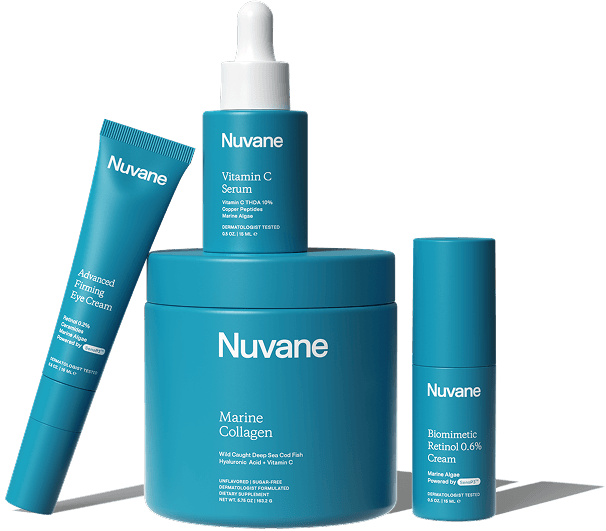
- Biomimetic Retinol Cream (0.3% or 0.6%): stabilized retinol + SenoP3™ + niacinamide, trehalose, marine algae, and hyaluronic acid. The core nightly collagen-rebuilding treatment.
- Biomimetic Bakuchiol Cream: a retinol-free option combining bakuchiol, peptides, a vitamin C derivative, Centella asiatica, and marine algae, ideal for sensitive skin.
- Firming Eye Cream: 0.2% retinol + SenoP3™ + caffeine + ceramides, formulated for crow's feet and under-eye lines.
- Advanced Vitamin C Serum: lipid-soluble THD ascorbate + copper peptides + ceramides for daytime antioxidant protection and collagen support.
- Oral Marine Collagen Supplement: hydrolyzed marine collagen + hyaluronic acid + vitamin C to support skin from within.
What did the Nuvane clinical study show?
Nuvane's AI-personalized SenoP3™ regimen was evaluated in a 12-week, IRB-supervised clinical study conducted by SGS (Protocol C25-D123) and presented at the EADV Symposium in Athens (May 2026) [11]. The study enrolled ethnically diverse women aged 35–65 (Fitzpatrick skin types II–VI). Each participant was assigned a night cream by Nuvane's AI skin assessment (0.3% retinol, 0.6% retinol, or bakuchiol, each with SenoP3™) plus the Firming Eye Cream. Results were graded by a blinded board-certified expert grader.
Key wrinkle-related results at week 12 (per-protocol, n=38):
- 86.8% showed expert-graded improvement in global fine lines, and 0% worsened.
- Fine lines improved by an average of 12.7% on expert grading, a statistically significant change.
- 86.8% showed improved cheek smoothness.
- 12 of 13 expert-graded parameters reached statistical significance as early as week 4.
- 84.2% of participants reported improvement in fine lines, and 81.6% reported improved firmness and elasticity.
- 91.2% of those with prior anti-aging experience said the regimen worked better than products they had used before.
- 94.7% reported overall satisfaction, with no serious adverse events and 100% rating the products comfortable to apply.
That sixth result speaks directly to the experience behind this article. Most of these women had already "done everything right." When their routine was matched to their skin and built on multiple pathways, more than nine in ten saw a difference they hadn't gotten before.
Find your personalized match by taking the free skin assessment.
What should your wrinkle routine look like after 45?
A simple framework that covers all five wrinkle drivers without overloading your skin.
An effective routine after 45 doesn't need ten steps. It needs the right steps, each doing a different job.
Morning
- Gentle cleanser
- Advanced Vitamin C Serum for antioxidant protection and collagen support
- Moisturizer
- Broad-spectrum SPF 30+ (non-negotiable)
Evening
- Gentle cleanser
- Biomimetic Retinol Cream (or Bakuchiol Cream for sensitive skin) on the face, neck, and décolleté
- Firming Eye Cream around the orbital bone and crow's feet area
Daily
- Oral Marine Collagen Supplement to support skin from within
What results can you expect, and when?
- Weeks 1–4: Improved hydration, smoother texture, and early softening of fine lines. In the Nuvane study, most expert-graded parameters reached significance by week 4.
- Weeks 4–8: Visible reduction in fine lines and more even tone as collagen remodeling begins.
- Weeks 8–12: Greater firmness, elasticity, and smoother expression lines.
- Months 4–12: Continued collagen building with consistent use.
Key Takeaways: Summary
- Your routine didn't fail you; your skin's needs changed. After 45, wrinkles come from at least five overlapping pathways.
- Sunscreen, hydration, and vitamin C are essential but mostly protect; they don't fully rebuild lost collagen or soften expression lines.
- Combine a stabilized retinoid (or bakuchiol) with targeted peptides to remodel collagen, calm inflammaging, and relax expression lines together.
- Personalization improves results: strength and formula should match your skin type and sensitivity.
- Nuvane's SenoP3™ regimen delivered expert-graded fine-line improvement in 86.8% of women in a 12-week clinical study, with 91.2% rating it better than prior anti-aging products.
- Give it 12 weeks of consistent use to see the full effect.
FAQs
Why did my wrinkles get worse even though my skincare routine stayed the same?
Your skin's biology changed even though your routine didn't. In your 40s, collagen production slows, senescent cells accumulate, and estrogen begins to decline, all of which accelerate wrinkle formation. A routine that kept you looking great at 32 may simply not target enough of these pathways anymore.
At what age should I start using retinol for wrinkles?
Many dermatologists recommend starting a retinoid in your late 20s to mid-30s for prevention. If you're over 45 and haven't started, it's absolutely not too late. Studies show retinol improves wrinkles and boosts collagen even in significantly aged skin [1].
Is 0.3% or 0.6% retinol better for wrinkles over 40?
It depends on your skin's tolerance and how deep your lines are. A 0.3% retinol is a good starting point for first-time or sensitive users, while 0.6% suits experienced users with more established wrinkles. Nuvane's skin assessment recommends the right strength for you, which is how participants in the clinical study were matched.
Do peptides really work for wrinkles?
Yes, specific peptides have clinical evidence behind them. Copper Tripeptide-1 (GHK-Cu) supports collagen and elastin synthesis [5], signal peptides improve wrinkle depth [10], and Acetyl Hexapeptide-8 has been shown to reduce expression-line depth [6]. They work best in combination with a retinoid.
Can I use retinol and peptides together?
Yes. Retinol and peptides work through complementary pathways and pair well. Nuvane's Biomimetic Retinol Cream combines both in a single formula, along with niacinamide and hyaluronic acid to support the skin barrier and reduce irritation.
What's the best wrinkle treatment if I have sensitive skin?
Bakuchiol is an excellent choice. In a 12-week randomized trial, bakuchiol improved wrinkles comparably to retinol with less stinging and scaling [12]. Nuvane's Biomimetic Bakuchiol Cream pairs bakuchiol with peptides and soothing Centella asiatica.
How long does it take to see results on wrinkles?
Most people notice smoother texture and hydration within 2–4 weeks, with visible fine-line improvement by 8–12 weeks. In Nuvane's 12-week study, 12 of 13 expert-graded parameters reached significance by week 4, and 86.8% showed fine-line improvement by week 12.
Does menopause make wrinkles worse?
Yes. Estrogen supports collagen, skin thickness, and hydration, and women can lose about 30% of skin collagen in the first five years after menopause [4]. A routine that combines collagen-stimulating actives with barrier support helps offset these changes.
References
- Kafi R, Kwak HS, Schumacher WE, et al. Improvement of naturally aged skin with vitamin A (retinol). Archives of Dermatology. 2007;143(5):606–612.
- Varani J, Dame MK, Rittie L, et al. Decreased collagen production in chronologically aged skin: roles of age-dependent alteration in fibroblast function and defective mechanical stimulation. American Journal of Pathology. 2006;168(6):1861–1868.
- Shuster S, Black MM, McVitie E. The influence of age and sex on skin thickness, skin collagen and density. British Journal of Dermatology. 1975;93(6):639–643.
- Brincat MP. Hormone replacement therapy and the skin. Maturitas. 2000;35(2):107–117.
- Pickart L, Margolina A. Regenerative and protective actions of the GHK-Cu peptide in the light of the new gene data. International Journal of Molecular Sciences. 2018;19(7):1987.
- Blanes-Mira C, Clemente J, Jodas G, et al. A synthetic hexapeptide (Argireline) with antiwrinkle activity. International Journal of Cosmetic Science. 2002;24(5):303–310.
- Ho CY, Dreesen O. Faces of cellular senescence in skin aging. Mechanisms of Ageing and Development. 2021;198:111525.
- Fisher GJ, Kang S, Varani J, et al. Mechanisms of photoaging and chronological skin aging. Archives of Dermatology. 2002;138(11):1462–1470.
- Mukherjee S, Date A, Patravale V, et al. Retinoids in the treatment of skin aging: an overview of clinical efficacy and safety. Clinical Interventions in Aging. 2006;1(4):327–348.
- Gorouhi F, Maibach HI. Role of topical peptides in preventing or treating aged skin. International Journal of Cosmetic Science. 2009;31(5):327–345.
- Harth Y, et al. A 12-week IRB-supervised study of an AI-personalized SenoP3™ skin longevity regimen in women aged 35–65 (SGS Protocol C25-D123). Abstract ID-759, e-Poster P0614. European Academy of Dermatology and Venereology (EADV) Symposium, Athens, Greece, 7–9 May 2026.
- Dhaliwal S, Rybak I, Ellis SR, et al. Prospective, randomized, double-blind assessment of topical bakuchiol and retinol for facial photoageing. British Journal of Dermatology. 2019;180(2):289–296.
Related Search Terms
why are my wrinkles getting worse after 40, wrinkles not improving with skincare, best wrinkle treatment for women over 45, why retinol stopped working, collagen loss in your 40s, perimenopause wrinkles skincare, best peptides for wrinkles, retinol and peptides together, SenoP3 clinical study results, Nuvane wrinkle cream review, anti-aging routine for women over 40, how to reduce crow's feet after 40, multi-target anti-wrinkle cream, retinol vs bakuchiol for wrinkles, clinically proven wrinkle cream 2026
Find the most effective anti-aging products for you by taking the free skin assessment.
Recommended Read
- Treatments — New study: SenoP3™ AI regimen improves 13 signs of skin aging in 12 weeks
- Ingredients — The best 10 ingredients to get rid of your wrinkles
- Treatments — What actually causes skin aging? The 5 biological pathways behind every wrinkle
- Treatments — How does low estrogen affect skin aging?
Find the most effective anti-aging products for you by taking the free skin assessment.
Enjoyed this article? Add Nuvane as a preferred source on Google.