
Is Longevity Skincare Going Mainstream?

Quick answer: is longevity skincare really going mainstream?
A short, self-contained answer before we go deeper.
Yes. In October 2026, The New York Times reported that longevity medicine is moving out of boutique clinics and into major academic health systems [1]. Skin longevity is following the same path, from a niche idea to an everyday way of caring for skin.
- Longevity medicine is now offered by mainstream hospitals. Cedars-Sinai, Northwestern Medicine, Weill Cornell Medicine and Mayo Clinic have launched longevity programs, and Mount Sinai is opening one this fall [1][2][3].
- Skin longevity applies the same healthspan logic to your skin. The goal is to keep skin cells working well for longer, not only to hide wrinkles after they appear.
- The science behind it is solid. Cellular senescence, inflammaging and collagen loss are well-documented drivers of skin aging [4][5][6].
- Proven ingredients are the foundation. Retinol, daily sunscreen, peptides such as Copper Tripeptide-1 (GHK-Cu), and antioxidants all have clinical data behind them [7][8][9][10].
- Skin longevity is far more accessible than longevity medicine. A hospital longevity program can cost $5,500 to $12,000 a year [3]; a consistent, science-based skin routine costs a small fraction of that.
What is driving longevity medicine into the mainstream?
This section explains what the New York Times reported and why it matters beyond hospital walls.
Longevity medicine is moving into the mainstream because large, trusted health systems are now offering it. The New York Times piece by Eilene Zimmerman follows people who want a proactive plan for aging but want it inside a major medical system, not a private wellness clinic [1]. One patient, a 66-year-old business owner whose parents both died before 62, describes exactly that: she wanted prevention, and she wanted it from a hospital she trusted.
The programs vary in price and scope. According to reporting that summarized the Times article, Northwestern Medicine charges about $5,500 a year, Weill Cornell Medicine charges $7,500 for a one-time assessment or $12,000 for a year of quarterly visits, and Cedars-Sinai's core evaluation is covered by insurance [3]. STAT reported that Mayo Clinic has also launched a cash-pay longevity clinic, and that hospital programs can reach $45,000 a year at the high end [2].
What these programs share is a focus on healthspan: the years you live in good health, free of chronic disease and disability. Testing typically includes cardiorespiratory fitness (VO2 max), body composition scans and detailed organ assessments [2]. The message is simple: aging is a process you can measure and influence, starting long before disease appears.
That shift in mindset is the real story. When the most conservative institutions in medicine start treating aging as something to manage proactively, it becomes a mainstream idea. Skin is the first place most people see aging, so it is a natural place for that idea to land.
How does longevity medicine translate to skin?
Here's how the healthspan concept maps onto your skin's biology.
Skin longevity is the healthspan idea applied to your skin: keeping skin cells healthy and functional for as long as possible, so visible aging slows down. Traditional anti-aging asks, "How do I fix this wrinkle?" Skin longevity asks, "How do I keep the cells that make collagen, repair damage and maintain my barrier working well?"
This is not just a marketing reframe. The same biological processes that longevity researchers study across the body also drive skin aging. The major hallmarks of aging, including cellular senescence, chronic inflammation, mitochondrial dysfunction and loss of protein balance, are all visible in aging skin [11].
Cellular senescence: the "zombie cell" problem
Senescent cells are cells that have stopped dividing but don't die. They stay in the tissue and release a mix of inflammatory signals called the senescence-associated secretory phenotype (SASP). In skin, senescent fibroblasts accumulate with age and sun exposure, and their signals break down collagen and impair the function of neighboring healthy cells [4].
Researchers are now testing ways to target these cells directly in skin. In a 2024 study from Boston University, topical application of the senolytic compound ABT-263 to aged mouse skin for five days reduced senescence markers and improved later wound healing: 80% of treated mice had fully healed wounds by day 24, compared with 56% of untreated mice [12]. This is early animal research, but it shows how seriously the field is taking skin senescence.
Inflammaging: low-grade inflammation that never switches off
Inflammaging is the chronic, low-level inflammation that builds with age [5]. In skin, it is fueled by UV exposure, pollution, a weakened barrier and the SASP from senescent cells. Over time, it speeds up collagen breakdown and contributes to dullness, uneven tone and sensitivity.
The exposome: everything your skin is exposed to
The skin aging exposome describes all the external and lifestyle factors that age skin, including sun, air pollution, smoking, poor sleep, nutrition and stress [6]. Sun exposure alone is responsible for most visible facial aging in fair-skinned people. This is why skin longevity starts with protection, not correction.
What does the evidence say about skin longevity ingredients?
A look at which ingredients have the strongest clinical support for long-term skin health.
The strongest skin longevity routines rely on ingredients with real human data. Here is where the evidence is most robust.
Daily sunscreen: the most proven longevity habit
In a randomized trial of 903 adults in Australia, people who used broad-spectrum sunscreen daily showed no detectable increase in skin aging over 4.5 years, while the discretionary-use group continued to age [7]. No other single habit has stronger evidence for preserving skin.
Retinol: the gold standard for collagen renewal
Retinol is converted in the skin to retinoic acid, the active form that stimulates collagen production and normalizes cell turnover. A comparative study found that retinol increased collagen-related gene expression and improved fine lines, with effects similar in direction to prescription retinoic acid and better tolerability [8].
Peptides: signaling molecules for repair
- Copper Tripeptide-1 (GHK-Cu) is a naturally occurring peptide that declines with age. It supports collagen and elastin synthesis, has antioxidant activity, and affects the expression of many genes involved in tissue repair [9].
- Acetyl Hexapeptide-8 (Argireline) reduces the muscle contraction signals behind expression lines. Early clinical work showed measurable reductions in wrinkle depth after 30 days of topical use [10].
- Palmitoyl Tripeptide-38 is a matrikine-type peptide designed to stimulate collagen and hyaluronic acid production in the skin's support structure.
Oral collagen: support from the inside
A systematic review and meta-analysis of 19 randomized trials including 1,125 participants found that hydrolyzed collagen supplementation improved skin hydration and elasticity, with benefits typically seen after about 90 days [13].
Why is skin longevity more accessible than longevity medicine?
Longevity medicine is expensive and still evolving. Skin longevity is affordable and grounded in proven tools.
Skin longevity is more accessible because its core tools are already proven, widely available and inexpensive compared with clinic-based programs. A year in a hospital longevity program can cost thousands of dollars, and insurers cover few of these services [3]. Even supporters acknowledge that some longevity tests are still being validated [2].
Skin is different. Dermatology has decades of evidence on what protects and renews skin. Sunscreen, retinoids, peptides, antioxidants and good barrier care all have clinical studies behind them. You don't need a whole-body MRI to start a skin longevity routine; you need consistency and the right ingredients.
The beauty industry has noticed. Founders and executives surveyed by Beauty Independent called longevity a defining theme of 2026, and several described skin longevity as moving "from a niche to more of a mainstream demand" [14]. Euromonitor identifies longevity as one of the top forces shaping beauty in 2026 and 2027, with consumers shifting from correcting aging to preventing it [15].
Who is skin longevity for?
Skin longevity is not only for people over 50. Prevention works best when it starts early:
- In your 20s and 30s: daily sunscreen, antioxidants and barrier care to slow damage before it shows.
- In your 40s and 50s: add retinol and peptides to rebuild collagen and support repair.
- In your 60s and beyond: focus on gentle, consistent renewal, hydration and barrier strength.
Skin longevity is also not just for women. More men are adopting simple, evidence-based routines, and the biology of skin aging is largely the same for everyone.
How do you build a skin longevity routine at home?
A simple, evidence-based framework you can follow every day.
You build a skin longevity routine around three goals: protect, renew and support. Each step targets one or more of the biological drivers described above.
- Morning: protect. Use a vitamin C serum for antioxidant protection, then a broad-spectrum SPF 30 or higher every day.
- Evening: renew. Apply a retinol or bakuchiol cream to stimulate collagen and support cell turnover. Start two to three nights a week and build up.
- Daily: support. Keep your barrier healthy with ceramides and hyaluronic acid, and consider an oral collagen supplement.
- Lifestyle: amplify. Sleep 7 to 9 hours, avoid smoking, eat a diet rich in protein and colorful plants, and stay active. The same habits that extend healthspan also slow skin aging.
What results can you expect, and when?
- Weeks 2–4: better hydration and smoother texture.
- Weeks 6–8: more even tone and fewer visible fine lines.
- Weeks 12 and beyond: improved firmness and elasticity as collagen remodeling builds.
How does Nuvane apply longevity science to skincare?
Here's how the science in this article is built into Nuvane's formulas.
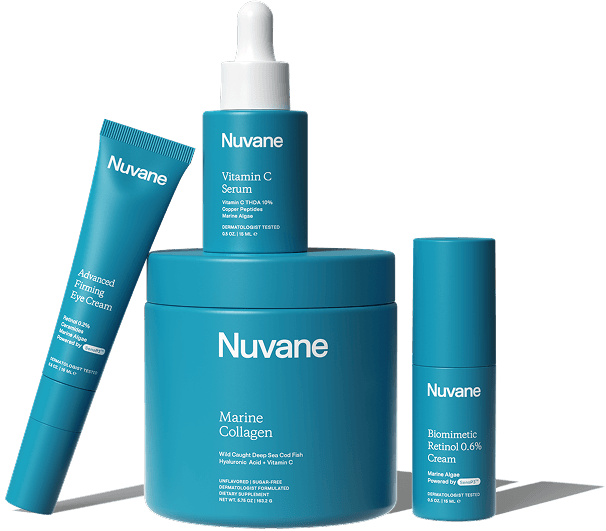
Nuvane was built as a skin longevity brand from the start. Every formula is designed to target the cellular drivers of aging, not just their visible signs. The common foundation is the SenoP3™ triple-peptide complex:
- Palmitoyl Tripeptide-38 helps stimulate collagen and hyaluronic acid production.
- Copper Tripeptide-1 (GHK-Cu) supports collagen and elastin synthesis and provides antioxidant protection.
- Acetyl Hexapeptide-8 helps relax expression lines.
SenoP3™ is paired with proven actives in each product:
- Biomimetic Retinol Cream (0.3% / 0.6%) combines stabilized retinol with SenoP3™, niacinamide, trehalose, marine algae and hyaluronic acid for collagen renewal with better tolerability.
- Biomimetic Bakuchiol Cream offers a retinol-free option with bakuchiol, peptides, a vitamin C derivative, Centella asiatica and marine algae, suited to sensitive skin.
- Advanced Vitamin C Serum uses stable, lipid-soluble THD ascorbate with copper peptides, ceramides and marine extracts for daily antioxidant protection.
- Regenerative Dark Spot Corrector combines alpha arbutin, retinol, SenoP3™, niacinamide and marine algae to target uneven tone.
- Firming Eye Cream pairs 0.2% retinol with SenoP3™, caffeine and ceramides for the delicate under-eye area.
- Oral Marine Collagen Supplement provides hydrolyzed marine collagen with hyaluronic acid and vitamin C to support skin from within.
In a 12-week, IRB-approved clinical study of women aged 35 to 65 across Fitzpatrick skin types II–VI, conducted by SGS and presented at EADV 2026, a personalized SenoP3™ regimen improved global fine lines in 86.8% of subjects and skin tone evenness in 81.6%, as rated by a blinded expert grader. Hydration rose 17.1% by week 12, and 94.7% of participants were satisfied overall [16].
Nuvane's AI-powered skin assessment matches each person with the products that fit their skin, age and concerns, which brings a personalized, longevity-style approach to an at-home routine.
Key takeaways
- Longevity medicine is now mainstream, with programs at Cedars-Sinai, Northwestern, Weill Cornell, Mayo Clinic and Mount Sinai [1][2][3].
- Skin longevity applies the healthspan mindset to skin, targeting senescence, inflammaging and collagen loss before they become visible.
- Daily sunscreen is the single most proven longevity habit for skin [7].
- Retinol, peptides, antioxidants and oral collagen form an evidence-based core routine [8][9][10][13].
- Skin longevity is affordable and accessible compared with clinic-based longevity programs.
- Start early and stay consistent; the biggest gains come from protection plus steady renewal over months and years.
Frequently asked questions
What is longevity skincare?
Longevity skincare is an approach that aims to keep skin cells healthy and functional for longer, so visible aging slows down. It focuses on root causes such as cellular senescence, chronic inflammation and collagen loss, rather than only treating wrinkles after they appear.
Is longevity skincare just a new name for anti-aging?
Not when it's done properly. Anti-aging usually focuses on correcting visible signs, while skin longevity targets the biological processes behind them and emphasizes prevention. Look for brands that explain the cellular mechanisms their ingredients address and back their claims with clinical data.
Why are hospitals like Mayo Clinic and Cedars-Sinai offering longevity medicine?
Patients increasingly want proactive, preventive care for aging, and many prefer to get it inside a trusted health system. Academic programs aim to bring a more rigorous, evidence-based approach to a field that grew up in private clinics [1][2].
Do I need a longevity clinic to start a skin longevity routine?
No. The most proven skin longevity tools, including daily sunscreen, retinol, peptides and antioxidants, are available for home use. A consistent routine built on these ingredients covers the main drivers of skin aging.
What are senescent cells, and why do they matter for skin?
Senescent cells have stopped dividing but remain in the skin, releasing inflammatory signals that break down collagen and affect nearby healthy cells. They build up with age and sun exposure and are one of the key targets of skin longevity research [4].
At what age should I start longevity skincare?
Prevention works best when it starts early, ideally in your 20s with daily sunscreen and antioxidants. Retinol and peptides become especially valuable from your 30s and 40s onward, but it's never too late to start.
Does longevity skincare work for men?
Yes. The biology of skin aging is largely the same for men and women, and the same ingredients work for both. Men often prefer a simpler routine: a vitamin C serum and sunscreen in the morning and a retinol cream at night covers the essentials.
How long does it take to see results from a skin longevity routine?
Most people notice better hydration and texture within 2 to 4 weeks. Improvements in fine lines and tone usually appear by 6 to 8 weeks, and firmness continues to improve after 12 weeks of consistent use.
Can supplements support skin longevity?
Yes. A meta-analysis of randomized trials found that hydrolyzed collagen supplements improved skin hydration and elasticity, typically after about three months [13]. Supplements work best alongside, not instead of, sunscreen and topical treatments.
References
- Zimmerman E. Longevity medicine is going mainstream. The New York Times. October 16, 2026.
- Selling longevity, part 1: Can you live longer for $5,500? Longevity clinics are the buzzy new trend at nonprofit hospitals. STAT News. October 6, 2026.
- Longevity medicine moves into academic health systems. Becker's Hospital Review. October 16, 2026.
- Ho CY, Dreesen O. Faces of cellular senescence in skin aging. Mech Ageing Dev. 2021;198:111525.
- Franceschi C, Campisi J. Chronic inflammation (inflammaging) and its potential contribution to age-associated diseases. J Gerontol A Biol Sci Med Sci. 2014;69(Suppl 1):S4–S9.
- Krutmann J, Bouloc A, Sore G, Bernard BA, Passeron T. The skin aging exposome. J Dermatol Sci. 2017;85(3):152–161.
- Hughes MCB, Williams GM, Baker P, Green AC. Sunscreen and prevention of skin aging: a randomized trial. Ann Intern Med. 2013;158(11):781–790.
- Kong R, Cui Y, Fisher GJ, et al. A comparative study of the effects of retinol and retinoic acid on histological, molecular, and clinical properties of human skin. J Cosmet Dermatol. 2016;15(1):49–57.
- Pickart L, Margolina A. Regenerative and protective actions of the GHK-Cu peptide in the light of the new gene data. Int J Mol Sci. 2018;19(7):1987.
- Blanes-Mira C, Clemente J, Jodas G, et al. A synthetic hexapeptide (Argireline) with antiwrinkle activity. Int J Cosmet Sci. 2002;24(5):303–310.
- López-Otín C, Blasco MA, Partridge L, Serrano M, Kroemer G. Hallmarks of aging: an expanding universe. Cell. 2023;186(2):243–278.
- Shvedova M, Thanapaul RJRS, Ha J, et al. Topical ABT-263 treatment reduces aged skin senescence and improves subsequent wound healing. Aging (Albany NY). 2024;17(1):16.
- de Miranda RB, Weimer P, Rossi RC. Effects of hydrolyzed collagen supplementation on skin aging: a systematic review and meta-analysis. Int J Dermatol. 2021;60(12):1449–1461.
- Top skincare trends for 2026—and those losing their sizzle. Beauty Independent. 2026.
- Top five trends shaping beauty and personal care in 2026 and 2027. Euromonitor International. 2026.
- Harth Y, et al. A personalized SenoP3™ regimen improves 13 signs of skin aging in 12 weeks. Presented at EADV 2026.
Related search terms
is longevity skincare going mainstream, what is longevity skincare, skin longevity vs anti-aging, longevity medicine for skin, best skin longevity routine, longevity clinics Mayo Cedars-Sinai Weill Cornell, healthspan and skin aging, senescent cells skin aging, inflammaging skincare, best longevity skincare ingredients 2026, SenoP3 peptide complex, retinol and peptides for skin longevity, longevity skincare for men, how to start a skin longevity routine, is longevity skincare worth it
Find the most effective anti-aging products for you by taking the free skin assessment.
Recommended Read
- Treatments — What is skin longevity?
- Treatments — Skin longevity vs. anti-aging
- Treatments — Best longevity treatments to outsmart skin senescence
- Treatments — New study: SenoP3™ AI regimen improves 13 signs of skin aging in 12 weeks
Find the most effective anti-aging products for you by taking the free skin assessment.
Enjoyed this article? Add Nuvane as a preferred source on Google.