
Can damaged mitochondria really make your skin look older?


Quick Answer: what do mitochondria have to do with wrinkles?
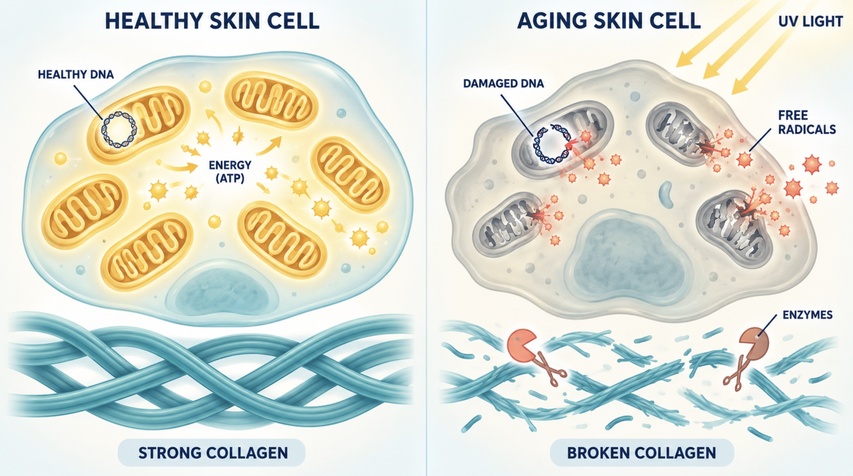
Quick Answer: Mitochondria are the tiny power plants inside every skin cell. When they get damaged — mostly by UV light and by normal aging — your skin cells make less energy, leak more free radicals, and start breaking down collagen faster than they rebuild it. That is a big part of why skin gets thinner, looser, and more lined over time.
Key Takeaways
- Mitochondria make ATP, the fuel your skin cells use to build collagen, repair DNA, and keep the skin barrier working. Less fuel means slower repair.
- Mitochondrial DNA is fragile. It sits right next to where free radicals are made and has a mutation rate up to 15 times higher than the DNA in the cell's nucleus [1].
- UV light is the main accelerator. Sun exposure leaves a specific scar in skin-cell mitochondrial DNA called the "common deletion," which shows up far more often in sun-exposed skin than in skin that stays covered [2].
- Damaged mitochondria switch on collagen-eating enzymes. When scientists partly removed mitochondrial DNA from human skin cells, those cells started behaving like cells from sun-damaged skin, including making more matrix metalloproteinases (MMPs) [3].
- NAD+ falls as you age. NAD+ is the molecule mitochondria need to turn food into energy, and levels drop in human skin as the years go by [4][8].
What exactly are mitochondria, and why should your skin care about them?
This section covers the basic biology in plain language, so the rest of the article makes sense.
Think of a skin cell as a small factory. The factory needs electricity to run its machines. Mitochondria are the generators. They take oxygen and the sugars and fats from your food, run them through a chemical assembly line called the electron transport chain, and produce a fuel molecule called ATP.
Almost everything your skin does well, it does with ATP. Fibroblasts — the cells in the deeper dermis — burn ATP to spin out new collagen and elastin, the proteins that keep skin firm and springy. Keratinocytes in the surface layer burn ATP to build the barrier that holds water in and keeps irritants out. Repair crews burn ATP to fix DNA damage after a day in the sun.
Skin is also unusually energy-hungry because it never stops rebuilding itself. Your outer layer completely replaces itself roughly every four to six weeks. That is a constant construction project, and construction projects stall when the power goes out.
Here is the catch. That assembly line is not perfectly clean. A small percentage of the electrons moving through it leak out and react with oxygen to form reactive oxygen species (ROS) — what most people call free radicals. In a healthy cell this is manageable; antioxidant enzymes mop up the spills. The problem starts when the generators get damaged, because a damaged generator leaks a lot more — and oxidative stress is one of the best-documented drivers of aging in human skin [12].
How does mitochondrial damage actually build up in skin?
Here is the step-by-step cycle dermatologists call the vicious circle of mitochondrial aging.
Mitochondria carry their own small loop of DNA, separate from the DNA in the cell's nucleus. Human mitochondrial DNA is tiny — 16,569 base pairs holding just 37 genes — but those genes matter enormously, because 13 of them are the blueprints for parts of the electron transport chain itself [1].
This DNA is in a rough neighborhood. It sits inside the mitochondrion, inches (in cellular terms) from where free radicals are produced, and it has fewer repair and protection systems than nuclear DNA. The result: mitochondrial DNA accumulates point mutations and deletions up to 15 times faster than nuclear DNA [1].
Now follow the loop:
- Free radicals damage mitochondrial DNA. Some of those damaged genes code for electron transport chain parts.
- The damaged parts build faulty assembly lines. Complex I, the first station in the chain, is especially vulnerable — several of its components are coded by mitochondrial DNA [1].
- A faulty assembly line leaks more free radicals and makes less ATP.
- More free radicals mean more mitochondrial DNA damage. Back to step one.
Each turn of this loop leaves the cell a little weaker. Researchers Krutmann and Schroeder called this the "defective powerhouse" model of skin aging: repeated UV exposure damages the mitochondria, the damaged mitochondria send distress signals back to the nucleus, and the nucleus responds by changing which genes it switches on — including genes that break down collagen [2].
Why is UV light the biggest culprit?
Most of what we call "aging skin" is really sun damage, and mitochondria are where a lot of that damage lands. UVA rays penetrate deep into the dermis and generate large amounts of ROS directly.
The clearest fingerprint is a specific 4,977-base-pair chunk of mitochondrial DNA that goes missing. Dermatologists call it the "common deletion." It is found much more often in skin that has taken years of sun than in protected skin from the same person, and it has also been detected after tanning-bed use [2]. It is, in effect, a scar you can measure in a lab.
What else damages skin mitochondria?
- Smoking and air pollution, which flood the skin with oxidants
- Chronic low-grade inflammation — the process often called inflammaging — which raises ROS and consumes NAD+
- Poor sleep and chronic stress, which reduce overnight repair capacity
- Simply getting older, since mitophagy (the cleanup system that recycles broken mitochondria, run mainly by the PINK1/Parkin pathway) becomes less efficient with age [1]
That last one is important and often skipped. Healthy cells do not just avoid damage — they actively identify broken mitochondria and digest them, then build fresh ones. When that recycling program slows down, broken generators pile up inside the cell and keep leaking.
How does a tired mitochondrion turn into a visible wrinkle?
The link between cell biology and what you see in the mirror comes down to collagen accounting.
Your skin is constantly making new collagen and constantly breaking old collagen down. Firm skin means the building side is keeping up. Aging skin means the demolition side has pulled ahead.
Damaged mitochondria tip that balance in three ways at once.
First, less fuel for building. Collagen synthesis is expensive. A fibroblast running on reduced ATP simply cannot produce collagen at the same rate.
Second, more demolition. ROS activate two master switches inside the cell, NF-κB and AP-1. Those switches turn up production of matrix metalloproteinases — enzymes whose job is to cut collagen and elastin apart [1]. One study made this strikingly clear: when researchers partially depleted mitochondrial DNA from healthy human skin fibroblasts, the cells shifted into a gene expression pattern that looked remarkably like photoaged skin, and MMP activity went up [3]. The mitochondria were the trigger; the collagen loss followed.
Third, more inflammation and more "zombie" cells. ROS also raise inflammatory signals, and cells with badly failing mitochondria often stop dividing altogether and become senescent. Senescent cells do not die quietly. They sit in the tissue releasing inflammatory molecules that push neighboring healthy cells toward the same fate. Senescence and mitochondrial failure go hand in hand: cells entering senescence show a lower NAD+/NADH ratio, a direct readout of mitochondrial trouble [1].
Put those three together and you get the familiar picture — skin that looks thinner, less elastic, duller, blotchier, and slower to bounce back from a blemish or a scratch.
What is NAD+, and why does everyone in longevity talk about it?
NAD+ is the single molecule that connects your diet, your mitochondria, and your skin's repair ability.
NAD+ (nicotinamide adenine dinucleotide) is a coenzyme — a helper molecule — and mitochondria cannot make ATP without it. It works as an electron shuttle, picking up electrons at one step and dropping them off at the next. When NAD+ is plentiful, the assembly line moves. When it runs short, everything downstream slows.
NAD+ has a second job that matters just as much for skin. It is the fuel for two families of repair enzymes:
- Sirtuins (especially SIRT1 and SIRT3), which help maintain mitochondrial quality and keep stress-response genes tuned correctly
- PARPs, which repair damaged DNA — including the DNA damage you get from UV exposure
Notice the trap built into that list. Sun exposure damages DNA, PARPs consume NAD+ to fix it, and the NAD+ they burn is no longer available to the mitochondria or to sirtuins. A sunburned day is also an NAD+-expensive day — in fact, keratinocyte survival after UVA and UVB exposure depends on the cell's ability to rebuild NAD+ through the enzyme NAMPT [11].
And NAD+ declines with age. Levels fall across human tissues — including skin, blood, liver, muscle, and brain — partly because we make less of it and partly because NAD+-consuming enzymes like CD38 become more active in older tissue [4][8][10]. Lower NAD+ leads to reduced sirtuin activity, which leads to worse mitochondrial quality control, which leads to more ROS. The same loop again.
This is exactly why NAD+ has become the center of longevity research. It is not a vitamin your skin can simply absorb from a jar — the molecule is too large and unstable to be delivered that way effectively. The practical route is to supply the body with NAD+ precursors, smaller molecules that cells convert into NAD+ internally.
What can you actually do about it?
Some of the strongest evidence here is not for a product at all.
The research is consistent on a few basics, and they are worth stating before any ingredient discussion:
- Daily broad-spectrum sunscreen is still the single most effective mitochondrial protection available, because it blocks the main source of the damage. Look specifically for good UVA coverage.
- Exercise restores signaling through PGC-1α and SIRT3, the pathways that drive new mitochondrial production and antioxidant defense [1].
- Caloric restriction and fasting-style eating patterns activate AMPK and sirtuins, which support mitochondrial DNA replication and reduce ROS output [1].
- Sleep is when most repair work happens. Shorting it shorts the repair budget.
- Stop smoking, and take air pollution seriously if you live in a city.
On the ingredient side, the Frontiers review highlighted several compounds with real mechanistic support: urolithin A (a gut metabolite of ellagic acid that improves mitochondrial health), spermidine and pterostilbene or resveratrol (which work through sirtuins and AMPK), melatonin (a free-radical scavenger that also tunes antioxidant gene expression), and NAD+ precursors [1].
One honest caveat from that same review: overexpressing antioxidant enzymes like SOD and catalase in mice did not extend their lifespan [1]. Simply mopping up free radicals is not enough on its own. What appears to matter is supporting the quality-control systems — energy production, recycling, and repair — not just scavenging the exhaust.
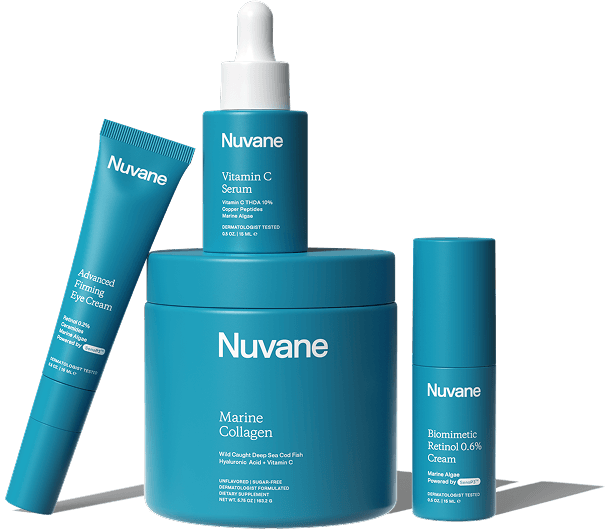
How do Nuvane's products target this pathway?
Mitochondrial aging happens both inside the cell and in the surrounding collagen matrix, so it takes both a topical and an oral approach.
Nuvane was built around skin longevity rather than surface cover-up, and mitochondrial health sits at the center of that.
What does the topical routine do?
The SenoP3™ triple-peptide complex addresses the collagen side of the equation — the demolition-versus-building balance described above:
- Palmitoyl Tripeptide-38 signals fibroblasts to step up collagen and hyaluronic acid production
- Copper Tripeptide-1 (GHK-Cu) supports collagen and elastin synthesis and acts as an antioxidant in its own right
- Acetyl Hexapeptide-8 relaxes the repeated muscle movement that etches in expression lines
SenoP3™ appears across the line, including the Biomimetic Retinol Cream (0.3% and 0.6%, with stabilized retinol, niacinamide, trehalose, marine algae, and hyaluronic acid), the retinol-free Biomimetic Bakuchiol Cream for sensitive skin, the Regenerative Dark Spot Corrector, and the Firming Eye Cream (retinol 0.2% with caffeine and ceramides).
For the oxidative-stress side, the Advanced Vitamin C Serum uses THD ascorbate, a stable lipid-soluble form of vitamin C, paired with copper peptides, ceramides, and marine extracts. Vitamin C does double duty here: it neutralizes free radicals and it is a required cofactor for the enzymes that cross-link new collagen.
What is in the Nuvane NAD+ Skin & Longevity Complex?
This is the part of the routine aimed directly at mitochondria, and it is taken by mouth because that is the only realistic way to raise NAD+ throughout the body. It is one vegetarian capsule per day, 30 per bottle.
| Ingredient | Per capsule | What it is there for |
|---|---|---|
| NMN (Uthever® β-Nicotinamide Mononucleotide) | 250 mg | Direct NAD+ precursor — the raw material mitochondria use to rebuild NAD+ |
| Niacinamide (Vitamin B3) | 100 mg | A second entry point into the NAD+ salvage pathway; the best-studied oral and topical B3 for skin appearance [9] |
| TMG (Trimethylglycine / betaine) | 50 mg | Methyl donor that supports healthy methylation while the body processes higher NAD+ precursor intake |
| Astaxanthin (natural, H. pluvialis) | 4 mg | Carotenoid antioxidant that concentrates in cell membranes, including mitochondrial membranes |
| Vitamin D3 (cholecalciferol) | 2,000 IU (50 mcg) | Skin, bone, and immune support; deficiency is common and affects skin repair |
| Zinc (as gluconate) | 10 mg | Required for wound healing, DNA repair, and antioxidant enzyme function |
| Selenium | 55 mcg | Cofactor for glutathione peroxidase, one of the body's core antioxidant enzymes |
Two things are worth being precise about.
On the NMN. We chose the branded Uthever® form because it has its own published human trial. In a multicentre, randomized, double-blind, placebo-controlled study of 62 healthy adults aged 40–65, 300 mg of Uthever® NMN daily for 60 days raised blood NAD+/NADH by about 38% from baseline at day 60, versus 14.3% in the placebo group, with a 6.5% improvement in six-minute walk distance and no clinically meaningful safety findings [5]. Our capsule delivers 250 mg, slightly below the trial dose, in combination with niacinamide as a second NAD+ route.
On the astaxanthin. A meta-analysis of 11 clinical studies found oral astaxanthin significantly improved skin moisture (effect size 0.53) and elasticity (0.77), but did not show a statistically significant reduction in wrinkle depth [6]. We include it for the hydration, elasticity, and membrane-antioxidant benefits, not as a wrinkle treatment.
The logic of pairing them is straightforward. The capsule works on the cell's internal power and repair systems. The creams work on the collagen matrix those cells are supposed to be maintaining. Neither one substitutes for the other, and neither substitutes for sunscreen.
These statements have not been evaluated by the Food and Drug Administration. This product is not intended to diagnose, treat, cure, or prevent any disease. Check with your physician before starting any supplement, especially if you are pregnant, nursing, or taking medication.
Key Takeaways
- Mitochondria run your skin's repair economy. Damage them and collagen production slows while collagen breakdown speeds up.
- The damage is self-reinforcing. Free radicals damage mitochondrial DNA, damaged DNA builds leakier assembly lines, leakier lines make more free radicals.
- UV light is the accelerator you control. The mitochondrial "common deletion" is concentrated in sun-exposed skin, which makes daily broad-spectrum sunscreen the highest-yield step available [2].
- NAD+ is the bottleneck molecule. It falls with age, it is consumed by UV-triggered DNA repair, and without it mitochondria cannot make energy or run quality control [4][8].
- Scavenging free radicals alone is not enough. Boosting antioxidant enzymes did not extend lifespan in mice — supporting energy production, recycling, and repair matters more [1].
- Work from both directions. NAD+ precursors and antioxidants by mouth, peptides and retinoids on the skin, sunscreen and sleep as the foundation.
Frequently Asked Questions
Can you actually reverse mitochondrial damage in skin?
You cannot undo mutations already present in a cell's mitochondrial DNA. What you can influence is the mix: supporting mitophagy and mitochondrial biogenesis helps cells clear out failing mitochondria and build fresh ones, which shifts the population toward healthier generators. Preventing new damage — mainly through sun protection — matters more than trying to repair old damage.
Does taking NMN improve how your skin looks?
The direct human evidence for NMN and visible skin appearance is still limited. What is well established is that NMN raises blood NAD+ levels in people [5], and that NAD+ is required for the sirtuin and PARP repair pathways skin depends on. Animal work shows oral NMN reducing UVB-induced wrinkle formation and collagen loss [7], but mouse skin is not human skin. It is a mechanistically sound intervention, not a proven wrinkle treatment — and any honest answer says so.
Is NMN or NR the better NAD+ precursor?
Both raise NAD+ and both have human safety data. NMN sits one step closer to NAD+ in the salvage pathway; NR has to be converted to NMN first. In practice the published increases in blood NAD+ are broadly comparable, and there is no head-to-head trial showing one is clearly better for skin. Dose, product quality, and whether you actually take it daily matter more than the choice between them.
Why do you include niacinamide in a capsule that already has NMN?
They enter the NAD+ salvage pathway at different points, so they are complementary rather than redundant. Niacinamide also has the deepest evidence base of any B3 form for skin appearance — it has been shown to improve fine lines, blotchiness, and skin tone in controlled studies [9].
What is TMG for, and do I need it?
TMG (trimethylglycine, or betaine) is a methyl donor. Your body clears excess nicotinamide by attaching a methyl group to it, which draws on your methyl pool. Including TMG alongside an NAD+ precursor is a conservative formulation choice to support normal methylation. It is precautionary rather than a proven requirement.
Do topical antioxidants reach the mitochondria?
Some do, to a degree. Lipid-soluble antioxidants like THD ascorbate and astaxanthin distribute into cell membranes, which is where lipid peroxidation begins. But a topical product cannot raise whole-body NAD+ or restart a failing electron transport chain. Topicals are best understood as reducing the oxidative load on skin cells, while oral precursors supply the raw material for repair.
Is red light therapy the same idea?
It is related. Red and near-infrared light are absorbed by cytochrome c oxidase, a component of the electron transport chain, which is the proposed mechanism for how red light increases ATP output. The concept is well grounded; the clinical results in at-home devices vary a lot by wavelength, power, and consistency of use.
How long before any of this shows up in the mirror?
Nothing in this category works in a week. Realistic timelines: 4–8 weeks for texture, hydration, and glow, driven mostly by the topicals; 12 weeks and beyond for fine lines and firmness, because new collagen takes that long to organize. Energy and NAD+ changes measured in trials appear within 30–60 days, but those are blood markers, not visible skin change [5].
Does exercise really help skin, or is that a stretch?
It is not a stretch. Exercise is one of the most reliable mitochondrial interventions known: it upregulates PGC-1α (which drives new mitochondrial production) and SIRT3, improving antioxidant defense [1]. Those pathways operate in skin cells as they do elsewhere.
References
- Somasundaram I, Jain SM, Blaauw D, et al. Mitochondrial dysfunction and its association with age-related disorders. Frontiers in Physiology. 2024;15:1384966.
- Krutmann J, Schroeder P. Role of mitochondria in photoaging of human skin: the defective powerhouse model. Journal of Investigative Dermatology Symposium Proceedings. 2009;14(1):44–49.
- Schroeder P, Gremmel T, Berneburg M, Krutmann J. Partial depletion of mitochondrial DNA from human skin fibroblasts induces a gene expression profile reminiscent of photoaged skin. Journal of Investigative Dermatology. 2008;128(9):2297–2303.
- Covarrubias AJ, Perrone R, Grozio A, Verdin E. NAD+ metabolism and its roles in cellular processes during ageing. Nature Reviews Molecular Cell Biology. 2021;22(2):119–141.
- Huang H. A multicentre, randomised, double blind, parallel design, placebo controlled study to evaluate the efficacy and safety of Uthever (NMN supplement), an orally administered supplementation in middle aged and older adults. Frontiers in Aging. 2022;3:851698.
- Zhou X, Cao Q, Orfila C, Zhao J, Zhang L. Systematic review and meta-analysis on the effects of astaxanthin on human skin ageing. Nutrients. 2021;13(9):2917.
- Zhou X, Du HH, Long X, et al. β-Nicotinamide mononucleotide (NMN) administrated by intraperitoneal injection mediates protection against UVB-induced skin damage in mice. Journal of Inflammation Research. 2021;14:5165–5182.
- Camacho-Pereira J, Tarragó MG, Chini CCS, et al. CD38 dictates age-related NAD decline and mitochondrial dysfunction through an SIRT3-dependent mechanism. Cell Metabolism. 2016;23(6):1127–1139.
- Bissett DL, Oblong JE, Berge CA. Niacinamide: a B vitamin that improves aging facial skin appearance. Dermatologic Surgery. 2005;31(7 Pt 2):860–865.
- Gomes AP, Price NL, Ling AJY, et al. Declining NAD+ induces a pseudohypoxic state disrupting nuclear-mitochondrial communication during aging. Cell. 2013;155(7):1624–1638.
- Katayoshi T, Nakajo T, Tsuji-Naito K. Restoring NAD+ by NAMPT is essential for the SIRT1/p53-mediated survival of UVA- and UVB-irradiated epidermal keratinocytes. Journal of Photochemistry and Photobiology B. 2021;221:112238.
- Rinnerthaler M, Bischof J, Streubel MK, Trost A, Richter K. Oxidative stress in aging human skin. Biomolecules. 2015;5(2):545–589.
Related Search Terms
mitochondria and skin aging, mitochondrial DNA common deletion skin, what causes collagen loss with age, NAD+ and skin aging, NMN supplement for skin, Uthever NMN clinical study, best NAD+ supplement for skin longevity, does NMN help wrinkles, mitophagy skin aging, free radicals and collagen breakdown, MMP-1 collagen degradation UV, astaxanthin for skin elasticity, niacinamide NAD precursor skin, cellular energy and skin repair, skin longevity supplement dermatologist
Find the most effective anti-aging products for you by taking the free skin assessment.
Recommended Read
- How is mitochondrial health crucial to your skin's longevity
- What actually causes skin aging? The 5 biological pathways behind every wrinkle
- How senescent cells drive skin aging?
- Best ways to diagnose and treat inflammaging
Find the most effective anti-aging products for you by taking the free skin assessment.
Enjoyed this article? Add Nuvane as a preferred source on Google.