
What actually causes skin aging? The 5 biological pathways behind every wrinkle

What's the quick answer: what actually causes skin to age?
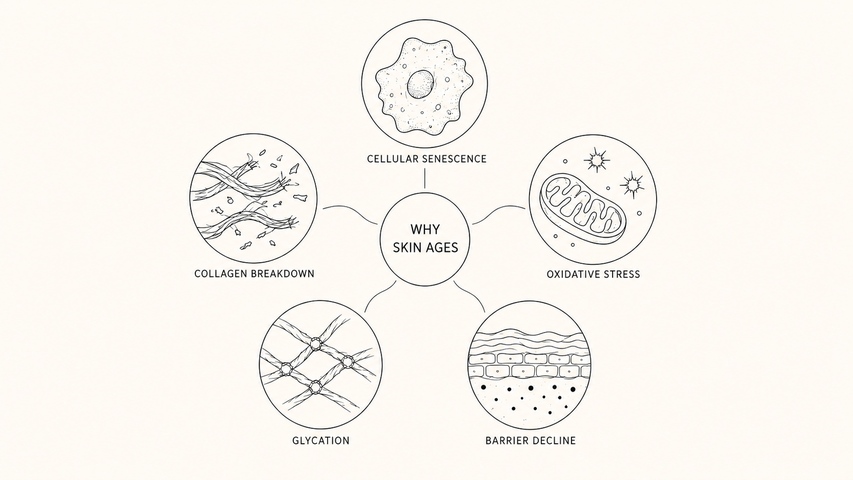
Quick Answer: Skin doesn't age through one process — it ages through five interlocking biological pathways: chronic low-grade inflammation, oxidative stress, declining protein synthesis, accumulated DNA damage, and failing cellular repair and clean-up. Every visible sign of aging, from a fine line to a dark spot to crepey texture, is the surface expression of at least one of these five. That's why single-ingredient routines plateau: they usually address one pathway and leave the other four running.
Key Takeaways
- Inflammation ("inflammaging") is chronic, low-grade, and self-sustaining. Activated NF-κB signaling drives matrix metalloproteinases (MMPs) that dismantle collagen faster than you can build it [1].
- Oxidative stress from UV, pollution, and mitochondrial leakage generates reactive oxygen species that damage lipids, proteins, and mitochondrial DNA — and feed straight back into inflammation [2].
- Protein synthesis falls with age. Collagen production drops roughly 1% per year from your mid-20s, and fibroblasts become both fewer and less responsive [3].
- DNA damage accumulates from UV-induced photoproducts and oxidative lesions. Repair itself is NAD⁺-dependent, and NAD⁺ declines with age — so damage outpaces repair [4].
- Cellular repair — autophagy and senescent-cell turnover — is the pathway most people have never heard of and the one that governs the rest. When clean-up fails, senescent "zombie" cells accumulate and secrete inflammatory signals that restart the whole loop [5].
- These five feed each other. Targeting one is why most routines stall. Nuvane's formulation logic is to place at least one validated active against each pathway.
Why do dermatologists now describe skin aging as five pathways instead of one process?
This section explains the shift from treating symptoms to treating mechanisms.
For most of the last century, skin aging was described the way it looks: lines, laxity, spots, dullness. Treatments followed that logic — something for lines, something for spots. It produced a large industry and a lot of routines that stop delivering after three months.
The last decade of geroscience changed the framing. Aging in any tissue is now understood as a set of definable, measurable hallmarks — genomic instability, mitochondrial dysfunction, cellular senescence, loss of proteostasis, chronic inflammation, and others. Skin, being the most accessible organ, turned out to be an unusually good place to study them. Recent frameworks such as Skinspan, published in 2025, explicitly organize skin longevity around these mechanistic pillars rather than around visible signs [6].
The practical consequence for anyone standing in front of a bathroom mirror is this: the sign you're looking at is a downstream readout. A crow's foot is not a problem in itself; it's what happens when collagen synthesis has fallen, degradation enzymes have risen, and repair capacity hasn't kept pace. Treating the readout gives you a cosmetic result. Treating the pathway gives you a trajectory.
Below are the five pathways that matter most in skin, what each one does, and how it shows up on your face.
Pathway 1: How does chronic inflammation age your skin?
Inflammaging is the pathway that converts every other insult into visible damage.
Acute inflammation is a repair mechanism. Inflammaging — the chronic, low-grade, sterile inflammation that accumulates with age — is the opposite. There's no injury to resolve, so the response never switches off.
The central switch is NF-κB, a transcription factor that sits in the cytoplasm until it's activated by UV exposure, pollutants, glycation end-products, or signals released by aging cells. Once activated, it moves into the nucleus and turns on genes for inflammatory cytokines (IL-1, IL-6, TNF-α) and, critically, for matrix metalloproteinases — the enzymes that cut collagen and elastin apart [1]. A single significant UV exposure elevates MMP-1 for days.
This is why inflammation is the pathway with the widest downstream reach. It doesn't just cause redness. It actively dismantles the structural proteins that give skin its firmness, and it does so continuously and quietly.
How it shows on skin: persistent redness or reactivity, a barrier that seems permanently compromised, accelerated loss of firmness, post-inflammatory dark marks that linger for months, and rosacea-pattern flushing that worsens with age.
What drives it: UV exposure, air pollution and particulate matter, glycation from high-glycemic diets, poor sleep, psychological stress, over-exfoliation, and — importantly — senescent cells, which secrete an inflammatory cocktail of their own.
Pathway 2: What does oxidative stress actually do to skin cells?
Oxidative stress is the damage engine that inflammation amplifies.
Every cell that makes energy also makes reactive oxygen species (ROS) as a byproduct. Under normal conditions, the cell's antioxidant systems — superoxide dismutase, catalase, glutathione — neutralize them. Oxidative stress is what happens when generation exceeds neutralizing capacity.
In skin, three things push it over the line. UV radiation generates ROS directly in the epidermis and dermis. Pollution, particularly fine particulate matter and ozone, generates it at the surface and depletes the skin's own antioxidant reserves. And aging mitochondria become progressively leakier — releasing more ROS while producing less energy, which is a vicious cycle rather than a linear decline [2].
The damage is broad: ROS oxidize membrane lipids (compromising the barrier), oxidize proteins (including collagen and the enzymes meant to repair it), and damage mitochondrial DNA, which lacks the protective histones and robust repair machinery of nuclear DNA. And oxidative damage is itself a potent activator of NF-κB — which is the point at which pathways one and two become a loop rather than two separate problems.
How it shows on skin: dullness and loss of luminosity, uneven tone, fine lines appearing earlier than expected, tired-looking skin that doesn't improve with sleep, and accelerated pigment change.
What drives it: UV and visible light, pollution, smoking, alcohol, chronic sleep deprivation, and the natural decline of mitochondrial efficiency after roughly age 40.
Pathway 3: Why does your skin stop building protein the way it used to?
This is the pathway most directly responsible for the loss of firmness.
Skin is, structurally, a protein scaffold. Collagen I and III provide tensile strength, elastin provides recoil, fibronectin and laminin anchor the layers together, and hyaluronic acid holds the water that keeps it all plump. All of these are manufactured by fibroblasts in the dermis.
Two things go wrong with age. First, output falls: dermal collagen production declines by roughly 1% per year beginning in the mid-20s, with a much steeper drop in the perimenopausal window — women lose approximately 30% of dermal collagen in the first five years after menopause [3]. Second, the cells become less responsive: aged fibroblasts sit in a degraded, fragmented matrix, and because fibroblasts sense mechanical tension from their surroundings, a collapsed matrix sends them a signal to produce less, not more. The damage becomes self-reinforcing.
Meanwhile the demolition side rises. MMP activity increases with age and with every inflammatory episode, so the balance between synthesis and degradation — governed by the MMP/TIMP ratio — tilts steadily toward loss.
The broader biology term for this pathway is proteostasis: the cell's overall ability to make, fold, and maintain functional proteins. In aged skin, proteostasis declines on all three fronts.
How it shows on skin: loss of firmness and bounce, sagging along the jawline, thinning and crepey texture on the neck and décolleté, deeper static lines, and skin that bruises or tears more easily.
What drives it: intrinsic chronological aging, estrogen decline, cumulative UV exposure, inadequate dietary protein, and rapid weight loss — including on GLP-1 medications.
Pathway 4: How much of skin aging is DNA damage?
More than most people expect — and repair capacity matters as much as damage load.
Your skin cells sustain an enormous volume of DNA damage. UVB generates cyclobutane pyrimidine dimers directly; UVA and oxidative stress generate lesions like 8-oxo-guanine. Most of it is repaired within hours by nucleotide excision repair and base excision repair. The problem is not that damage occurs — it's the arithmetic between damage rate and repair rate.
That arithmetic worsens with age for a specific reason: DNA repair is energy-expensive and NAD⁺-dependent. PARP enzymes, which detect and coordinate the response to DNA strand breaks, consume NAD⁺ to do their work. NAD⁺ levels fall substantially with age, so the same lesion that a 25-year-old repairs efficiently sits unrepaired longer in a 55-year-old. Nicotinamide — the amide form of vitamin B3 — replenishes cellular NAD⁺ and has been shown to enhance repair of UV-induced DNA damage in human keratinocytes and ex vivo skin [4].
Unrepaired damage has two fates. If it's severe, the cell either dies or enters permanent growth arrest — senescence — which hands the problem to pathway five. If it's tolerated, mutations accumulate, which is the pathway to actinic keratoses and skin cancer.
How it shows on skin: solar lentigines and mottled pigmentation, actinic keratoses, deep etched lines in chronically exposed areas, leathery texture, and a visible difference between sun-exposed and sun-protected skin on the same person.
What drives it: cumulative lifetime UV exposure above all else, plus oxidative stress, smoking, and declining NAD⁺ availability.
Pathway 5: What is cellular repair, and why is it the pathway nobody talks about?
Autophagy and senescent-cell turnover are the quality-control systems that govern the other four.
Cells have a maintenance system. Autophagy — literally "self-eating" — is the process by which a cell packages damaged proteins, dysfunctional mitochondria, and cellular debris into vesicles and recycles them. It's how a cell stays functional over decades rather than accumulating junk.
Autophagic flux declines with age, and it's specifically impaired by UV exposure. Research on photoaging shows that dysregulated autophagy sits at the intersection of oxidative and inflammatory damage: restore autophagic function, and both oxidative and inflammatory markers fall [7]. When clean-up fails, damaged mitochondria stay in circulation leaking ROS (pathway two), and misfolded proteins accumulate (pathway three).
The second half of this pathway is cellular senescence. When a cell sustains damage it cannot repair, it can enter a permanent non-dividing state rather than dying. Senescent cells are not inert. They secrete the senescence-associated secretory phenotype (SASP) — a mix of inflammatory cytokines, growth factors, and proteases, including MMPs. In other words, a senescent fibroblast stops making collagen and starts producing enzymes that destroy the collagen around it, while pushing neighboring healthy cells toward senescence themselves [5].
This is why pathway five is the keystone. Failed repair generates the inflammation of pathway one, the oxidative load of pathway two, and the synthesis deficit of pathway three. It is the mechanism that turns aging from a linear process into an accelerating one.
How it shows on skin: the plateau — skin that stops responding to a routine that used to work, slow recovery from procedures or irritation, wounds and blemishes healing more slowly, and generalized dullness with loss of density.
What drives it: chronological aging, UV, metabolic stress, and the accumulated output of the other four pathways.
How do Nuvane ingredients target each of the five pathways?
Nuvane's formulation logic is one simple rule: no pathway left unaddressed.
Most skincare is organized around a hero ingredient. That approach almost always maps to a single pathway — which is precisely why routines plateau. Nuvane's formulations, built around the SenoP3™ triple-peptide complex, are constructed so that each of the five mechanisms has at least one validated active working against it.
Targeting inflammation
Fucus vesiculosus (bladderwrack) extract is the primary anti-inflammatory active across the Nuvane line. Its phlorotannins have been shown to modulate the inflammatory response specifically by blocking NF-κB signaling — intervening at the switch rather than downstream of it [8]. A separate clinical study on topical Fucus vesiculosus found measurable changes in human skin thickness and mechanical properties [9].
Niacinamide, present in the Biomimetic Retinol Cream and Regenerative Dark Spot Corrector, adds a second anti-inflammatory vector and supports barrier lipid synthesis — a barrier that holds is a barrier that isn't constantly triggering inflammatory signaling. Centella asiatica, in the Biomimetic Bakuchiol Cream, contributes madecassoside and asiaticoside, both well-characterized for calming reactive skin.
Products: Biomimetic Retinol Cream (0.3% / 0.6%), Biomimetic Bakuchiol Cream, Advanced Vitamin C Serum.
Targeting oxidative stress
THD ascorbate — tetrahexyldecyl ascorbate — is the antioxidant backbone of the Advanced Vitamin C Serum. Unlike L-ascorbic acid, which requires a low pH, oxidizes rapidly, and irritates many users, THD ascorbate is lipid-soluble and pH-neutral, so it penetrates the lipid-rich stratum corneum and remains stable in the bottle. It converts to active ascorbic acid in the skin, where it neutralizes ROS and serves as an essential cofactor for collagen cross-linking.
Copper Tripeptide-1 (GHK-Cu), one of the three SenoP3™ peptides, contributes independent antioxidant activity alongside its matrix effects [10]. Fucus vesiculosus phlorotannins are potent radical scavengers in their own right, and marine algae extracts across the line add a broad polyphenol pool.
Products: Advanced Vitamin C Serum, all SenoP3™-containing creams.
Targeting protein synthesis
This is where SenoP3™ does its most direct work, using three peptides with three distinct jobs:
- Palmitoyl Tripeptide-38 signals fibroblasts to synthesize a broad panel of matrix constituents — collagen I, III, and IV, fibronectin, hyaluronic acid, and laminin-5. Its palmitoyl lipid tail is engineered specifically to carry it through the stratum corneum's lipid bilayers.
- Copper Tripeptide-1 (GHK-Cu) restores a signaling molecule whose plasma level falls from roughly 200 ng/mL at age 20 to about 80 ng/mL by 60. It upregulates collagen and elastin synthesis and — critically for this pathway — helps rebalance the MMP/TIMP ratio, addressing the degradation side of the equation rather than only the synthesis side [10].
- Acetyl Hexapeptide-8 reduces the repetitive micro-contraction that mechanically stresses newly formed collagen, by interfering with SNARE complex assembly at the neuromuscular junction.
Stabilized retinol works alongside them through a different mechanism: retinoids bind nuclear retinoic acid receptors, upregulate procollagen I transcription, and suppress the AP-1 pathway that drives MMP-1 expression [11]. Peptides signal; retinol changes gene expression. Running both gives you two independent routes to the same outcome.
For patients who cannot tolerate retinoids, bakuchiol produces a comparable retinol-like gene-expression profile with substantially better tolerability. And the Oral Marine Collagen Supplement supplies the substrate side — hydrolyzed collagen peptides plus vitamin C, the obligatory cofactor for collagen hydroxylation.
Products: Biomimetic Retinol Cream (0.3% / 0.6%), Biomimetic Bakuchiol Cream, Firming Eye Cream, Oral Marine Collagen Supplement.
Targeting DNA damage
Niacinamide is the key active here and the mechanism is specific: it is a precursor to NAD⁺, the cofactor PARP enzymes require to detect and coordinate repair of DNA strand breaks. Topical and oral nicotinamide have been shown to enhance repair of UV-induced DNA damage in human keratinocytes and ex vivo skin, and nicotinamide is the only topical agent with randomized trial evidence for reducing actinic keratoses and non-melanoma skin cancer incidence in high-risk patients [4].
THD ascorbate contributes upstream by reducing the oxidative lesion load in the first place, and alpha arbutin in the Regenerative Dark Spot Corrector addresses the pigmentary consequence of accumulated photodamage by inhibiting tyrosinase.
None of this substitutes for daily broad-spectrum SPF, which remains the single highest-leverage intervention against this pathway.
Products: Biomimetic Retinol Cream, Regenerative Dark Spot Corrector, Advanced Vitamin C Serum.
Targeting cellular repair and senescence
Trehalose is the deliberate inclusion here. It's a non-reducing disaccharide with well-documented cell-protective properties, and research in keratinocytes shows it protects against UVB damage by activating autophagy via TIMP3 and ATG9A regulation [12] — directly supporting the clean-up machinery that declines with age.
GHK-Cu is relevant again, and this is where its gene-expression breadth matters most. Analysis of its transcriptional effects shows it modulates a very large number of human genes, including many involved in DNA repair, antioxidant response, and tissue remodeling — behaving as a broad reset signal toward a more youthful expression pattern rather than as a single-target active [10].
The name SenoP3™ reflects this pathway explicitly. The complex is formulated to address the senescence side of skin aging — supporting the repair and clean-up processes whose failure allows senescent cells to accumulate and drive the other four pathways forward.
In a 12-week, IRB-supervised clinical evaluation of the SenoP3™ AI-personalized regimen (38 per-protocol subjects, results presented at EADV 2026), expert grading on a modified Griffiths scale found improvement in fine lines in 86.8% of subjects, with 92.1% reporting improved smoothness and 94.7% overall satisfaction. Hydration was assessed by corneometry and barrier function by transepidermal water loss [13].
Products: Biomimetic Retinol Cream (0.3% / 0.6%), Biomimetic Bakuchiol Cream, Firming Eye Cream — all SenoP3™-containing.
Do you need prescription actives to target these pathways?
A fair question, since several compounding-pharmacy brands now market prescription formulas against the same five mechanisms.
A growing category of physician-prescribed and compounded skincare targets this same pathway framework using prescription molecules: tretinoin for protein synthesis, topical rapamycin for cellular senescence, estriol for the hormonal component of collagen loss, and hydroquinone for pigment. The mechanistic logic is sound, and some of it is genuinely interesting — a small controlled study of topical rapamycin in older adults reported reduced expression of the senescence marker p16^INK4A^ alongside increased dermal collagen [15].
There are real trade-offs, though, and they're worth stating plainly rather than dismissing.
- Tolerability. Tretinoin is more potent than cosmetic retinol and correspondingly more irritating. Since irritation activates NF-κB, an over-aggressive retinoid can worsen pathway one while improving pathway three. Adherence data across dermatology consistently shows that the treatment people actually keep using outperforms the more potent one they abandon.
- Duration limits. Hydroquinone is intended for defined treatment courses, not indefinite use, because of the risk of exogenous ochronosis and rebound pigmentation with prolonged application.
- Hormonal actives require medical oversight. Topical estriol is a hormone. It may be entirely appropriate for a specific patient under supervision, but it is not a general-population ingredient.
- Access and continuity. Prescription and compounded formulas require an ongoing prescriber relationship, and compounded products are not subject to the same standardization requirements as manufactured cosmetics.
The honest position is that these are complementary routes, not rivals. A cosmetic-grade formulation that covers all five pathways with well-tolerated actives is the right default for most people and can be used continuously for years — which matters, because these pathways run continuously. A prescription protocol makes sense when a specific pathway is failing hard enough to justify the additional oversight: significant photodamage, refractory melasma, or an unusually rapid post-menopausal decline in dermal density. Many patients reasonably do both, using prescription actives in defined courses and a daily peptide-based routine as the permanent layer underneath.
Key takeaways
- Every visible sign of aging is downstream of at least one of five pathways. Treating the sign gives a cosmetic result; treating the pathway changes the trajectory.
- The pathways feed each other. Oxidative damage activates inflammation, inflammation degrades collagen, unrepaired DNA damage creates senescent cells, and senescent cells generate more inflammation. This is why aging accelerates rather than progressing linearly.
- Cellular repair is the keystone. Autophagy and senescent-cell burden govern how fast the other four run — and it's the pathway conventional skincare almost entirely ignores.
- Coverage beats potency. A routine with a moderate active against all five pathways outperforms a high-strength single active working against one.
- Sunscreen is non-negotiable. UV is a primary driver of four of the five pathways simultaneously. No topical or injectable outruns unprotected sun exposure.
- Nuvane's approach is pathway coverage by design: Fucus vesiculosus and niacinamide for inflammation, THD ascorbate and marine polyphenols for oxidative stress, SenoP3™ peptides and retinol or bakuchiol for protein synthesis, niacinamide for DNA repair, and trehalose plus GHK-Cu for cellular repair and senescence.
Frequently asked questions
Which of the five pathways matters most?
They're not equally weighted at every age. In your 20s and 30s, oxidative stress and DNA damage dominate because they're driven by exposure. From your 40s onward, declining protein synthesis and failing cellular repair take over, and inflammation amplifies whatever else is happening. If you have to pick one thing to fix at any age, it's UV protection — because it hits four of the five.
Can I target all five pathways with one product?
Partially. A well-constructed multi-active cream can put a meaningful ingredient against each pathway, which is how Nuvane's SenoP3™ formulations are built. But you'll get better coverage from two or three products used consistently — an antioxidant serum in the morning, a peptide-plus-retinoid cream at night — than from one product used sporadically.
Is inflammaging the same as having sensitive skin?
No, though they can look similar. Sensitive skin is a barrier and reactivity issue that produces acute, visible symptoms. Inflammaging is chronic, low-grade, and largely invisible — it's happening at the cytokine level whether or not your skin looks red. You can have inflammaging with skin that looks completely calm.
How do I know if senescent cells are affecting my skin?
There's no at-home test, but the clinical pattern is recognizable: skin that stops responding to a routine that previously worked, slower recovery from irritation or procedures, and a general loss of density that doesn't track with any obvious new exposure. That plateau is often the signature of accumulated senescent burden rather than of an inadequate active.
Does diet affect these pathways?
Yes, on at least three of them. High-glycemic diets drive glycation, which activates NF-κB and inflammation. Inadequate protein intake limits the amino acid substrate for collagen synthesis. And dietary polyphenols and antioxidants contribute to the cell's overall redox capacity. Sleep matters too — most nocturnal repair and autophagy activity happens during sleep.
How long before targeting these pathways shows visible results?
Roughly in this order: hydration and barrier improvement in 2–4 weeks; tone, brightness, and smoothness at 4–8 weeks; fine lines and firmness at 8–12 weeks, with continued gains beyond that. Pathway-level change is slower than surface change, which is why the 12-week mark is the standard evaluation point in clinical studies.
Do I need to take collagen orally if I'm using peptides topically?
They do different things. Topical peptides are signals telling fibroblasts to build. Oral collagen peptides supply substrate and appear to provide a secondary signaling effect. Neither replaces the other, and there's a reasonable argument for both if you're over 45 or on a GLP-1 medication with reduced protein intake.
Is there anything that reverses damage already done?
Some, honestly — not all. Retinoids and peptides can measurably increase dermal collagen and improve the appearance of existing lines. Pigment from accumulated photodamage responds well to tyrosinase inhibitors and retinoids. What doesn't reverse is DNA mutation load, which is why prevention carries so much more weight than correction on that particular pathway.
References
- Pilkington SM, Bulfone-Paus S, Griffiths CEM, Watson REB. "Inflammaging and the Skin." Journal of Investigative Dermatology, 2021;141(4S):1087–1095.
- Rinnerthaler M, Bischof J, Streubel MK, et al. "Oxidative Stress in Aging Human Skin." Biomolecules, 2015;5(2):545–589.
- Shuster S, Black MM, McVitie E. "The influence of age and sex on skin thickness, skin collagen and density." British Journal of Dermatology, 1975;93(6):639–643.
- Surjana D, Halliday GM, Damian DL. "Nicotinamide enhances repair of ultraviolet radiation-induced DNA damage in human keratinocytes and ex vivo skin." Carcinogenesis, 2013;34(5):1144–1149.
- Wang AS, Dreesen O. "Biomarkers of Cellular Senescence and Skin Aging." Frontiers in Genetics, 2018;9:247.
- Kream RM, et al. "Skinspan: A Holistic Roadmap for Extending Skin Longevity With Evidence-Based Interventions." Journal of Cosmetic Dermatology, 2025.
- Wang M, et al. "Dysregulation of autophagy during photoaging reduces oxidative stress and inflammatory damage caused by UV." Frontiers in Pharmacology, 2025.
- Catarino MD, Silva AMS, Cardoso SM, et al. "Phlorotannins from Fucus vesiculosus: Modulation of Inflammatory Response by Blocking NF-κB Signaling Pathway." International Journal of Molecular Sciences, 2020;21(18):6897.
- Fujimura T, Tsukahara K, Moriwaki S, et al. "Treatment of human skin with an extract of Fucus vesiculosus changes its thickness and mechanical properties." Journal of Cosmetic Science, 2002;53(1):1–9.
- Pickart L, Margolina A. "Regenerative and Protective Actions of the GHK-Cu Peptide in the Light of the New Gene Data." International Journal of Molecular Sciences, 2018;19(7):1987.
- Varani J, Warner RL, Gharaee-Kermani M, et al. "Vitamin A Antagonizes Decreased Cell Growth and Elevated Collagen-Degrading Matrix Metalloproteinases and Stimulates Collagen Accumulation in Naturally Aged Human Skin." Journal of Investigative Dermatology, 2000;114(3):480–486.
- Li X, et al. "Trehalose Protects Keratinocytes against Ultraviolet B Radiation by Activating Autophagy via Regulating TIMP3 and ATG9A." Oxidative Medicine and Cellular Longevity, 2022;2022:9366494.
- Nuvane / SGS. "12-week clinical evaluation of the SenoP3™ AI-personalized regimen (Protocol C25-D123)." Presented at EADV Congress, 2026.
- Damian DL. "Nicotinamide for skin cancer chemoprevention." Australasian Journal of Dermatology, 2017;58(3):174–180.
- Chung CL, Lawrence I, Hoffman M, et al. "Topical rapamycin reduces markers of senescence and aging in human skin: an exploratory, prospective, randomized trial." GeroScience, 2019;41(6):861–869.
Related search terms
what causes skin aging biologically, five pathways of skin aging, inflammaging skin treatment, NF-kB skin inflammation collagen, oxidative stress and wrinkles, why does collagen production decline with age, NAD+ and skin DNA repair, niacinamide DNA repair evidence, autophagy skincare ingredients, senescent cells skin aging, SASP inflammatory skin, trehalose autophagy skin, GHK-Cu gene expression skin, THD ascorbate antioxidant benefits, Fucus vesiculosus anti-inflammatory skin, hallmarks of skin aging explained, SenoP3 peptide complex mechanism
Find the most effective anti-aging products for you by taking the free skin assessment.
Recommended Read
The 6 Reasons Skin Ages — One Routine Targets Them All
How senescent cells drive skin aging?
Best ways to diagnose and treat inflammaging
How is mitochondrial health crucial to your skin's longevity
Find the most effective anti-aging products for you by taking the free skin assessment.
Enjoyed this article? Add Nuvane as a preferred source on Google.