
Bloom skin vs. glass skin: which one is actually better for your skin in 2026?


What's the quick answer: bloom skin or glass skin?
Quick Answer: Glass skin describes a finish — a high-shine, reflective surface produced mostly by layered humectants and occlusives sitting on top of the stratum corneum. Bloom skin, the K-beauty aesthetic overtaking it in 2026, describes a condition — soft, plump, lit-from-within luminosity that comes from an intact barrier and a dense dermal matrix underneath. The distinction is not cosmetic semantics. One is applied and washes off; the other is built and lasts. For skin over 35, bloom skin is the better target, because the biology that produces it is the same biology that determines how your skin ages.
Key Takeaways
- Glass skin is optical, not structural. A hydrated, smooth stratum corneum reflects light more specularly — a real effect, but one that reverses within hours of washing your face [1].
- Bloom skin is dermally generated. Research shows the dermal matrix itself affects how light travels through skin: denser, better-organized collagen increases translucency and produces glow you cannot apply from a bottle [2].
- The trend data is dramatic. Google searches for "bloom skin" rose 800% over the past year, and "bloom skin care" is a breakout term with searches up 5,000% in the year ending July 2026 [3].
- The 10-step routine was part of the problem. Aggressive layering, daily acid exfoliation, and double cleansing on already-dry skin raise transepidermal water loss (TEWL) and trigger the inflammatory signaling that degrades collagen.
- Barrier plus matrix is the formula. Ceramides, niacinamide, and hyaluronic acid restore the barrier; peptides like SenoP3™, retinol or bakuchiol, and vitamin C rebuild the dermal density that generates real luminosity.
What is bloom skin, and how is it different from glass skin?
This section defines both terms precisely, because the marketing language obscures a real biological difference.
Glass skin — yuri pibu in Korean — emerged in the mid-2010s and became the dominant global skincare aspiration of the decade. The target was a poreless, mirror-like, almost wet-looking finish, achieved through a long sequence: double cleansing, toner, essence, serum, ampoule, sheet mask, moisturizer, occlusive. It gave us snail mucin, hydrogel masks, and the ten-step routine.
Bloom skin is the 2026 successor, and it defines its goal differently. As Dr. Christine Hall, an aesthetic doctor and Korean skincare expert, described it to Cosmetics Business: where glass skin aims for an ultra-dewy, mirror-like finish, bloom skin aims for softer, healthy-looking radiance — skin that looks naturally luminous and plump rather than wet or glossy [3]. The facialist April Brodie has characterized it as hydrated, strengthened, even-toned skin that looks luminous rather than shiny, achieved through consistency rather than layering [4].
The important word in both descriptions is healthy. Glass skin is a look you produce. Bloom skin is a state your skin is in, which happens to look a particular way. That's a meaningful reframe, and it maps onto something dermatologists have observed for years: the multi-step glass-skin routine often produced beautiful skin in a 22-year-old and a compromised barrier in a 45-year-old, because the routine was optimizing for a surface property while quietly taxing the underlying tissue.
Why is the shift happening now?
Three forces converged. Consumers who ran maximalist routines for a decade started hitting the tolerance wall — sensitized, reactive skin that photographs beautifully under a ring light and feels tight and irritated in real life. The skin longevity conversation moved the goalposts from "how do I look today" to "how is my skin aging." And the K-beauty industry itself pivoted toward barrier science, PDRN, ceramides, and bio-fermented actives rather than layering count [4].
The search data reflects a genuine consumer shift rather than a manufactured one: 800% growth for "bloom skin" over the past year, and 5,000% growth for "bloom skin care" in the year ending July 2026 [3].
Glass skin vs. bloom skin: what’s the difference at a glance?
Which one suits your skin?
Bottom line
Glass skin is how your face looks in an hour. Bloom skin is what it becomes in three months. After 35, the two routines pull in opposite directions.
Why does hydrated skin look glowy — and why does that glow disappear?
Understanding the optics explains exactly what glass skin achieves and where it stops.
Skin's appearance under light comes down to two things: how much light bounces off the surface (specular reflection) and how much enters the skin, scatters, and comes back out (diffuse reflection).
The stratum corneum — the outermost layer, roughly 15–20 cell layers of flattened corneocytes in a lipid matrix — is what handles the first. When it's dehydrated, corneocytes curl at the edges and the surface becomes microscopically rough, scattering light in every direction and reading as dull. When it's well hydrated, corneocytes lie flat, the surface smooths, and light reflects more uniformly. That is the entire optical basis of the glass skin effect, and research on optical clearing confirms the mechanism: hydration changes the physical properties of corneocytes and reduces light scattering by the stratum corneum [1].
This is a real effect. It's also a surface effect, occupying roughly the top 20 micrometers of your skin, and it reverses on the timescale of hydration — hours, not months. Layering essences produces it. Washing your face removes it. Occlusives extend it. Nothing about the process changes the tissue underneath.
Which raises the obvious question: where does the other kind of glow come from?
Where does "lit-from-within" radiance actually come from?
This is the part of the trend that has real biology behind it — and it lives in the dermis, not on the surface.
Diffuse reflection is the light that penetrates past the surface, travels through the epidermis and into the dermis, scatters off the collagen and elastin network, and re-emerges. This is what makes skin look translucent and lit from within rather than merely shiny. And it is governed by the structure of the dermal matrix.
Research on skin optics has shown directly that the dermal matrix affects the translucency of incident light on the skin [2]. Densely packed, well-organized collagen fibers scatter light differently than a sparse, fragmented, cross-linked matrix. As collagen density falls with age — roughly 1% per year from the mid-20s, with a steeper drop after menopause — and as UV damage fragments the fibers that remain, light penetrates and returns differently. The skin reads as flat, sallow, or tired even when it is perfectly hydrated.
Three other dermal factors feed into it:
- Microvascular density. Capillary networks in the papillary dermis supply the pink undertone that reads as "healthy." That network thins with age and with smoking.
- Glycation. Sugar-protein cross-links accumulate on long-lived collagen, producing yellowed, stiffened fibers that shift skin tone toward sallow.
- Pigment distribution. Even mild uneven melanin deposition disrupts the uniformity that the eye reads as radiance.
None of these are addressable with a humectant. This is why bloom skin, taken seriously, is a structural goal — and why it overlaps almost entirely with the skin longevity agenda rather than with the essence-layering agenda.
Did the 10-step routine damage skin barriers?
For some people, yes — and understanding the mechanism explains why the trend reversed.
The glass-skin routine was not inherently harmful. Many of its components — gentle cleansing, humectant layering, ceramide-rich moisturizers — are sound. The problems came from three specific practices that scaled badly.
Daily chemical exfoliation. Acids used every day, often stacked with physical exfoliation and a retinoid, strip barrier lipids faster than the skin resynthesizes them. Barrier lipid replacement takes days, not hours. The result is a chronically elevated TEWL — transepidermal water loss — which is the measurable signature of a compromised barrier.
Double cleansing on dry or mature skin. An oil cleanser followed by a foaming cleanser is appropriate for heavy sunscreen and makeup on oily skin. Applied twice daily to dry, thinning, post-menopausal skin, it removes lipids the skin cannot replace at the same rate.
Ingredient stacking without a rationale. Eight actives applied in sequence means eight opportunities for irritation and near-zero ability to identify the culprit when something goes wrong.
The consequence matters beyond discomfort. A compromised barrier is not just uncomfortable — it's pro-inflammatory. Barrier disruption triggers cytokine release, which activates NF-κB signaling, which upregulates matrix metalloproteinases (MMPs) — the enzymes that degrade collagen and elastin. In other words, a routine pursued in the name of glow can, over years, accelerate the loss of the dermal density that produces real glow.
That is the honest indictment of the maximalist era, and it's why the correction toward barrier-first thinking is a genuine improvement rather than a rebranding.
What does a bloom skin routine actually look like?
Fewer steps, better-chosen actives, and a clear division between barrier work and matrix work.
A bloom skin routine has two jobs. Repair and maintain the barrier so the surface is smooth, hydrated, and non-inflamed. Rebuild the dermal matrix so the deeper optical and structural properties improve. Most routines do the first and skip the second, which is why they produce comfortable skin that still looks flat.
Morning
- Rinse or use a gentle cleanser. If your skin is dry or mature, water alone in the morning is defensible — you cleansed eight hours ago.
- Antioxidant serum. A stable vitamin C protects against the oxidative load of the day and supports collagen cross-linking.
- Moisturizer with barrier lipids. Ceramides, cholesterol, and fatty acids in a physiological ratio, plus humectants underneath them.
- Broad-spectrum SPF 30+. Non-negotiable. UV drives inflammation, MMP activation, pigment irregularity, and collagen fragmentation simultaneously.
Evening
- Single gentle cleanse (or a double cleanse only if you wore heavy sunscreen or makeup).
- Peptide and retinoid treatment. This is the matrix-building step and the one that distinguishes a bloom skin routine from a hydration routine.
- Occlusive or richer cream if your skin is dry or the retinoid is new.
Weekly, not daily
- Exfoliation once or twice a week at most, and skip it entirely during any period of barrier repair.
Note what's missing: essence layers, ampoules, and daily masks. If your barrier is intact and your matrix is being fed, those steps add cost and irritation risk without adding much.
How does Nuvane build bloom skin rather than surface shine?
Nuvane's formulations were designed around the same principle bloom skin has arrived at — that visible radiance is a byproduct of biological health, not a layer you apply.
The SenoP3™ triple-peptide complex is the matrix side of the equation. Three peptides, three mechanisms:
- Palmitoyl Tripeptide-38 signals fibroblasts to synthesize collagen I, III, and IV, plus fibronectin, hyaluronic acid, and laminin-5 — the constituents that determine how light travels through the dermis. Its palmitoyl tail is engineered to carry it through the stratum corneum's lipid layers.
- Copper Tripeptide-1 (GHK-Cu) restores a signaling molecule that declines from roughly 200 ng/mL at age 20 to about 80 ng/mL by 60, supporting collagen and elastin synthesis and helping rebalance the MMP/TIMP ratio that governs matrix breakdown [5].
- Acetyl Hexapeptide-8 softens the repetitive micro-contraction that mechanically stresses newly built collagen.
The barrier side is handled by the supporting formulation rather than by a separate step:
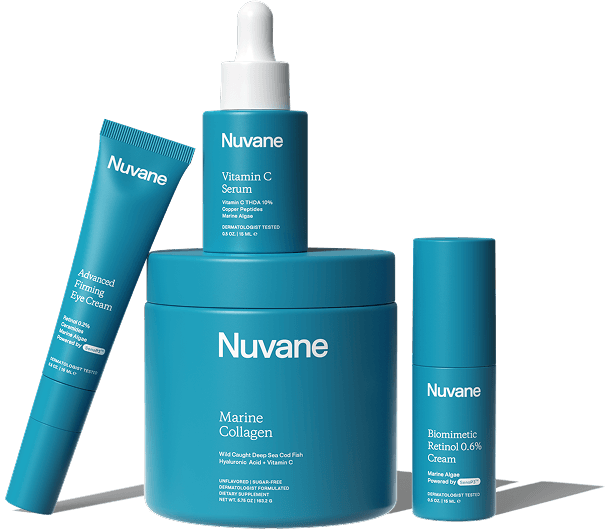
- Ceramides in the Advanced Vitamin C Serum and Firming Eye Cream replace the lipids that aggressive routines deplete.
- Niacinamide in the Biomimetic Retinol Cream and Regenerative Dark Spot Corrector supports barrier lipid synthesis, calms inflammatory signaling, and evens tone — three of the four inputs to visible radiance.
- Trehalose and hyaluronic acid hold water in the stratum corneum, which is the same mechanism glass skin exploits — except here it sits alongside actives that change the tissue rather than only the surface.
- Fucus vesiculosus and other marine algae extracts contribute polyphenols that modulate inflammatory signaling, addressing the pathway that connects barrier disruption to collagen loss.
Where each product fits a bloom skin routine:
- Advanced Vitamin C Serum (THD ascorbate + copper peptides + ceramides) — the morning step. THD ascorbate is lipid-soluble and pH-neutral, so it doesn't carry the sting and instability of L-ascorbic acid, which matters when barrier tolerance is the whole point.
- Biomimetic Retinol Cream 0.3% or 0.6% (stabilized retinol + SenoP3™ + niacinamide + trehalose + marine algae + hyaluronic acid) — the evening matrix step, formulated so the barrier support and the active arrive together rather than requiring you to layer a buffer.
- Biomimetic Bakuchiol Cream — the retinol-free route for reactive or already-compromised skin, with Centella asiatica for calming and a vitamin C derivative for tone.
- Firming Eye Cream (0.2% retinol + SenoP3™ + caffeine + ceramides) — for the periorbital area, where barrier thinness makes the tolerance question sharpest.
- Regenerative Dark Spot Corrector — for the even-tone requirement, since uneven pigment disrupts radiance regardless of hydration.
- Oral Marine Collagen Supplement — substrate support alongside the topical signals.
In a 12-week, IRB-supervised clinical evaluation of the SenoP3™ AI-personalized regimen (38 per-protocol subjects, presented at EADV 2026), 92.1% of participants reported improved smoothness and 94.7% reported overall satisfaction, with hydration measured by corneometry and barrier function by TEWL [6]. Those two instrumental measures are, in effect, the bloom skin endpoints.
Key takeaways
- Glass skin is a finish; bloom skin is a condition. One is applied to the top 20 micrometers of skin and rinses off; the other is built in the dermis and persists.
- The glow you can't apply comes from the dermal matrix. Collagen density and organization change how light travels through skin — which is why radiance and skin longevity are the same project [2].
- Fewer steps, better chosen. Barrier repair (ceramides, niacinamide, humectants) plus matrix building (peptides, retinoid or bakuchiol, vitamin C) covers what a ten-step routine was trying to do.
- Over-exfoliation is not a shortcut to glow. It raises TEWL, triggers inflammatory signaling, and activates the MMPs that degrade the collagen producing your radiance.
- Sunscreen is the highest-leverage step for both goals. UV degrades the barrier and the matrix simultaneously.
- Expect 8–12 weeks. Hydration improves in days. Dermal density — the source of real bloom — moves on a three-month timescale.
Frequently asked questions
Is bloom skin just a rebrand of "healthy skin"?
Largely, yes — and that's a point in its favor. The useful thing about the term is that it moves the aspirational target from a photographable finish to a biological state. The risk is the same as with any trend term: brands will attach it to products that do nothing structural. Judge the formula, not the label.
Can I get bloom skin if I have dry or sensitive skin?
Often more easily than you can get glass skin, because bloom skin doesn't require heavy layering. Start with barrier repair — a gentle cleanser, a ceramide moisturizer, and no exfoliation for two to four weeks. Once the barrier is stable, introduce a low-strength retinoid or bakuchiol with peptides, twice weekly at first.
Do I need to abandon my Korean skincare routine entirely?
No. Keep the parts that hold up — gentle cleansing, humectants before occlusives, diligent sunscreen, and the general emphasis on consistency. Drop the parts that were about layer count rather than mechanism: daily masks, four sequential essences, and daily acid exfoliation.
Is snail mucin still worth using?
It's a decent humectant with some soothing properties, and there's no reason to remove it if your skin likes it. It is not, however, a matrix-building active, so it belongs in the barrier half of your routine rather than as your primary anti-aging step.
How long does it take to see bloom skin results?
Barrier comfort and surface hydration improve within one to two weeks. Tone and smoothness at four to eight weeks. Firmness and the deeper luminosity that comes from dermal density at eight to twelve weeks, continuing beyond that with consistent use. If a product promises the last of these in a week, it is describing a hydration effect.
Does bloom skin work for mature skin over 50?
It's arguably better suited to mature skin than glass skin was. The glass-skin approach relied on a strong barrier tolerating heavy layering and exfoliation — exactly what post-menopausal skin doesn't have. A barrier-first, matrix-building approach addresses the two things that actually change after 50: lipid production and collagen density.
Can I still use retinol if I'm going for bloom skin?
Yes, and you probably should — retinoids are among the best-evidenced ways to increase dermal collagen, which is the structural basis of the look. The key is formulation and frequency. A retinol buffered with niacinamide, ceramides, and hyaluronic acid, used two to three nights a week to start, builds matrix without the barrier cost that pushed people away from actives in the first place.
Is PDRN part of the bloom skin trend?
It's frequently marketed alongside it, and injected PDRN does have real evidence for skin quality. Be more skeptical of topical PDRN: the molecule is far too large for passive penetration through intact skin, and most brands don't publish molecular weight or delivery data. Any benefit you see from a PDRN serum is more likely coming from the peptides and humectants beside it in the formula.
References
- Lee S, et al. "Optical clearing agent reduces scattering of light by the stratum corneum and modulates the physical properties of corneocytes via hydration." Skin Research and Technology, 2018;24(1):40–47.
- Kikuchi K, Masuda Y, Yamashita T, et al. "Dermal matrix affects translucency of incident light on the skin." Skin Research and Technology, 2016;22(2):145–150.
- Barber L. "Is 'bloom skin' the new 'glass skin' in K-beauty?" Cosmetics Business, 26 August 2026.
- "6 Korean Beauty Trends Shaping 2026: Moving From 'Glass Skin' To 'Bloom Skin'." Refinery29 Australia, 2026.
- Pickart L, Margolina A. "Regenerative and Protective Actions of the GHK-Cu Peptide in the Light of the New Gene Data." International Journal of Molecular Sciences, 2018;19(7):1987.
- Nuvane / SGS. "12-week clinical evaluation of the SenoP3™ AI-personalized regimen (Protocol C25-D123)." Presented at EADV Congress, 2026.
- Elias PM. "Stratum corneum defensive functions: an integrated view." Journal of Investigative Dermatology, 2005;125(2):183–200.
- Draelos ZD. "The science behind skin care: moisturizers." Journal of Cosmetic Dermatology, 2018;17(2):138–144.
- Bissett DL, Oblong JE, Berge CA. "Niacinamide: A B vitamin that improves aging facial skin appearance." Dermatologic Surgery, 2005;31(7 Pt 2):860–865.
- Varani J, Warner RL, Gharaee-Kermani M, et al. "Vitamin A Antagonizes Decreased Cell Growth and Elevated Collagen-Degrading Matrix Metalloproteinases and Stimulates Collagen Accumulation in Naturally Aged Human Skin." Journal of Investigative Dermatology, 2000;114(3):480–486.
- Dhaliwal S, Rybak I, Ellis SR, et al. "Prospective, randomized, double-blind assessment of topical bakuchiol and retinol for facial photoageing." British Journal of Dermatology, 2019;180(2):289–296.
Related search terms
bloom skin vs glass skin, what is bloom skin K-beauty, bloom skin routine 2026, is glass skin bad for your barrier, how to get lit from within glow, skin barrier repair routine ceramides, does hydration make skin glow, dermal collagen and skin translucency, over-exfoliation damaged barrier signs, K-beauty trends 2026 explained, best peptides for skin radiance, glass skin routine for mature skin, transepidermal water loss meaning, bloom skin for sensitive skin, is snail mucin worth it, retinol for glowing skin, SenoP3 peptide complex radiance
Find the most effective anti-aging products for you by taking the free skin assessment.
Recommended Read
Which 2026 skincare trends really live up to the hype?
Best ways to fix a damaged skin barrier fast
K-Beauty vs. Western Skincare: Which Is Best for Women Over 40?
What's the "less is more" idea in skin longevity?
Find the most effective anti-aging products for you by taking the free skin assessment.
Enjoyed this article? Add Nuvane as a preferred source on Google.