
Retinol or bakuchiol while you're on a GLP-1?


Quick Answer
The general answer favors retinol. The GLP-1 answer often favors bakuchiol — at least to start. Weight-loss medication changes the calculation because it changes the skin you're applying the product to.
- Retinol has the deeper evidence base for building dermal collagen, which is the specific deficit GLP-1 weight loss creates. It remains the reference standard.
- Bakuchiol produced comparable improvement in wrinkles and pigmentation to retinol in a randomized double-blind trial, with significantly less scaling and stinging [1] — and tolerability is the binding constraint on GLP-1 skin.
- The product you use consistently for twelve months outperforms the stronger one you abandon in week three. On drier, more reactive skin, this is the decisive consideration.
- Timing beats potency. Starting a gentle active in month one is worth more than starting an aggressive one in month six, because dermal remodeling takes 8–12 weeks to become measurable.
- A staged approach works well: bakuchiol during titration when skin is driest, transitioning to retinol at maintenance if tolerated — or running both, on alternating nights.
Why does being on a GLP-1 change the answer?
Because the standard retinol-versus-bakuchiol comparison assumes a normal barrier, and GLP-1 skin does not have one.
In the general population, retinol usually wins the comparison. It has fifty years of clinical evidence, a well-mapped receptor mechanism, and dose-responsive effects on dermal collagen. Bakuchiol is the gentler alternative you choose when retinol proves intolerable.
Weight-loss medication inverts several of the assumptions behind that ranking.
GLP-1 skin is drier. The American Academy of Dermatology lists dry skin among the documented effects of these drugs, driven by reduced fluid intake and hormonal change [2]. Retinol's irritation profile is dose- and barrier-dependent: the same 0.5% cream that a well-hydrated 35-year-old tolerates nightly can produce visible peeling on someone four months into tirzepatide titration.
GLP-1 skin is more reactive. Barrier lipid synthesis depends on dietary precursors that fall when intake falls. A compromised barrier absorbs actives less predictably and reacts to them more.
GLP-1 skin needs more from the active, not less. This is the tension. Rapid weight loss depletes facial fat and reduces dermal support simultaneously. Retinoids increase dermal thickness and procollagen production — exactly what this skin needs. So you have a population that would benefit most from a retinoid and tolerates it least well.
The treatment window is long. Most people are on a GLP-1 for a year or more. Over that horizon, adherence dominates potency. A product used four nights a week for fifty weeks delivers far more cumulative retinoid signal than one used nightly for three weeks and then abandoned.
The honest framing
There is no ingredient that is universally correct here. There is a product you will actually use through the hardest three months of your treatment, and that is the one that will work.
How do retinol and bakuchiol actually differ?
Same destination, different roads — and the difference in the road explains the difference in tolerability.
Retinol: the receptor pathway
Retinol is a vitamin A derivative. Once absorbed, it is converted in two enzymatic steps — retinol to retinaldehyde to retinoic acid — and retinoic acid binds nuclear retinoic acid receptors (RAR) and retinoid X receptors (RXR). These are transcription factors: binding changes which genes the cell expresses.
Downstream, this increases procollagen I and III synthesis, inhibits matrix metalloproteinases that degrade existing collagen, accelerates keratinocyte turnover, and normalizes follicular keratinization. In a vehicle-controlled trial in older adults, 0.4% retinol applied three times weekly for 24 weeks significantly increased glycosaminoglycan content and procollagen I, with matching clinical improvement in fine wrinkling [3].
The same receptor activation drives the irritation. Retinoid dermatitis — the redness, scaling, and stinging of the first weeks — is a direct consequence of accelerated turnover and transient barrier disruption. It is mechanistically inseparable from the benefit, which is why "retinization" is a real process rather than a marketing concept.
Bakuchiol: the parallel pathway
Bakuchiol is a meroterpene phenol from the seeds of Psoralea corylifolia, used in Ayurvedic medicine long before its cosmetic application. It is not a vitamin A derivative and it does not bind retinoic acid receptors.
What it does is produce a strikingly similar gene expression signature. In functional genomics work, bakuchiol upregulated collagen types I, III, and IV and modulated many of the same pathways as retinol, apparently through independent mechanisms [4]. It also has antioxidant and anti-inflammatory activity that retinol lacks, and it is photostable — unlike retinol, which degrades in light and air.
Because it does not activate RAR, it does not produce retinoid dermatitis. That is the entire practical advantage, and on GLP-1 skin it is a large one.
The head-to-head data
The comparison most often cited is a 12-week prospective, randomized, double-blind trial by Dhaliwal and colleagues, published in the British Journal of Dermatology in 2019 [1]. Forty-four participants used either 0.5% bakuchiol twice daily or 0.5% retinol once daily.
- Both groups showed significant, statistically comparable reductions in wrinkle surface area and hyperpigmentation.
- Retinol users reported significantly more facial skin scaling and stinging.
- No significant difference in efficacy was detected between the two.
Two caveats deserve stating plainly. The study was small and ran only 12 weeks — long enough to detect surface changes, arguably not long enough to detect the dermal remodeling that is retinol's strongest long-term claim. And bakuchiol was applied twice daily against retinol once daily. Retinol's total body of evidence remains substantially deeper. But for the specific question "will this deliver visible benefit at acceptable comfort over three months," the data support bakuchiol as a legitimate choice rather than a consolation prize.
Which should you choose during weight loss?
A decision framework based on where you are in treatment and how your skin is behaving.
Choose bakuchiol if:
- You are in the titration phase (roughly weeks 4–16), when intake is lowest and dryness peaks.
- Your skin is currently dry, tight, flaking, or stinging with products it previously tolerated.
- You have a history of rosacea, eczema, or sensitive skin.
- You have tried retinol before and abandoned it because of irritation.
- You are pregnant or breastfeeding — retinoids are contraindicated, bakuchiol is not, though confirm with your obstetrician.
- You want a single product used morning and evening rather than managing a night-only active.
Choose retinol if:
- You are at a stable maintenance dose with intake and skin comfort recovered.
- Your skin is comfortable and well-hydrated with a functioning barrier.
- You have used retinoids successfully before.
- Your priority is maximum dermal collagen building and you can tolerate a slow ramp.
- You are also treating acne or post-inflammatory pigmentation, where retinoid evidence is stronger.
Or run both — the approach I most often recommend
The two work through independent pathways, which means they are complementary rather than redundant. A practical schedule on GLP-1 skin:
- Weeks 1–4: bakuchiol nightly. Establish tolerance and support the barrier.
- Weeks 5–8: bakuchiol on five nights, low-strength retinol on two.
- Weeks 9–16: alternate nights, as comfort allows.
- Maintenance: whatever ratio keeps your skin comfortable. Skew toward bakuchiol during any period of rapid loss, GI upset, or increased dryness.
This gives you retinoid receptor activation and bakuchiol's antioxidant and anti-inflammatory activity, at a total irritation load that dehydrated skin can absorb. It also builds in a fallback: on a bad skin week you drop the retinol nights rather than stopping treatment altogether.
What about prescription tretinoin?
Tretinoin is retinoic acid itself, requiring no enzymatic conversion, and it is considerably more potent and more irritating. During active GLP-1 weight loss, I generally advise against starting it. If you are already established on tretinoin and tolerating it well, there is no reason to stop — but expect to need a richer moisturizer and possibly a reduced frequency during titration.
How does Nuvane formulate for each pathway?
Both Nuvane actives are built on the same peptide foundation, so switching between them or alternating does not mean losing the rest of the benefit.
The core of both formulas is the SenoP3™ triple-peptide complex:
- Palmitoyl Tripeptide-38 — signals fibroblasts to produce collagen I, III, and IV, fibronectin, and hyaluronic acid.
- Copper Tripeptide-1 (GHK-Cu) — a naturally occurring copper-binding tripeptide whose plasma concentration falls with age; it stimulates collagen and elastin synthesis and provides antioxidant and tissue-remodeling activity [5].
- Acetyl Hexapeptide-8 — reduces the depth of dynamic expression lines; a controlled study of a 10% solution showed roughly 30% reduction in wrinkle depth over 30 days [6].
This matters for the retinol-versus-bakuchiol decision because the peptide work continues either way. Peptides act through pathways independent of both retinoid receptors and bakuchiol's mechanism, so a week spent on bakuchiol because your skin is struggling is not a week of lost collagen stimulation.
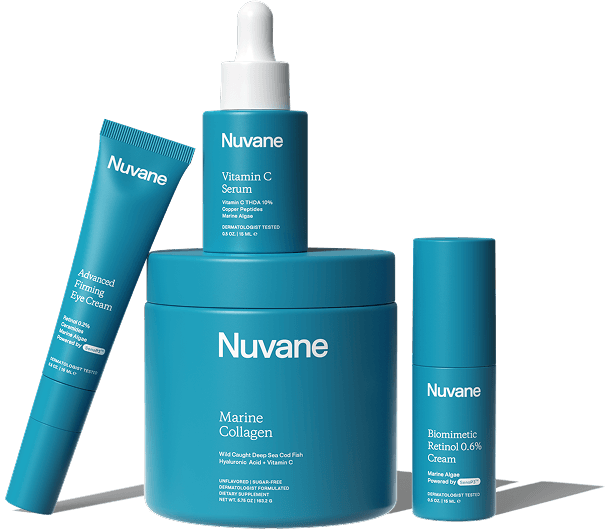
The Biomimetic Bakuchiol Cream combines bakuchiol with peptides, a vitamin C derivative, Centella asiatica — a botanical with documented anti-inflammatory and wound-healing activity — and marine algae. It is the appropriate default during the titration phase and for anyone with a history of reactive skin.
The Biomimetic Retinol Cream is available in 0.3% and 0.6%, with stabilized retinol alongside SenoP3™, niacinamide, trehalose, marine algae, and hyaluronic acid. The inclusion of niacinamide is deliberate and relevant here: it increases the skin's own ceramide and free fatty acid synthesis, offsetting part of the barrier disruption the retinoid causes [7]. Trehalose protects cells against dehydration stress. On GLP-1 skin, start at 0.3%, two to three nights weekly.
Supporting products work with either choice. The Advanced Vitamin C Serum uses THD ascorbate, a lipid-soluble derivative that penetrates well and stings far less than L-ascorbic acid, with copper peptides and ceramides. The Firming Eye Cream treats the periorbital area — first to show volume loss on a GLP-1 — with retinol 0.2%, SenoP3™, caffeine, and ceramides. The Regenerative Dark Spot Corrector pairs alpha arbutin with retinol, SenoP3™, and niacinamide where pigmentation is also a concern. The Oral Marine Collagen Supplement supplies hydrolyzed marine collagen, hyaluronic acid, and vitamin C, which matters when protein intake is compromised by appetite suppression [8].
What results should you expect, and when?
Neither ingredient works quickly. Set the timeline correctly and you are far more likely to still be using it when it starts working.
- Weeks 1–2: nothing visible. With retinol, possible dryness, mild flaking, or tightness. With bakuchiol, usually nothing at all.
- Weeks 3–6: improved surface texture and radiance from increased turnover. Retinol users typically past the adjustment phase by now.
- Weeks 8–12: the first genuine dermal changes. Fine lines soften; skin feels firmer. This is when procollagen increases become measurable [3].
- Weeks 12–24: meaningful improvement in elasticity and dermal thickness. On a GLP-1, this is also when the difference between people who started early and people who did not becomes visible.
- Beyond 6 months: continued, slower accrual. Benefits are maintained only with continued use.
The reason to be explicit about this: the steepest phase of GLP-1 weight loss usually falls between months two and six. If you start an active in week one, you are entering that phase with the dermis already remodeling. If you start when you first notice hollowing, you begin the 12-week clock from behind.
Why does oral collagen matter more when you're on a GLP-1?
Collagen synthesis is substrate-limited: the dermis builds new matrix from glycine, proline, and lysine, using vitamin C as an obligatory cofactor for the enzymes that stabilize the collagen triple helix. On a GLP-1, both inputs fall at once — appetite suppression drives total protein intake down at precisely the moment the skin is being asked to remodel around a rapidly shrinking frame.
Nuvane's Marine Collagen is formulated for that gap. Each scoop provides 5,000 mg of hydrolyzed marine collagen peptides supplying types I and III, the two collagen types that dominate skin and connective tissue, alongside 100 mg of hyaluronic acid for dermal water-binding and 60 mg of vitamin C supplying the cofactor the synthesis pathway requires. The combination matters more than any single component: most standalone collagen powders ship without vitamin C, which leaves the amino acids arriving without the enzyme support needed to use them.
A systematic review and meta-analysis of randomized controlled trials found that hydrolyzed collagen supplementation produced statistically significant improvements in skin hydration and elasticity over 8 to 12 weeks [8]. The same amino acid and micronutrient shortfall that affects skin also contributes to the hair thinning and brittle nails the American Academy of Dermatology now lists among GLP-1 side effects [2], so a single daily serving addresses more than one complaint at a time.
It will not restore lost facial fat — nothing taken by mouth will. What it does is support the dermal quality that determines how gracefully skin drapes over a smaller face, working from the side that topical products cannot reach.
Key Takeaways
- Retinol has deeper evidence; bakuchiol has better tolerability — and on GLP-1 skin, tolerability frequently decides the outcome.
- In the one good head-to-head trial, efficacy was comparable and retinol caused significantly more scaling and stinging [1].
- Start with bakuchiol during titration, when dryness peaks, and consider transitioning to retinol at maintenance.
- Alternating both is often the best answer — independent pathways, complementary effects, manageable irritation load.
- Start at 0.3% retinol, two to three nights weekly, never 0.6% out of the gate on GLP-1 skin.
- Peptides work regardless of your choice. SenoP3™ continues stimulating collagen and elastin on the nights you skip the active.
- Begin in month one. Dermal remodeling takes 8–12 weeks; the steepest weight loss arrives in months two through six.
- Sunscreen every morning, particularly with retinol, which increases photosensitivity.
Frequently Asked Questions
Is bakuchiol as effective as retinol?
In the available head-to-head evidence — a 12-week randomized double-blind trial — bakuchiol produced statistically comparable improvement in wrinkles and pigmentation with significantly less irritation [1]. Retinol's overall evidence base is deeper and longer, particularly for dermal remodeling beyond 12 weeks. For most people on a GLP-1, the practical difference is smaller than the difference between using something consistently and not.
Can I use retinol and bakuchiol together?
Yes, and on GLP-1 skin it is often the best approach. They act through independent pathways, so the effects are complementary. Alternate nights rather than layering both at once, so the irritation load stays manageable.
Which is better for Ozempic face specifically?
For volume loss itself, neither — that is a fat compartment issue that topicals cannot address. For the skin quality problem that accompanies it, retinol has the stronger evidence for increasing dermal thickness, which is what helps skin drape better over a smaller face. Bakuchiol is the better choice if retinol is not tolerable, and a peptide complex such as SenoP3™ should be part of either routine.
Will retinol make my skin drier on a GLP-1?
Initially, yes — transient barrier disruption is part of how retinoids work. On skin that is already dry from reduced intake, this can be significant. Mitigate it by starting at 0.3% two nights weekly, applying moisturizer before the retinoid, choosing a formula that includes niacinamide and trehalose, and increasing frequency only once your skin is comfortable.
How long before I see results from either?
Surface texture and radiance improve within three to six weeks. Genuine dermal change — firmness, fine line reduction, elasticity — takes 8 to 12 weeks, with continued improvement through six months.
Is bakuchiol safe during pregnancy?
Retinoids are contraindicated in pregnancy, and bakuchiol is widely used as the alternative because it is not a vitamin A derivative. That said, safety data in pregnancy are limited for most cosmetic actives, so confirm with your obstetrician before using anything. This is relevant here because a number of people conceive while on or shortly after GLP-1 treatment.
Should I stop my active during the worst of the dryness?
Reduce rather than stop, if you can. Dropping to one or two nights a week, or switching to bakuchiol entirely, preserves the benefit while letting the barrier recover. Stopping outright for months means restarting the adjustment period later.
Does bakuchiol cause purging like retinol can?
Rarely. Purging — a transient acne flare from accelerated turnover pushing existing microcomedones to the surface — is a retinoid phenomenon and typically settles within four to six weeks. Bakuchiol increases turnover more gently and purging is uncommon.
Do I still need sunscreen with bakuchiol?
Yes. Bakuchiol is photostable and does not increase photosensitivity the way retinol does, but UV exposure is the dominant driver of collagen and elastin degradation. On a GLP-1, protecting the elastin you still have is central to how well your skin retracts. Broad-spectrum SPF 30+ daily, regardless of which active you use.
Can men use either of these while on a GLP-1?
Yes, with no modification. Male skin is typically thicker with denser collagen, which sometimes means better retinol tolerance, but the same dryness and reactivity develop during weight loss and the same staged approach applies.
References
- Dhaliwal S, Rybak I, Ellis SR, et al. Prospective, randomized, double-blind assessment of topical bakuchiol and retinol for facial photoageing. Br J Dermatol. 2019;180(2):289–296.
- American Academy of Dermatology. How can GLP-1 drugs affect my skin, hair, and nails? AAD Public Resource Center. 2025.
- Kafi R, Kwak HSR, Schumacher WE, et al. Improvement of naturally aged skin with vitamin A (retinol). Arch Dermatol. 2007;143(5):606–612.
- Chaudhuri RK, Bojanowski K. Bakuchiol: a retinol-like functional compound revealed by gene expression profiling and clinically proven to have anti-aging effects. Int J Cosmet Sci. 2014;36(3):221–230.
- Pickart L, Margolina A. Regenerative and protective actions of the GHK-Cu peptide. Int J Mol Sci. 2018;19(7):1987.
- Blanes-Mira C, Clemente J, Jodas G, et al. A synthetic hexapeptide with antiwrinkle activity. Int J Cosmet Sci. 2002;24(5):303–310.
- Bissett DL, Oblong JE, Berge CA. Niacinamide: a B vitamin that improves aging facial skin appearance. Dermatol Surg. 2005;31(7 Pt 2):860–865.
- de Miranda RB, Weimer P, Rossi RC. Effects of hydrolyzed collagen supplementation on skin aging: a systematic review and meta-analysis. Int J Dermatol. 2021;60(12):1449–1461.
- Mukherjee S, Date A, Patravale V, et al. Retinoids in the treatment of skin aging. Clin Interv Aging. 2006;1(4):327–348.
- Cosmoderma. Semaglutide and the skin: a brief review of dermatologic implications. Cosmoderma. 2024;4:98.
Related Search Terms
retinol or bakuchiol on GLP-1, bakuchiol vs retinol Ozempic, best retinol for GLP-1 users, can I use retinol on semaglutide, gentle retinol alternative weight loss, bakuchiol for dry skin on Mounjaro, retinol strength to start on Zepbound, alternating retinol and bakuchiol, retinoid irritation during weight loss, is bakuchiol as good as retinol, best active ingredient for Ozempic face, retinol 0.3 vs 0.6 sensitive skin, peptides with retinol GLP-1, tretinoin while on weight loss injections, bakuchiol pregnancy safe retinol alternative
Find the most effective anti-aging products for you by taking the free skin assessment.
Recommended Read
Retinol vs. Bakuchiol — which is best for your skin?
Best skincare for people on GLP-1
Best retinol for sensitive skin (derm-backed)
Best copper peptides (GHK-Cu) for aging skin and hair
Find the most effective anti-aging products for you by taking the free skin assessment.
Enjoyed this article? Add Nuvane as a preferred source on Google.