
Best 10 ingredients to get rid of your under-eye bags


Key Takeaways
- Caffeine is the most immediate and well-documented ingredient for reducing under-eye puffiness — it constricts blood vessels and reduces fluid accumulation in the delicate periorbital tissue.
- Retinol at 0.2% is the most effective long-term ingredient for under-eye bags caused by thinning, crepey skin — it rebuilds the structural integrity that keeps the eye area looking firm and smooth.
- Copper Tripeptide-1 (GHK-Cu) stimulates collagen and elastin production in the eye area, gradually restoring the density and resilience that prevents the hollowing and shadowing that makes bags appear worse.
- The under-eye area requires a different approach than the rest of the face. The skin here is 40% thinner, has fewer sebaceous glands, and is subject to constant movement — making both ingredient selection and concentration critical.
- Combining depuffing, structural, and brightening ingredients addresses the three overlapping causes of under-eye bags: fluid retention, loss of skin density, and pigmentation — for results no single ingredient can produce alone.
Why are under-eye bags so hard to treat?
The under-eye area is the most structurally complex and fragile zone on the face — and it ages faster than almost anywhere else.
Under-eye bags are not one problem — they are three overlapping problems that appear together and reinforce each other. Puffiness results from fluid accumulation and fat pad prolapse through weakened connective tissue. Dark circles result from a combination of thin skin that reveals the underlying blood vessels, melanin hyperpigmentation, and shadowing caused by the loss of structural volume. Crepiness and fine lines result from the thinning and sagging of skin that has lost collagen, elastin, and hydration.
The same ingredients that work on the cheeks or forehead often cannot be used at full strength around the eyes — and many cannot be used at all. Formulas for the eye area need to be gentler, more precisely dosed, and more specifically targeted. An eye cream is not just a moisturizer applied close to the eye: it is a delivery system for specific actives at concentrations calibrated for one of the most sensitive surfaces on the body.
The ten ingredients below address all three aspects of under-eye bags — depuffing, structural rebuilding, and brightening — with evidence behind each one.
What are the 10 best ingredients for getting rid of under-eye bags?
Here is a dermatologist's ranked breakdown of the most effective ingredients for the under-eye area, from the most immediately visible to the most structurally transformative.
#1 — Caffeine
Caffeine is the most reliably effective immediate-action ingredient for reducing under-eye puffiness, with a mechanism that is well-understood and a track record that is hard to argue with.
Caffeine is a methylxanthine that works through two distinct mechanisms. First, it is a potent vasoconstrictor — it narrows the small blood vessels beneath the thin under-eye skin, reducing the blood pooling that causes dark circles to appear more pronounced [1]. Second, it inhibits phosphodiesterase, promoting lipolysis (fat breakdown) in subcutaneous tissue, which helps reduce the appearance of fat pad protrusion that creates puffiness [1].
Clinical studies on topical caffeine have shown measurable reductions in under-eye puffiness and dark circle intensity within 4–6 weeks of twice-daily use. The vasoconstricting effect is visible within minutes of application, making it one of the few skincare ingredients with a meaningful immediate cosmetic effect alongside its longer-term cumulative benefits.
Caffeine is also an antioxidant, offering some protection against the UV-generated free radicals that accelerate structural degradation in the periorbital area. For a region of skin that is constantly exposed and moving, this added protection is relevant.
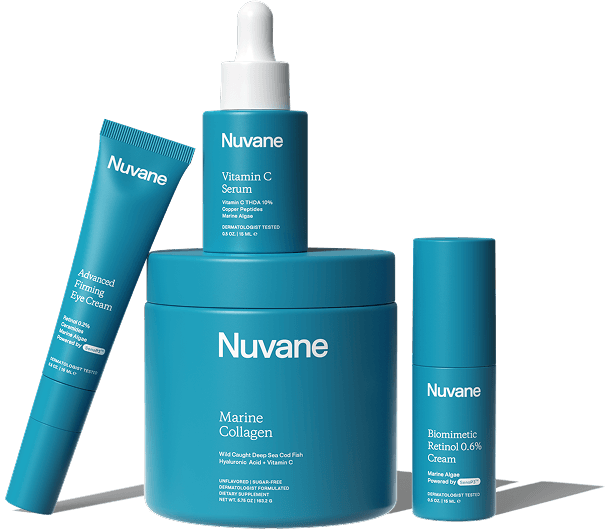
In Nuvane's lineup: The Advanced Firming Eye Cream includes caffeine as a core active alongside retinol, SenoP3™, and ceramides — specifically designed for the depuffing and structural needs of the under-eye area.
#2 — Retinol (0.2%)
Retinol is the most structurally transformative ingredient for under-eye bags caused by thinning, crepey skin — but concentration and formulation must be calibrated specifically for the eye area.
Full-strength retinol (0.3–1%) is too aggressive for the periorbital zone in most people. The skin here is 40% thinner than on the rest of the face, has minimal sebaceous glands to buffer the active, and is subject to constant movement that compromises barrier function more rapidly. At 0.2%, retinol delivers the collagen-stimulating and cell-turnover-accelerating benefits of vitamin A without the dryness, irritation, and increased photosensitivity that higher concentrations typically cause in this area [2].
What retinol does in the under-eye area is both direct and indirect. Directly, it stimulates fibroblasts in the thin dermis to produce more collagen and elastin — thickening the skin over time so the underlying vasculature and fat compartments become less visible. Indirectly, it accelerates cell turnover, which disperses accumulated pigmentation and improves the overall texture of crepey under-eye skin [2].
Visible improvement in fine lines and structural density around the eye typically becomes apparent within 8–12 weeks of consistent nightly use. The effect compounds over time: skin that has been consistently supported by low-dose retinol for six months looks genuinely different from skin that has not.
In Nuvane's lineup: The Advanced Firming Eye Cream uses retinol at the appropriate 0.2% concentration for the periorbital area, paired with SenoP3™, caffeine, and ceramides to support the skin barrier throughout the treatment.
#3 — Copper Tripeptide-1 (GHK-Cu)
Copper Tripeptide-1 addresses the structural root cause of long-term under-eye bags by rebuilding the collagen and elastin network that keeps the periorbital skin firm, supported, and resistant to the hollowing that makes bags appear worse.
As GHK-Cu levels in the skin decline with age, the dermis loses its capacity for self-repair. In the under-eye area — where the dermis is already thin and the skin is subject to near-constant movement — this loss accelerates the structural sagging that allows fat pads to protrude and blood vessels to show through [3].
Topically applied GHK-Cu stimulates fibroblast activity, collagen type I and III synthesis, and elastin production in the dermis. It also reduces the activity of matrix metalloproteinases (MMPs) — the enzymes that break down existing collagen — effectively slowing the structural deterioration that causes the eye area to hollow and sag with age [3].
GHK-Cu is particularly valuable in the under-eye area because its skin-repair activity extends to the microvasculature. It supports the integrity of the small blood vessels beneath the eye skin, which when weakened contribute to the dark, purplish discoloration associated with vascular dark circles.
GHK-Cu is part of Nuvane's SenoP3™ complex and is present in the Advanced Firming Eye Cream alongside caffeine and retinol.
#4 — Palmitoyl Tripeptide-38
Palmitoyl Tripeptide-38 rebuilds the extracellular matrix that has been gradually lost in the under-eye area — restoring the skin's ability to support itself and resist the creasing and hollowing that make bags appear more severe.
The extracellular matrix beneath the under-eye skin is a complex scaffold of collagen, elastin, fibronectin, and hyaluronic acid. When this scaffold degrades — through UV exposure, inflammation, and the natural decline of biosynthetic activity with age — the skin loses its internal support structure. The result is the thin, loose, creased skin that characterizes aging around the eyes.
Palmitoyl Tripeptide-38 signals fibroblasts to upregulate the production of six critical matrix components: collagen I, III, and IV, fibronectin, hyaluronic acid, and laminin-5 [4]. This multi-component rebuilding approach is more complete than ingredients that target only collagen, because skin density depends on the entire matrix — not one protein alone.
Clinical studies with Palmitoyl Tripeptide-38 have shown measurable improvements in skin density, firmness, and wrinkle depth within 2 months of consistent use [4]. In the under-eye area, where lost matrix volume is one of the primary drivers of bags and hollowing, this structural rebuilding produces meaningful visible improvements over time.
Palmitoyl Tripeptide-38 is the second component of Nuvane's SenoP3™ complex, present in the Advanced Firming Eye Cream.
#5 — Acetyl Hexapeptide-8 (Argireline)
Acetyl Hexapeptide-8 specifically targets the expression lines and dynamic creases around the eye that deepen with every blink, squint, and smile — addressing the movement-driven component of under-eye aging that structural ingredients alone cannot reach.
The periorbital area is subject to an estimated 10,000 muscle contractions per day. Every blink, every squint in bright light, every smile creates repeated mechanical stress on the delicate skin around the eye — gradually deepening crow's feet, under-eye crinkles, and the creases at the inner corners. Acetyl Hexapeptide-8 modulates the neuromuscular signaling that drives these contractions by competing with the SNAP-25 protein in the SNARE complex [5].
The result is a temporary, local softening of the repetitive muscle movements that engrave expression lines into the under-eye skin. Clinical studies have demonstrated visible reductions in crow's feet depth and periorbital line intensity with twice-daily use over 30 days [5]. This effect is gradual and cumulative rather than immediate — unlike caffeine's rapid depuffing, Acetyl Hexapeptide-8 produces results that build meaningfully over weeks and months.
Acetyl Hexapeptide-8 completes Nuvane's SenoP3™ complex, present in the Advanced Firming Eye Cream as the third peptide in the triple-peptide system.
#6 — Ceramides
Ceramides are the cornerstone of under-eye barrier function — and a compromised barrier in this area amplifies every sign of aging, from puffiness to dark circles to crepey texture.
Ceramides are lipid molecules that make up approximately 50% of the stratum corneum — the outermost protective layer of the skin. In the under-eye area, where the skin barrier is naturally thinner and more vulnerable, ceramide levels decline significantly with age. When the barrier is compromised, the skin loses moisture rapidly, becomes more reactive, and is less able to defend against the environmental stressors that accelerate structural aging [6].
Topical ceramides (particularly ceramides 1, 3, and 6-II) replenish this lipid barrier, reducing transepidermal water loss (TEWL), improving hydration, and protecting the delicate periorbital skin from the dehydration-driven lines that make the under-eye area look perpetually tired. They also reduce the skin's inflammatory reactivity — important because chronic low-grade inflammation in the eye area contributes to both pigmentation and structural breakdown.
In a well-designed eye cream, ceramides play the role of the supporting cast that makes every active ingredient perform better. Retinol, peptides, and caffeine all produce better results in a skin that is properly protected, hydrated, and barrier-intact.
Ceramides are a key structural ingredient in Nuvane's Advanced Firming Eye Cream, where they work alongside retinol and SenoP3™ to support barrier health throughout the treatment.
#7 — Hyaluronic Acid (Sodium Hyaluronate)
Hyaluronic acid is the most important hydration ingredient for the under-eye area — and in skin this thin, hydration has a visible structural effect that goes beyond simple moisture.
The under-eye skin has almost no sebaceous glands and therefore cannot produce its own surface lipids to retain moisture. It relies almost entirely on external hydration support and barrier integrity to maintain adequate water content. When it loses that hydration — through a compromised barrier, dry environments, or insufficient skincare — it becomes more transparent (making vessels more visible), more creased (making fine lines more pronounced), and more shadowed (making bags appear deeper) [7].
Low-molecular-weight sodium hyaluronate penetrates into the epidermis where it binds water and plumps the skin from within — temporarily reducing the hollowing and shadowing effect that makes under-eye bags appear more severe. With consistent daily use, this hydration support also improves the skin's response to active ingredients like retinol and peptides, reducing irritation and improving penetration.
Hyaluronic acid does not rebuild structure, fade pigmentation, or depuff on its own. But it creates the well-hydrated, plump skin environment in which all other under-eye ingredients perform more effectively.
Sodium hyaluronate appears throughout Nuvane's treatment lineup, including in the Advanced Firming Eye Cream and both Biomimetic Retinol Creams.
#8 — Niacinamide (Vitamin B3)
Niacinamide addresses the pigmentation component of under-eye dark circles — the melanin deposits that make the under-eye shadow darker and more pronounced — with outstanding tolerability for the periorbital area.
Dark circles have multiple causes. Vascular dark circles (bluish-purple) result from blood pooling in thin under-eye skin. Structural dark circles result from shadowing caused by hollowing and loss of volume. Pigmented dark circles (brownish) result from accumulated melanin deposits — most common in people with medium-to-deep skin tones, but increasingly prevalent in lighter skin after years of UV exposure.
Niacinamide addresses this third type by inhibiting the transfer of melanosomes from melanocytes to keratinocytes — reducing how much melanin actually reaches the skin surface [8]. At 4–5% concentration, it has been shown to improve the evenness of skin tone around the eye, reduce the intensity of brownish discoloration, and brighten the overall appearance of the periorbital area.
Niacinamide also strengthens the skin barrier, reduces inflammation, and supports ceramide production — making it a versatile supporting ingredient for under-eye skin that needs both brightening and protection simultaneously.
Niacinamide appears in Nuvane's Biomimetic Retinol Creams and Regenerative Dark Spot Corrector, and can be used in the orbital area as part of a broader brightening approach.
#9 — Vitamin C (THD Ascorbate)
Vitamin C targets vascular dark circles — the bluish discoloration from blood pooling beneath thin under-eye skin — by strengthening blood vessel walls and neutralizing the oxidized hemoglobin that creates that characteristic dark shadow.
The blue-purple tint of vascular dark circles comes partly from the visibility of blood through thin skin, and partly from the oxidation of hemoglobin that leaks from fragile periorbital capillaries. Vitamin C addresses both pathways. As an antioxidant, it reduces the oxidative conversion of hemoglobin to hemosiderin — the rust-colored byproduct that deepens the discoloration [9]. As a cofactor for collagen synthesis, it helps strengthen the capillary walls themselves, reducing the leakage that contributes to pigmentation over time.
THD Ascorbate's lipid-soluble form penetrates the under-eye skin efficiently and remains stable in formula — making it more reliable than standard ascorbic acid in this application. Its broader antioxidant coverage also protects the periorbital area against UV-generated free radicals that accelerate both structural aging and pigmentation.
The Advanced Vitamin C Serum can be carefully applied to the orbital area as a brightening morning step, adding antioxidant protection alongside its melanin-inhibiting and collagen-supporting effects.
#10 — Marine Algae (Fucus Vesiculosus)
Marine algae provides the antioxidant protection and hydration support that keeps the under-eye area resilient against the environmental and metabolic stressors that accelerate visible aging in this uniquely vulnerable zone.
Fucus vesiculosus is rich in fucoidan, polyphenols, and alginic acid — compounds with documented antioxidant, anti-inflammatory, and skin-conditioning properties [10]. In the under-eye area, where the skin is thin, constantly moving, and poorly equipped to defend itself against environmental stress, these properties translate into meaningful protection.
The antioxidant activity of marine algae extracts neutralizes free radicals generated by UV exposure and pollution — reducing the oxidative damage that accelerates collagen breakdown and blood vessel fragility in the periorbital area. The anti-inflammatory properties help calm the low-grade chronic inflammation that contributes to structural degradation and pigmentation over time.
Marine algae also provides skin-conditioning polysaccharides that support surface hydration and improve the tactile smoothness of under-eye skin. As a supporting ingredient — rather than a primary active — it contributes a protective layer that helps every other ingredient in the formula perform more durably.
Marine algae appears in both Biomimetic Retinol Creams and the Regenerative Dark Spot Corrector across Nuvane's lineup.
Which Nuvane products are best for under-eye bags?
The under-eye area needs targeted treatment — a formula calibrated for the delicate periorbital zone, not simply a face cream applied lower.
The Advanced Firming Eye Cream is Nuvane's dedicated solution for the under-eye area. It is the only product in the range specifically formulated at the concentrations and pH appropriate for periorbital skin — combining caffeine, retinol 0.2%, SenoP3™, and ceramides in a single formula that addresses puffiness, structural thinning, expression lines, and barrier health simultaneously.
For comprehensive under-eye treatment:
- Night: Advanced Firming Eye Cream (retinol + caffeine + SenoP3™)
- Morning: Advanced Vitamin C Serum carefully applied to the orbital area (antioxidant + brightening)
- Both: Consistent broad-spectrum SPF during the day — UV exposure is a primary driver of under-eye structural aging
Which Nuvane products target the under-eye area?
- Advanced Firming Eye Cream — The core under-eye treatment. Retinol 0.2% + SenoP3™ (GHK-Cu, Palmitoyl Tripeptide-38, Acetyl Hexapeptide-8) + caffeine + ceramides. Addresses puffiness, structural thinning, crepey texture, and expression lines in a single calibrated formula.
- Advanced Vitamin C Serum — Morning brightening and antioxidant protection for the orbital area. THD Ascorbate + copper peptides targets vascular and pigmented dark circles while defending against UV-driven structural aging.
- Regenerative Dark Spot Corrector — For under-eye dark circles with a strong pigmentation component. Alpha arbutin + retinol + SenoP3™ + niacinamide addresses brownish discoloration and melanin accumulation around the eye.
Key Takeaways: The Under-Eye Ingredient Hierarchy
- Caffeine for immediate puffiness. Nothing depuffs the under-eye area faster or more reliably — it is the ingredient that makes the difference between looking tired and looking rested.
- Retinol at 0.2% for long-term structural improvement. The under-eye area needs the collagen-rebuilding power of retinol, but at a concentration calibrated for its uniquely thin and sensitive skin.
- Peptides for structural depth. GHK-Cu, Palmitoyl Tripeptide-38, and Acetyl Hexapeptide-8 address collagen loss, matrix degradation, and expression lines — three distinct structural mechanisms in a single complex.
- Ceramides for barrier protection. Without a healthy barrier, every other active ingredient in an eye cream underperforms and causes irritation.
- Vitamin C and niacinamide for dark circles. Addressing the pigmentation and vascular components of dark circles is as important as the structural work — and requires ingredients with completely different mechanisms.
Frequently Asked Questions
What actually causes under-eye bags?
Under-eye bags have three overlapping causes. First, fluid retention and fat pad prolapse through weakened connective tissue (structural puffiness). Second, thin skin that reveals underlying blood vessels and creates vascular shadowing. Third, melanin hyperpigmentation that adds a brownish tint to the discoloration. Most people experience a combination of all three, which is why multi-ingredient approaches produce better results than single actives.
Does caffeine really reduce under-eye puffiness?
Yes — both immediately and cumulatively. Topical caffeine constricts blood vessels within minutes of application, reducing the blood pooling that creates dark shadowing and puffiness. With consistent twice-daily use, it also inhibits the phosphodiesterase that drives subcutaneous fat accumulation, producing a gradual long-term reduction in fat pad protrusion.
Is retinol safe to use around the eyes?
Yes, at the appropriate concentration. Retinol at 0.2% — as used in Nuvane's Advanced Firming Eye Cream — is specifically formulated for the periorbital area. Standard face retinol (0.3–1%) can be too irritating for the thin, sebaceous-gland-poor skin around the eye. The key is using an eye-specific formula rather than applying face retinol to the orbital area directly.
How long does it take to see results from an eye cream?
Caffeine's depuffing effect is visible within minutes. Meaningful improvements in fine lines, structural firmness, and dark circles from retinol and peptides typically require 8–12 weeks of consistent use. The structural rebuilding driven by collagen-stimulating peptides is a cumulative process — results become more pronounced with sustained daily use over months.
Can under-eye bags be completely eliminated with skincare?
Skincare can significantly improve the appearance of under-eye bags caused by skin thinning, fluid accumulation, dark circles, and crepey texture. It cannot address bags caused by significant structural fat pad prolapse or bone resorption — which are anatomical changes that may require in-office procedures. For most people in their 30s and 40s, consistent use of the right ingredients produces genuinely meaningful improvement.
What is the best way to apply eye cream?
Apply with the ring finger (the weakest finger on the hand) using a gentle patting motion along the orbital bone — not dragging or rubbing. Apply from the outer corner inward along the lower orbital rim. Use a pea-sized amount at most; more product does not produce better results and can migrate into the eye, causing irritation.
Why are dark circles so hard to treat?
Because dark circles have multiple causes — vascular (blood vessel visibility), structural (shadowing from hollowing and volume loss), and pigmented (melanin deposits) — and each requires different ingredients. A single active rarely addresses all three. The most effective approach combines caffeine (vascular), peptides and retinol (structural), and niacinamide or vitamin C (pigmentation) in a coordinated routine.
Can I use the Advanced Firming Eye Cream with the Vitamin C Serum?
Yes. Use the Advanced Vitamin C Serum in the morning around the orbital area for antioxidant and brightening benefits. Use the Advanced Firming Eye Cream at night for retinol, caffeine, and peptide treatment. This morning/evening approach covers the full spectrum of under-eye concerns across 24 hours.
Does SenoP3™ work specifically on under-eye skin?
SenoP3™'s three peptides — Copper Tripeptide-1, Palmitoyl Tripeptide-38, and Acetyl Hexapeptide-8 — each address mechanisms that are highly relevant to under-eye aging. GHK-Cu supports collagen and vessel integrity. Palmitoyl Tripeptide-38 rebuilds the extracellular matrix. Acetyl Hexapeptide-8 softens expression lines from repetitive eye movement. Together they address the structural drivers of under-eye bags comprehensively.
At what age should I start using an eye cream?
Prevention produces better long-term results than repair. Most dermatologists recommend beginning a dedicated eye cream by the late 20s to early 30s — before significant structural changes have occurred. The under-eye area ages faster than the rest of the face, and consistent early use of supportive and collagen-stimulating ingredients makes a measurable difference over a 10–20 year horizon.
References
[1] Hexsel D, et al. "Phosphodiesterase inhibitors and the skin: caffeine in dermatology." J Cosmet Dermatol. 2012;11(4):302–308.
[2] Kligman LH, et al. "Topical retinoic acid enhances the repair of ultraviolet damaged dermal connective tissue." Connect Tissue Res. 1984;12(2):139–150.
[3] Pickart L, Margolina A. "Regenerative and Protective Actions of the GHK-Cu Peptide in Human Body Organs." Symmetry. 2018;10(7):290.
[4] Lintner K, Peschard O. "Biologically active peptides: From a laboratory bench curiosity to a functional skin care product." Int J Cosmet Sci. 2000;22(3):207–218.
[5] Blanes-Mira C, et al. "A synthetic hexapeptide (Argireline) with antiwrinkle activity." Int J Cosmet Sci. 2002;24(5):303–310.
[6] Elias PM. "Stratum corneum defensive functions: an integrated view." J Invest Dermatol. 2005;125(2):183–200.
[7] Papakonstantinou E, Roth M, Karakiulakis G. "Hyaluronic acid: A key molecule in skin aging." Dermatoendocrinol. 2012;4(3):253–258.
[8] Bissett DL, et al. "Niacinamide: A B vitamin that improves aging facial skin appearance." Dermatol Surg. 2005;31(7 Pt 2):860–865.
[9] Sauermann K, et al. "Topically applied vitamin C increases the density of dermal papillae in aged human skin." BMC Dermatol. 2004;4:13.
[10] Bocanegra A, et al. "Specific Bioactive Compounds in Seaweed as Potential Agents for the Prevention of Skin Melanogenesis." Mar Drugs. 2021;19(8):422.
Related Search Terms
best ingredients for under-eye bags, caffeine eye cream for puffiness, retinol for under-eye bags, peptides for dark circles, under-eye dark circles treatment, how to get rid of under-eye bags, best eye cream ingredients dermatologist, Nuvane firming eye cream, copper peptides eye area, ceramides under-eye skin, sodium hyaluronate eye cream, acetyl hexapeptide-8 eye cream, niacinamide dark circles, vitamin C for under-eye, SenoP3 eye cream
Find the most effective anti-aging products for you by taking the free skin assessment.
Recommended Read
- Remedy vs Nuvane: What's the best eye cream?
- Best retinol routine for women over 60?
- Can topical argireline really mimic Botox?
- What works best with retinol: ingredient pairing guide
Find the most effective anti-aging products for you by taking the free skin assessment.
Enjoyed this article? Add Nuvane as a preferred source on Google.