
Best copper peptides (GHK-Cu) for aging skin and hair?


Key Takeaways
- GHK-Cu (glycyl-L-histidyl-L-lysine bound to a copper ion) is a naturally occurring tripeptide, first isolated from human plasma in 1973 by biochemist Loren Pickart. Blood levels of GHK fall sharply with age, which is one reason skin repairs more slowly over time.
- In a controlled clinical trial, daily topical GHK-Cu raised skin collagen by an average of 28% over three months, with the top quartile of participants improving roughly 51%.
- GHK-Cu is a true multi-pathway "regenerative" peptide: reviews report it influences the expression of a large share of human genes and shifts aged-skin cells toward a younger, repair-oriented profile.
- Beyond collagen, GHK-Cu supports elastin synthesis, antioxidant defense, anti-inflammatory signaling, and wound-repair biology — the structural foundations of firm, resilient skin.
- Nuvane uses copper tripeptide-1 (GHK-Cu) as the "recovery" arm of its SenoP3™ triple-peptide complex, alongside palmitoyl tripeptide-38 and acetyl hexapeptide-8.
What exactly is a GHK-Cu copper peptide?
A copper peptide is a short chain of amino acids bound to a copper ion. The most studied form is GHK-Cu — short for glycyl-L-histidyl-L-lysine copper. It was discovered in 1973 by biochemist Loren Pickart, who noticed that a small molecule in human plasma helped aged liver tissue behave more like young tissue. That molecule turned out to be the GHK tripeptide, and its activity depended on its ability to carry copper into cells. [1]
GHK is not a synthetic lab invention in the way many cosmetic actives are — your body makes it. It circulates in blood, saliva, and other tissues, and it is released at sites of injury, where it appears to act as a signal that tells cells to begin repair. The catch is that GHK levels decline substantially with age, dropping from roughly 200 ng/mL around age 20 to about 80 ng/mL by age 60. Less GHK means weaker repair signaling, which tracks closely with how skin loses firmness and bounce-back over the decades. [1]
When formulated into skincare, GHK is paired with copper to form GHK-Cu, the bioactive complex. Copper is not incidental here: it is an essential cofactor for the enzymes that crosslink collagen and elastin, and the GHK peptide acts partly as a delivery vehicle that shuttles copper to the cells that need it.
How do GHK-Cu copper peptides work in the skin?
GHK-Cu acts less like a single-target ingredient and more like a broad repair signal.
The most striking finding from modern gene research is breadth. Reviews of GHK-Cu describe it as influencing the expression of roughly one-third of human genes — switching some on and others off — which is why it is often framed as a regulator of cellular behavior rather than a one-trick active. In aged or stressed skin cells, GHK-Cu appears to reset gene-expression patterns toward those seen in younger, healthier tissue. [1][2]
In practical, skin-level terms, that broad signaling translates into several concrete actions:
- Collagen and ECM rebuilding — GHK-Cu stimulates fibroblasts (the skin's matrix-building cells) to produce more collagen and to organize the extracellular matrix more effectively.
- Elastin support — laboratory work with human dermal fibroblasts shows increased elastin production, which is tied to skin's ability to snap back.
- Antioxidant defense — GHK-Cu helps neutralize free radicals and is associated with the activity of protective enzymes that limit oxidative damage.
- Anti-inflammatory signaling — it can dampen the chronic, low-grade inflammation ("inflammaging") that erodes skin quality over time.
- Wound-repair and remodeling — in classic wound-chamber studies, GHK-Cu drove concentration-dependent increases in collagen, glycosaminoglycans, and total protein. [3]
The takeaway is that GHK-Cu does not just "add collagen." It nudges the skin's own machinery back toward a more youthful, repair-ready state.
What does the clinical evidence actually show?
The headline numbers come from controlled human testing, not just lab dishes.
The most cited human result comes from an IRB-approved trial of 21 women who applied a topical GHK-Cu gel daily. After three months, participants showed an average 28% increase in skin collagen, and the top quartile improved by roughly 51%. Separate studies of topical GHK-Cu have reported firmness improvements in the range of 20–30% over about 12 weeks, along with measurable gains in elasticity and reductions in fine-line appearance. [2][3]
It's worth being precise about what these studies do and don't prove. They are mostly small and often industry-adjacent, so they're best read as strong, consistent signals rather than large-scale randomized confirmation. What gives GHK-Cu unusual credibility is that the topical results line up with decades of mechanistic and wound-healing research pointing in the same direction — collagen up, repair up, oxidative damage down.
Can GHK-Cu help with wrinkles and firmness specifically?
Yes, indirectly but meaningfully. Wrinkles and slackness are downstream of a weakening collagen-and-elastin scaffold. By prompting fibroblasts to rebuild that scaffold and reinforcing the dermal-epidermal junction, GHK-Cu addresses an underlying cause of those changes rather than only masking the surface. Results are cumulative and consistency-dependent — think months, not days.
How does GHK-Cu compare to retinol and vitamin C?
These aren't rivals so much as different jobs in the same routine.
Retinol remains the gold-standard topical for accelerating cell turnover and stimulating collagen, but it can irritate, and not everyone tolerates nightly use. Vitamin C is a potent antioxidant and a cofactor for collagen synthesis. GHK-Cu occupies a distinct lane: a gentle, repair-oriented signal peptide with anti-inflammatory and antioxidant properties and a very favorable tolerability profile, which makes it attractive for sensitive or reactive skin.
There is one important formulation rule. Do not layer copper peptides in the same step as direct acids or high-strength vitamin C (L-ascorbic acid), because a low pH and strong reducing environment can destabilize the copper-peptide bond. The practical fix is simple: use them at different times (for example, vitamin C in the morning, copper peptides at night), or rely on a formula that pairs them using a stabilized, lipid-soluble vitamin C derivative rather than raw ascorbic acid.
How does Nuvane use GHK-Cu in SenoP3™?
Nuvane treats GHK-Cu not as a standalone hero but as one third of a coordinated peptide strategy.
Nuvane's signature SenoP3™ triple-peptide complex is built on the idea that visible aging has more than one driver, so a single peptide can only do part of the job. SenoP3™ combines three complementary signal peptides, each assigned to a different aging pathway:
- Palmitoyl Tripeptide-38 — the structure arm. A matrikine-mimetic that signals fibroblasts to rebuild multiple matrix components (collagens, hyaluronic acid, fibronectin, laminin) for firmness and reduced wrinkle depth.
- Acetyl Hexapeptide-8 — the movement arm. It mimics part of the SNAP-25 protein to subtly soften repeated expression-line creasing over time (a gentle, cumulative effect, not an injectable-style result).
- Copper Tripeptide-1 / GHK-Cu — the recovery arm. This is where the copper-peptide biology described above does its work: regeneration, antioxidant and anti-inflammatory support, and repair-oriented gene signaling.
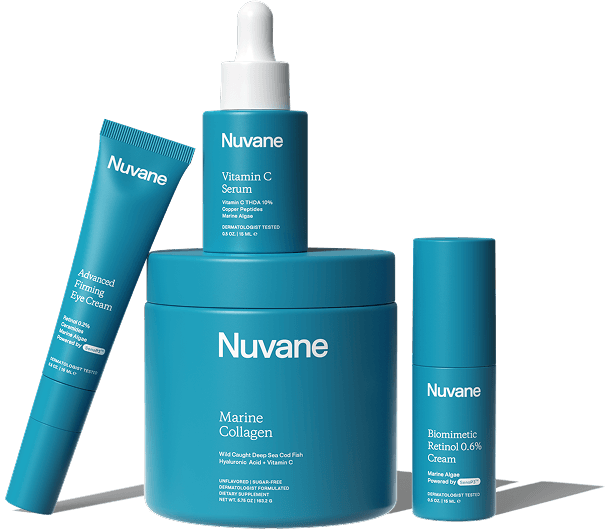
You'll find SenoP3™ across the Nuvane range, including the Biomimetic Retinol Cream (0.3% and 0.6%, with stabilized retinol, niacinamide, trehalose, marine algae, and hyaluronic acid), the retinol-free Biomimetic Bakuchiol Cream, the Regenerative Dark Spot Corrector (alpha arbutin + retinol + niacinamide), and the Firming Eye Cream (retinol 0.2% + caffeine + ceramides). Nuvane's Advanced Vitamin C Serum is built around THD ascorbate — a stable, lipid-soluble vitamin C — specifically so it can include copper peptides without the destabilization problem that affects raw L-ascorbic acid. For an inside-out approach, the Oral Marine Collagen Supplement supplies hydrolyzed marine collagen, hyaluronic acid, and vitamin C.
Where does GHK-Cu show up beyond skincare — including MDhair?
The same copper-peptide biology that rebuilds skin also supports the hair follicle.
GHK-Cu's repair signaling isn't limited to facial skin. Copper peptides — GHK-Cu and the closely related AHK-Cu — have a substantial evidence base in hair science, where they stimulate the dermal papilla cells at the base of each follicle, extend the anagen (growth) phase, and activate the Wnt/β-catenin pathway that governs follicle regeneration. Studies report copper peptides can increase follicle size by up to 40%, raise density by 30–40%, and reduce shedding by 25–30% over 2–6 months of consistent use. [4][5]
This is why our sister brand MDhair builds copper peptides into its dermatologist-formulated regrowth line:
- MDhair Restore Serum features copper tripeptide-1 (GHK-Cu) as a key biomimetic peptide, combined with 20+ DHT-blocking and botanical actives (argan oil, pumpkin seed oil, biotin, aloe) so the peptide works in concert with proven co-actives.
- MDhair Restore Shampoo delivers a hexapeptide complex to support scalp and follicle health at every wash.
- MDhair Regrowth Serum offers a different peptide profile (biotinoyl tripeptide-1) for sensitive or dry scalps, and the Advanced Eyebrow and Eyelash Serums apply peptide complexes to fine facial hair.
The throughline across Nuvane and MDhair is the same principle the science keeps confirming: copper peptides perform best as part of a thoughtfully formulated stack, not as a lone miracle ingredient.
Are GHK-Cu copper peptides safe?
Topical copper peptides have a strong tolerability record, with a few sensible precautions.
Topical GHK-Cu is generally very well tolerated, which is part of its appeal for people who struggle with stronger actives. As with any new active, a 24-hour patch test on the inner forearm is smart, and you should discontinue use if you notice redness, itching, or burning. Copper toxicity from properly formulated over-the-counter products is considered extremely unlikely, because the concentrations used are low and carefully controlled. If you are pregnant or breastfeeding, discuss any new active with your clinician as a general precaution.
Summary: should GHK-Cu be in your routine?
The actionable bottom line.
- GHK-Cu is one of the most thoroughly studied regenerative peptides, with human data showing meaningful collagen and firmness gains over ~12 weeks.
- It works through many pathways at once — collagen and elastin synthesis, antioxidant and anti-inflammatory support, and repair-oriented gene signaling.
- It is gentle and broadly tolerated, making it a strong option for sensitive skin and a good partner to retinol.
- Separate it from raw acids and L-ascorbic acid, or use formulas that pair it with stabilized vitamin C.
- It is most effective as part of a complex — which is exactly how Nuvane's SenoP3™ and MDhair's regrowth serums deploy it.
Shop now:
Ready to put GHK-Cu to work? These are the products in this post that contain SenoP3™ or copper peptides:
- Biomimetic Retinol Cream 0.3% — stabilized retinol + SenoP3™ (with copper tripeptide-1).
- Biomimetic Retinol Cream 0.6% — the higher-strength retinol + SenoP3™ formula.
- Regenerative Dark Spot Corrector — alpha arbutin + retinol + SenoP3™.
- Advanced Firming Eye Cream — retinol + SenoP3™ + caffeine.
- Advanced Vitamin C Serum — THD ascorbate paired with copper peptides.
- MDhair Restore Serum — copper tripeptide-1 for the scalp and hair follicle.
Frequently Asked Questions
How long does GHK-Cu take to work?
Most studies measuring collagen, firmness, and wrinkle changes use GHK-Cu consistently for 8–12 weeks. Some people notice texture or smoothness improvements sooner, but structural gains are cumulative — plan on at least three months before judging results.
Is GHK-Cu better than retinol?
They do different jobs. Retinol accelerates turnover and is the gold standard for collagen stimulation but can irritate; GHK-Cu is a gentler, repair-and-recovery signal with antioxidant and anti-inflammatory benefits. Many routines use both, on different nights or layered carefully.
Can I use copper peptides with vitamin C?
Not in the same step as raw L-ascorbic acid, which can destabilize the copper-peptide bond. Use them at separate times of day, or choose a formula built around a stable derivative like THD ascorbate, which is how Nuvane's Advanced Vitamin C Serum combines the two.
Do copper peptides really increase collagen?
Yes — both lab studies on human fibroblasts and controlled topical trials show increased collagen synthesis, with one trial reporting an average 28% rise over three months. The effect is consistent across mechanistic and clinical research.
Is GHK-Cu safe for sensitive skin?
It is one of the better-tolerated anti-aging actives and is often suitable for sensitive or reactive skin. As always, the full formula matters, and a patch test before regular use is wise.
Can the same copper peptide help both skin and hair?
The core biology is shared — collagen synthesis, repair signaling, and follicle stimulation. That's why GHK-Cu/copper tripeptide-1 appears in both Nuvane's SenoP3™ skincare and MDhair's Restore Serum for hair, formulated differently for each tissue.
Does GHK-Cu help with dark spots or scarring?
Indirectly. Its support for collagen remodeling and tissue repair can improve overall texture and tone, which is why Nuvane includes it (alongside alpha arbutin and niacinamide) in the Regenerative Dark Spot Corrector. It is not a primary pigment-blocking ingredient on its own.
What concentration of copper peptides should I look for?
Look for "copper tripeptide-1" or "GHK-Cu" positioned near the middle of the ingredient list rather than the very end, which signals a meaningful concentration. Delivery system matters too — well-formulated emulsions and serums improve absorption.
References
- Pickart L, Margolina A. Regenerative and Protective Actions of the GHK-Cu Peptide in the Light of the New Gene Data. International Journal of Molecular Sciences. 2018;19(7):1987. PMID: 29986520.
- Pickart L, Vasquez-Soltero JM, Margolina A. GHK Peptide as a Natural Modulator of Multiple Cellular Pathways in Skin Regeneration. BioMed Research International. 2015;2015:648108.
- Pickart L, Vasquez-Soltero JM, Margolina A. The Human Tripeptide GHK and Tissue Remodeling. Journal of Biomaterials Science, Polymer Edition. 2008;19(8):969-988.
- Pyo HK, et al. The effect of tripeptide-copper complex on human hair growth in vitro. Archives of Pharmacal Research. 2007;30(7):834-839. PMID: 17703734.
- Trüeb RM. Molecular mechanisms of androgenetic alopecia. Experimental Gerontology. 2002;37(8-9):981-990.
- Skibska A, Perlikowska R. Signal Peptides — Promising Ingredients in Cosmetics. Current Protein & Peptide Science. 2021;22(10):716-728. PMID: 34382523.
- Lintner K, Gerstein F. A serum containing vitamins C & E and a matrix-repair tripeptide reduces facial signs of aging. Journal of Cosmetic Dermatology. 2020;19(12):3262-3269. PMID: 33103342.
Related Search Terms
GHK-Cu copper peptide, what are copper peptides for skin, GHK-Cu collagen study, copper tripeptide-1 benefits, does GHK-Cu work, copper peptides vs retinol, copper peptides and vitamin C, GHK-Cu anti-aging, regenerative peptide skincare, copper peptide serum for wrinkles, SenoP3 copper peptide, GHK-Cu for firmness, copper peptides skin barrier repair, are copper peptides safe, copper peptides for hair and skin
Find the most effective anti-aging products for you by taking the free skin assessment.
Recommended Read
- SenoP3™: a breakthrough in skincare and longevity
- Can biomimetic peptides outperform traditional anti-aging ingredients?
- The complete guide to skin longevity ingredients
- Can topical argireline really mimic botox?
Find the most effective anti-aging products for you by taking the free skin assessment.
Enjoyed this article? Add Nuvane as a preferred source on Google.