
What is skin longevity?


What is skin longevity, in one sentence?
A quick, self-contained answer before we go deeper.
Skin longevity is the science of keeping your skin's cells working well for as long as possible, rather than only smoothing the lines and slackening that appear once aging is already visible. It reframes aging skin as a biological process that begins inside the cell — long before you see it in the mirror — and asks a different question: not "how do we hide the damage?" but "how do we keep the skin's living machinery productive over the decades?"
Key Takeaways
- Skin longevity targets the biology of aging, not just its appearance. The goal is to preserve healthy cellular function over time, so skin holds onto its structure, firmness, and radiance for longer.
- Fibroblasts are central. These dermal cells build collagen, elastin, and hyaluronic acid. As they slow and drift toward a worn-out, senescent state, skin loses its foundation.
- Decline starts early and invisibly. Cellular changes are underway well before wrinkles form, and are accelerated by UV, pollution, and daily stressors.
- The field has matured quickly. Over the past few years, longevity biology — the same "hallmarks of aging" science studied across the whole body — has been applied directly to skin, creating a new category often called pro-longevity or longevity skincare.
- Nuvane's approach is built on this science. Every formula is centered on the SenoP3™ triple-peptide complex, designed to re-engage tired fibroblasts and support them consistently over time.
How did "skin longevity" become its own category?
This section covers where the idea came from and why it emerged in the last few years.
For most of its history, anti-aging skincare focused on the surface. The strategy was largely corrective: wait for a wrinkle, a dark spot, or a loss of firmness to appear, then treat the visible sign. It was reactive by design, and it treated aging as something that happens to the skin rather than something that happens inside it.
That framing began to shift as a broader scientific movement — often called geroscience, or the biology of aging — matured. Researchers studying why the whole body ages converged on a shared set of underlying mechanisms, formalized in the influential "hallmarks of aging" framework, which in its updated form describes twelve interconnected drivers of biological decline, including genomic instability, telomere attrition, epigenetic changes, loss of protein quality control, mitochondrial dysfunction, and cellular senescence [1][2]. Crucially, these are not abstractions unique to internal organs. Skin, as the body's largest and most accessible organ, turns out to display the very same hallmarks — and because we can see and sample it easily, it has become one of the clearest windows into how aging actually works [3][9].
Over the past few years, that insight has been translated into a distinct approach. Instead of asking how to camouflage the results of aging, the longevity lens asks how to slow the biological processes that produce them in the first place. Review articles have begun describing a new frontier of "longevity" formulations built around geroprotective goals — protecting cells, supporting their repair systems, and keeping them functional for longer [6]. A parallel body of work has proposed formal frameworks for measuring and extending skin's healthy "span," treating skin aging as something to be managed proactively across a lifetime rather than corrected episodically [7].
The result is a genuine category shift. Skin longevity is not a rebranding of anti-aging; it is a change in the target — from the visible symptom to the underlying cell biology that determines how, and how quickly, skin ages.
Why do the cells matter more than the wrinkles?
This section explains the core biological premise of skin longevity.
Visible aging is a late symptom. By the time a line becomes permanent or the jawline softens, the biological events that caused it have been unfolding quietly for years. The smooth surface you can still see in your thirties can sit on top of a foundation that is already changing beneath it.
The cells that matter most in this story are fibroblasts — the master builders of the dermis. Fibroblasts manufacture the collagen that gives skin its strength, the elastin that lets it snap back, and the hyaluronic acid that keeps it plump and hydrated. When fibroblasts are young and active, this scaffolding is continuously produced and repaired. Collagen density is high, the network is well organized, and skin looks firm and resilient.
With age, fibroblasts lose function. They produce less collagen and elastin, they organize the matrix less effectively, and they respond more weakly to the signals that would normally prompt them to rebuild. This is why collagen is estimated to decline by roughly one percent per year from the mid-twenties onward, and why hormonal shifts can accelerate that curve dramatically — in the years surrounding menopause, for example, the drop in estrogen has been associated with a loss of around thirty percent of skin collagen [7]. Less collagen, less elastin, and a disorganized matrix add up to thinner, less elastic, more fragile skin.
The deeper problem is not just that fibroblasts slow down — it is why. A growing body of research points to cellular senescence as a central driver.
What is cellular senescence, and why is it a problem?
Senescence is a state in which a cell stops dividing but does not die. These cells linger in the tissue and, worse, secrete a mix of inflammatory molecules, growth factors, and enzymes collectively known as the senescence-associated secretory phenotype (SASP). In skin, the SASP can degrade existing collagen, fuel low-grade chronic inflammation (sometimes called inflammaging), and push neighboring healthy cells toward dysfunction as well [3][8]. Because a small number of senescent cells can influence the tissue around them, they act as an outsized brake on the skin's ability to renew itself.
Recent reviews have specifically identified dermal fibroblast senescence as a central hub of skin aging — a point where many of the broader hallmarks converge and express themselves as the sagging, thinning, and slow repair we recognize as aged skin [1][4][5]. This is precisely why the longevity approach concentrates on fibroblasts: support them early and consistently, and you are addressing one of the root nodes of the aging process rather than one of its downstream symptoms.
What accelerates the decline — and what can slow it?
This section covers the everyday forces that speed cellular aging and the logic of intervening early.
Cellular aging happens naturally with time, but its pace is not fixed. It is measurably sped up by external stressors — chief among them ultraviolet radiation, which drives the majority of visible facial aging, along with air pollution, oxidative stress, sleep disruption, and glycation from excess sugar. Each of these adds to the load of DNA damage, oxidative wear, and inflammation that pushes fibroblasts toward that exhausted, senescent state faster than time alone would.
The practical implication is a shift in timing. If decline begins in the cells long before it shows on the surface, then the most effective moment to act is early and consistently, not only once damage is visible. Daily sun protection remains the single most important intervention. Beyond that, the longevity strategy is about keeping cells working within a healthier range of activity for as long as possible — reducing the stressors that accelerate senescence while actively supporting the cellular signaling that keeps skin resilient. The aim is to lengthen the window during which skin retains its structure, firmness, and natural glow, rather than to chase each new line after it appears.
What is the science behind the Nuvane formula?
This section explains how Nuvane translates skin longevity biology into a working formulation.
Nuvane approaches aging from the cell outward. Rather than concentrating on wrinkles at the surface, the formulas are designed to work at the biological origin of skin aging — the health and output of the cells that build and maintain skin. It is a pro-longevity philosophy: the objective is to sustain cellular function over time, not simply to mask its decline. In practice, that means supporting fibroblasts so they keep producing the collagen, elastin, and hyaluronic acid that hold skin together, and keeping them within a healthier bioactivity range for as long as possible.
How does SenoP3™ speak to skin cells?
Every Nuvane formula is built around SenoP3™, a biomimetic triple-peptide complex designed to communicate with skin cells in their own biochemical language. "Biomimetic" means the peptides mimic messengers the body already recognizes, so instead of forcing an effect, they prompt the skin's own cells to act. The three signals work together, deep in the dermis, to help fibroblasts stay active and productive:
- Palmitoyl Tripeptide-38 — a matrikine messenger. Matrikines are signaling fragments that tell fibroblasts to rebuild the matrix; this one prompts renewed production of collagen, elastin, and hyaluronic acid.
- Copper Tripeptide-1 (GHK-Cu) — a regenerative signal that supports collagen and elastin synthesis, helps balance the ongoing remodeling of skin tissue, and contributes to neutralizing oxidative stress.
- Acetyl Hexapeptide-8 — works on the muscle tension behind expression lines, helping ease it for a visibly smoother surface.
The premise is straightforward but important. As fibroblasts age, they not only produce less but also respond more weakly to actives and even to in-office treatments — the receiving end of the signal has grown faint. SenoP3™ is designed to re-engage those cells, helping restore the cellular signaling that keeps skin resilient rather than relying on a single active to brute-force a result.
What surrounds the SenoP3™ core?
Around this peptide core, each Nuvane formula pairs a supporting cast of actives chosen to protect and energize the same cells:
- Trehalose, a cell-protecting sugar that helps shield cellular components from stress and dehydration.
- Niacinamide, which supports cellular energy production and reinforces the skin barrier's resilience.
- Marine algae extract, contributing antioxidant defense against the oxidative load that accelerates senescence.
- Biomimetic retinol or bakuchiol, supporting skin renewal and further collagen support — retinol for those who tolerate it, bakuchiol as a gentler, retinol-free alternative for sensitive skin.
Together, the intent is coherent with the longevity thesis: protect cells from the stressors that age them, energize the barrier that defends them, and signal the fibroblasts that rebuild the skin — so skin can stay firmer, calmer, and more radiant for longer.
How does this show up across Nuvane's products?
This section connects the science to the specific formulas built on it.
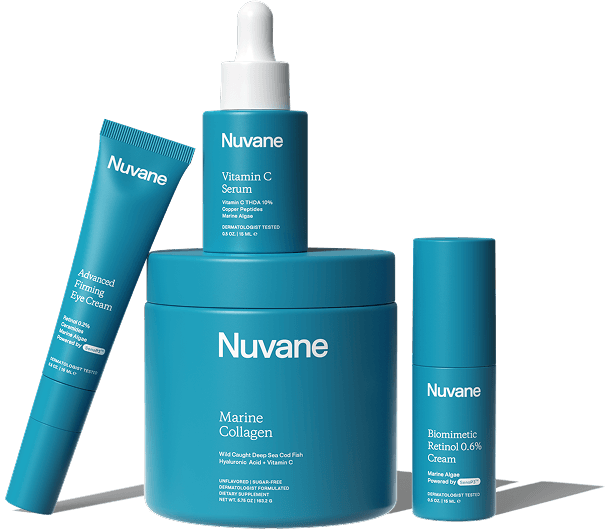
Because SenoP3™ is the shared foundation, the science described above runs through the whole Nuvane line, with each product tuned to a particular need. The Biomimetic Retinol Cream (available in 0.3% and 0.6%) combines stabilized retinol with SenoP3™, niacinamide, trehalose, marine algae, and hyaluronic acid for renewal and collagen support. The Biomimetic Bakuchiol Cream offers a retinol-free path built around bakuchiol, peptides, a vitamin C derivative, Centella asiatica, and marine algae for those with reactive skin. The Advanced Vitamin C Serum pairs a stable, lipid-soluble form of vitamin C with copper peptides, ceramides, and marine extracts for antioxidant brightening. The Regenerative Dark Spot Corrector targets uneven tone with alpha arbutin, retinol, SenoP3™, niacinamide, and marine algae, while the Firming Eye Cream brings retinol, SenoP3™, caffeine, and ceramides to the delicate eye area. For those who prefer to support skin from within, the Oral Marine Collagen Supplement combines hydrolyzed marine collagen with hyaluronic acid and vitamin C.
The through-line is consistency rather than novelty for its own sake: the same cell-supporting logic, applied morning and night, across the areas and concerns where skin ages.
Key Takeaways
- Skin longevity is a shift in target — from smoothing visible signs of age to preserving the cellular function that determines how skin ages in the first place.
- Fibroblasts are the linchpin. Keeping these collagen-building cells active and responsive is central to firmer, more resilient skin over time.
- Cellular senescence and its SASP are key drivers of dermal aging; longevity skincare aims to support cells before they drift into that worn-out state.
- Start early and stay consistent. Sun protection plus daily cellular support does more than episodic correction after damage appears.
- Nuvane operationalizes this science through the SenoP3™ triple-peptide complex — Palmitoyl Tripeptide-38, Copper Tripeptide-1 (GHK-Cu), and Acetyl Hexapeptide-8 — supported by trehalose, niacinamide, marine algae, and biomimetic retinol or bakuchiol.
Frequently asked questions
Is skin longevity the same as anti-aging?
Not quite. Anti-aging typically describes correcting visible signs after they appear. Skin longevity focuses on the biology underneath — keeping cells functioning well so those signs develop more slowly. Think of anti-aging as symptom management and skin longevity as maintaining the system that produces the symptoms.
At what age should I start thinking about skin longevity?
Because cellular decline begins invisibly, often from the mid-twenties, earlier is better. That does not mean an elaborate routine in your twenties — it means daily sun protection and consistent, gentle cellular support well before visible aging sets in. Starting later still helps; consistency matters more than timing.
What are fibroblasts and why do they matter so much?
Fibroblasts are the dermal cells that manufacture collagen, elastin, and hyaluronic acid — the scaffolding that gives skin its firmness and bounce. As they slow with age and become less responsive, skin thins and loses structure, which is why longevity skincare concentrates on keeping them active.
What is cellular senescence in simple terms?
It is a state where a cell stops dividing but doesn't die. These lingering "worn-out" cells release inflammatory signals (the SASP) that degrade collagen and nudge nearby cells toward the same dysfunction, quietly eroding the skin's ability to renew itself.
Can skincare really affect cell behavior, or just the surface?
Well-designed actives can influence cell signaling. Biomimetic peptides, for instance, mimic messengers the skin already recognizes and can prompt fibroblasts to increase matrix production. No topical reverses aging, but supporting cellular function is a meaningfully different mechanism from surface hydration or camouflage.
What does "biomimetic" mean?
Biomimetic ingredients are designed to imitate molecules the body already uses. Rather than forcing a change, they communicate with cells in a familiar language — which is the idea behind SenoP3™'s peptide signals to fibroblasts.
How long before I see results from a longevity-focused routine?
Cellular changes are gradual. Surface hydration and radiance can improve within weeks, while firmness and fine-line changes that reflect renewed collagen typically take longer and depend on consistent, ongoing use. Longevity is a long-game strategy by definition.
Does sunscreen still matter if I use longevity skincare?
Absolutely — more than any single product. UV exposure is the largest accelerant of cellular aging, so daily broad-spectrum sun protection is the foundation that everything else builds on.
References
- Zhang J, et al. Aging in the dermis: Fibroblast senescence and its significance. Aging Cell. 2023.
- López-Otín C, Blasco MA, Partridge L, Serrano M, Kroemer G. Hallmarks of aging: An expanding universe. Cell. 2023;186(2):243-278.
- Thau H, et al. Senescence as a molecular target in skin aging and disease. Ageing Research Reviews. 2025.
- Nan L, et al. Recent advances in dermal fibroblast senescence and skin aging. Frontiers in Pharmacology. 2025.
- Zheng J, et al. Dermal fibroblast senescence: the central hub of skin aging. International Journal of Molecular Sciences. 2026.
- Longevity cosmeceuticals as the next frontier in cosmetic innovation. Review. 2025. (PMC12137348)
- Skinspan™: A healthy longevity framework for skin aging. Mayo Clinic Proceedings. 2025.
- The role of cellular senescence in skin aging and age-related skin conditions. Review. 2023. (PMC10703490)
- Hallmarks of skin aging: update. Aging and Disease. 2023.
Related search terms
what is skin longevity, skin longevity vs anti-aging, cellular senescence skin, fibroblast senescence, hallmarks of skin aging, pro-longevity skincare, longevity skincare explained, how to slow skin aging biologically, SASP skin inflammation, collagen decline with age, biomimetic peptides for skin, SenoP3 complex, senescent cells skin aging, keeping skin cells active, inflammaging skin, extend skin healthspan
Find the most effective anti-aging products for you by taking the free skin assessment.
Recommended Read
- Skin longevity vs. anti-aging
- How senescent cells drive skin aging
- Can skin longevity outsmart senescence? How Nuvane targets the biology of aging skin
- The complete guide to skin longevity ingredients
Find the most effective anti-aging products for you by taking the free skin assessment.
Enjoyed this article? Add Nuvane as a preferred source on Google.