
Do men really need an eye cream?

Quick Answer
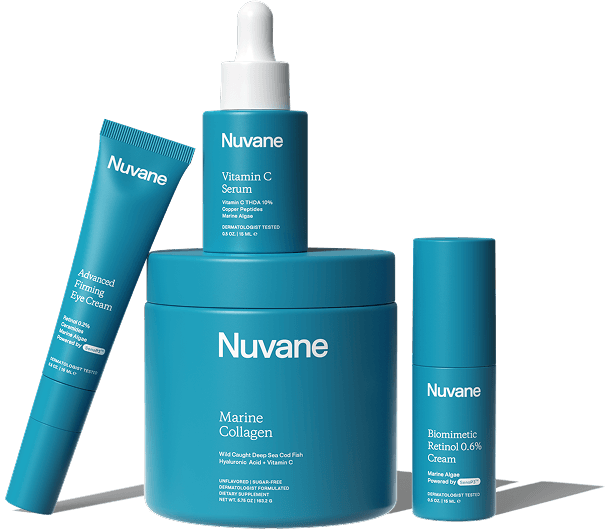
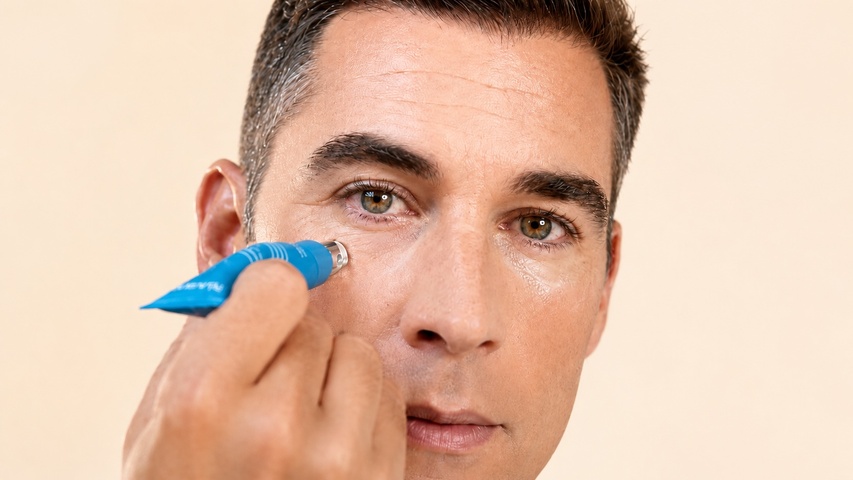
Most men do not need a twelve-step routine. But the eye area is the one place where a dedicated product genuinely earns its spot — because the structural advantages of male skin (thicker dermis, denser collagen, more oil) largely stop at the orbital rim. Add the fact that 83% of men don't use sunscreen daily [1], and the eye area becomes the region where male faces show age first and most obviously. Nuvane Advanced Firming Eye Cream pairs 0.2% retinol with the SenoP3™ triple-peptide complex, caffeine, and a cooling zinc alloy applicator — one product, ten seconds, no shine.
Key Takeaways
- Male skin is thicker and denser overall — but eyelid skin is the thinnest on any face, male or female, with a dermis of roughly 759 µm versus about 1,969 µm at the nasal sidewall [2]. Your general advantage doesn't apply here.
- 83% of men report not using sunscreen daily [1], and UV is the dominant driver of crow's feet. Decades of unprotected squinting is why men often present with deeper etched lines than women of the same age.
- Retinol has the strongest evidence for periorbital lines. A 12-week trial showed 33% improvement in lines and wrinkles, 41% less under-eye darkness, and 55% less puffiness [3].
- Texture is not a vanity concern for men — it's the adoption barrier. In the same survey, 43% of men said excess oiliness deterred them from using a product daily [1]. An eye treatment has to disappear on application or it won't get used twice.
- A cream cannot fix a hollow or a true fat-pad bulge. Those are anatomy. Know the difference before you buy anything.
Why does the eye area show age faster on men than the rest of their face?
This section explains why the usual advantages of male skin don't extend to the eye contour — and why that catches most men off guard.
Male skin has real structural advantages. It is measurably thicker, carries greater collagen density at every age, and produces significantly more sebum [4]. Men also age more linearly than women, who experience an accelerated collagen decline around menopause. On the cheeks, jaw, and forehead, this buys you time.
Around the eyes, it buys you almost nothing.
A comprehensive analysis of skin thickness across 39 facial regions found the upper medial eyelid has the thinnest dermis on the entire face, at roughly 759 µm, compared with about 1,969 µm at the lower nasal sidewall [2]. That measurement is not meaningfully rescued by being male. You are still working with the least structural support on your face, in the region under the most mechanical stress.
Doesn't oilier skin at least protect the eye area?
No — and this is the part that surprises people. Men's higher sebum output comes from sebaceous glands, and periorbital skin has almost none of them. The lipid barrier around your eyes is thin and poorly supplied regardless of how oily your T-zone gets. So a man can have a shiny forehead and genuinely dehydrated, crepey under-eyes at the same time. They are different microenvironments on the same face.
The practical consequence: the moisturizer you skip because "my skin is oily" was never going to help the one area that actually needed it.
What does skipping sunscreen for thirty years actually cost you?
This is where behavior overtakes biology. In a survey of 705 men, 83% reported not using sunscreen daily, and only 38% used it even weekly [1]. UV exposure is the single largest driver of wrinkle formation, and the periorbital region receives a disproportionate share of it — it is prominent, rarely covered, and surrounded by skin that squints reflexively in bright light.
Every squint folds thin skin over a muscle that has minimal padding beneath it. The orbicularis oculi contracts an estimated 10,000–15,000 times a day through blinking alone, before you add sun squinting, screen strain, and laughing. Repeated folding without UV protection is precisely how a dynamic line becomes a permanently etched one.
Sex differences in facial wrinkle severity have been quantified with three-dimensional imaging, and the pattern is consistent: men tend to present with fewer but deeper wrinkles, and the periorbital region is among the earliest to show measurable change [5]. Cumulative unprotected exposure is the most plausible explanation, and it is the one variable you can still control.
What's actually making your eyes look tired — and can a cream do anything about it?
This section separates the five distinct causes of "tired eyes," because four respond to skincare and one does not.
"I look exhausted" is a symptom, not a diagnosis. There are five separate mechanisms, and men tend to have a different mix than women.
Fluid retention and puffiness
The most common complaint in men, and the most responsive. Driven by sleep debt, alcohol, high sodium intake, late meals, allergies, and flying. It fluctuates day to day, which is the diagnostic clue. Caffeine, cooling, and consistent hydration all help, and the improvement is genuine but temporary — it depends on continued use.
Vascular darkness (blue or purple)
Visible microvasculature beneath translucent skin, worsened by fatigue and congestion. Responds to caffeine-driven vasoconstriction and to anything that reduces local inflammation [6]. A 12-week study of a multicorrective eye treatment documented improvement specifically through reduced microvascular congestion and permeability alongside pigment reduction [7].
Pigmented darkness (brown or gray-brown)
True periorbital hyperpigmentation, often hereditary and more common in Fitzpatrick skin types III–VI. Responds to niacinamide, licorice extract, retinoids, and sun protection — slowly, over 8–12 weeks.
Etched lines and crepey texture
Crow's feet, fine crinkling, and the "paper-y" quality that shows up in photographs. This is the most treatable category with topicals, and the one men most consistently underestimate because it develops gradually. Retinol and peptides are the relevant actives.
Structural hollowing
A shadow cast by volume loss at the tear trough or a defined bulge from herniated orbital fat. This is anatomy, not skin quality. No topical product fills a hollow or flattens a true bag, and any product claiming otherwise is misrepresenting how faces work. If this is your primary issue, the honest answer is a consultation, not a cream.
Most men over 35 have some combination of the first four. That is the argument for a multi-mechanism formula rather than buying four separate products you'll abandon by March.
What should men look for in an eye cream — and what should rule one out?
This section covers the practical selection criteria, starting with the one most brands ignore.
Why does texture matter more than the ingredient list for most men?
Because a product you stop using has an efficacy of zero. In the survey of male skincare behavior, 43% of men cited excess oiliness or shine as a deterrent to daily use, while 31% prioritized moisturizing performance and 27% wanted non-irritating formulas [1]. Those are not superficial preferences. They are the difference between a product used for twelve weeks and a product used for four days.
For an eye treatment specifically, the requirements are narrow: it must absorb fast, leave no visible sheen, not sting, not migrate into the eye during the workday, and not pill under sunscreen. Anything heavy or occlusive around the eyes also risks milia — small white keratin cysts that are annoying to remove and entirely avoidable.
Which actives actually have evidence behind them?
A short list, and it hasn't changed much in twenty years:
- Retinoids — the most rigorously validated topical class for photoaging. They increase cell turnover, inhibit the matrix metalloproteinases that degrade collagen, and stimulate procollagen synthesis [8][9].
- Peptides — signaling molecules that support matrix rebuilding and, in the case of Acetyl Hexapeptide-8, modestly reduce muscle-driven expression lines [10][11].
- Caffeine — vasoconstriction and microcirculation support for puffiness and vascular darkness [6].
- Niacinamide — barrier support, tone improvement, and reduced appearance of hyperpigmentation [12][13].
- Ceramides and humectants — barrier repair and hydration, which is what makes a retinoid tolerable in thin skin [14].
What should disqualify a product immediately?
- Claims to "erase" bags or "fill" hollows. Anatomically impossible.
- Face-strength retinol (0.3%+) marketed for eye use. Wrong dose for the thinnest skin on your body.
- Fragrance-forward formulas. The periorbital region has the lowest tolerance margin on the face.
- Anything requiring more than one step. Be honest about what you'll actually do every day.
How does Nuvane Advanced Firming Eye Cream fit into a man's routine?
This section maps the formula to the mechanisms above and explains the ten-second application logic.
Nuvane Advanced Firming Eye Cream is a 15 ml treatment built around the specific vulnerabilities of eye-area skin rather than adapted down from a face cream. Every component maps to one of the five mechanisms described earlier.
The structural work — retinol plus peptides
- Retinol 0.2% sits at the concentration where meaningful receptor activity meets periorbital tolerability. Higher is not better here: irritation drives inflammation, and inflammation drives both redness and post-inflammatory darkening — the opposite of the goal.
- SenoP3™ triple-peptide complex covers three separate pathways. Palmitoyl Tripeptide-38 signals fibroblasts to rebuild collagen I, III, and IV plus hyaluronic acid. Copper Tripeptide-1 (GHK-Cu) supports collagen and elastin synthesis and functions as an antioxidant and copper carrier [15][16]. Acetyl Hexapeptide-8 interferes with SNAP-25 to modestly soften muscle-driven expression lines — the original work reported roughly a 30% reduction in wrinkle depth over 30 days [10].
That pairing is not arbitrary. In the 12-week periorbital trial, subjects who added a peptide-rich eye cream alongside the retinoid showed comparable wrinkle improvement with substantially better erythema reduction — 68% [3]. Peptides make the retinoid easier to tolerate, which for men translates directly into compliance.
The visible-tomorrow layer
- Caffeine and Arnica montana extract for puffiness and visible fatigue.
- A cooling zinc alloy applicator tip, which produces genuine thermal vasoconstriction. Zinc alloy pulls heat from skin faster than ceramic and stays cool longer through application. It also means you're not using your fingers, and it turns the step into something closer to a tool than a cosmetic ritual — which, in practice, is why men keep using it.
- An instant micro-firming gel network that visibly tightens and smooths on contact. This is an optical and mechanical effect, not a structural one, but it solves the real problem with eye treatments: people quit at week three, long before the retinol and peptides have shown up.
The tone and comfort layer
- Niacinamide and licorice (Glycyrrhiza uralensis) extract for the pigment component.
- Ceramide NP, sodium hyaluronate, glycerin, and trehalose to replace the lipids and water that periorbital skin under-produces.
- Panthenol and allantoin for irritation control — relevant if you shave daily.
- Bakuchiol and marine algae (Fucus vesiculosus) for additional renewal and antioxidant support without adding retinoid load.
The finish is light and non-shiny, and it sits under sunscreen without pilling. If you are already using Biomimetic Retinol 0.3% or 0.6% on your face, this handles the zone that product should not touch.
How do you use it if you shave daily, travel, and forget things?
This section is the practical protocol, including the two mistakes that cause nearly all eye-cream irritation in men.
How much, and exactly where?
A rice-grain amount per eye — not a pea-sized blob for both. Apply along the orbital bone, the bony ridge you can feel under your eye and out toward the temple. Never on the mobile lid, never along the inner lash line. Product migrates upward and inward on its own with body heat and blinking; starting close to the lash line guarantees it ends up in your eye.
Use the cooling tip, work outward toward the temple, then tap in with your ring finger. Do not drag or rub. Ten seconds, both eyes.
How does this interact with shaving?
Two rules. First, don't apply it immediately after shaving — a freshly shaved face has a temporarily compromised barrier, and actives sting more. Shave, let skin settle, then apply. Or apply it at night and shave in the morning, which is simpler.
Second, if you shave high on the cheek near the orbital rim, keep the blade below where you've applied product and use a sharp one. Razor drag plus retinol in the same zone is the most reliable way to produce irritation you'll blame on the cream.
How often should you start?
- Weeks 1–2: three nights per week. This is how you find out whether you're sensitive before it compounds.
- Weeks 3–4: every other night if there's no stinging or flaking.
- Week 5 onward: once daily. Night is typical; morning is fine if you prefer it and follow with sunscreen.
If irritation shows up, cut frequency rather than quitting. Barrier recovery takes days; starting over from zero costs weeks.
What are the non-negotiables?
- Daily broad-spectrum SPF 30+ and actual sunglasses. Retinol increases photosensitivity, and squinting is itself a mechanical wrinkle stimulus. Given the 83% figure [1], this is the highest-leverage change most men can make — larger than any product decision.
- Don't stack face-strength retinol into the same zone. Stop your face retinol at the orbital rim.
- Address the inputs. Sleep, sodium, and alcohol move under-eye puffiness more than any topical will. A cream is not a substitute for a Tuesday night that ends before 1 a.m.
What if you're travelling?
The 15 ml size is carry-on compliant, and the cooling applicator is genuinely useful after a red-eye. Refrigerate it at home if you want a stronger de-puffing effect; skip that on the road and it still works fine.
What results should you realistically expect, and when?
This section sets an honest timeline, separating the optical effects from the structural ones.
- First application: cooling de-puffing and visible smoothing from the micro-firming network. Temporary, repeatable, and legitimately useful before a meeting or a photograph.
- Days 3–14: better hydration, softer surface texture, less of the tight, papery feeling.
- Weeks 2–4: reduced morning puffiness with consistent use; a slightly brighter look as texture evens out and reflects light better.
- Weeks 6–8: measurable softening of crow's feet and fine lines as retinoid turnover and peptide signaling accumulate.
- Weeks 8–12: the changes other people notice — better under-eye density, less crepiness, reduced darkness where the cause was vascular or textural. This matches the published periorbital retinoid timeline [3].
- Beyond 12 weeks: continued gradual improvement plus a preventive effect. Stop, and results plateau and slowly reverse.
What will not happen: a deep tear trough won't fill, a hereditary pigment pattern won't fully clear, and a defined fat-pad bulge won't flatten. Those need procedural intervention. Anyone promising otherwise is selling you something.
Key Takeaways
- Your thicker skin doesn't cover the eye area. Eyelid dermis is the thinnest on any face, and men have almost no sebaceous support there — so oily skin elsewhere tells you nothing about your under-eyes.
- Behavior is doing more damage than biology. With 83% of men skipping daily sunscreen [1], cumulative UV is the main reason male crow's feet tend to be deeper. Sunscreen and sunglasses outperform any cream.
- Identify your mechanism before buying. Fluid, vascular, pigment, and texture all respond to topicals. Hollowing and true fat-pad bags do not.
- 0.2% retinol plus peptides is the evidence-backed combination — and the peptides measurably improve tolerability, not just results [3].
- Texture determines whether you'll actually use it. Fast-absorbing, non-shiny, one step, ten seconds. Compliance is the active ingredient nobody lists.
- Judge it at week 8, not week 1. The instant smoothing is real but cosmetic; the firming is structural and slow.
FAQs
Do men actually need a separate eye cream, or is face moisturizer enough?
If the eye area is a concern, a dedicated product is worth it — not because of marketing, but because the dose and texture requirements are genuinely different. Face formulas are dosed for thicker skin, are often too occlusive around the eyes (which promotes milia), and lack caffeine and pigment-modulating actives. If your eye area doesn't bother you, you can skip it. This is skincare, not a mandate.
What's the best eye cream for men over 40?
Look for a low-dose retinoid (around 0.2%), peptides, caffeine, and barrier support in a fast-absorbing, non-shiny base. Nuvane Advanced Firming Eye Cream was built to that specification. The more important question is whether you'll use it daily for three months — that matters more than which well-formulated product you pick.
Will an eye cream get rid of my under-eye bags?
It depends what they are. Puffiness that fluctuates with sleep, salt, and alcohol usually responds well to caffeine, cooling, and improved skin firmness. A fixed bulge from herniated orbital fat is structural and requires a procedure. Press gently under your eye in the morning and again at night — if it changes noticeably, it's fluid, and topicals will help.
Is 0.2% retinol strong enough to do anything?
Yes. Concentration should match skin thickness, not be maximized. Eyelid dermis is roughly two-and-a-half times thinner than skin elsewhere on your face [2], so 0.2% delivers real receptor activity while staying inside the region's tolerance. Going higher typically produces irritation and post-inflammatory darkening — you'd be making the problem worse and slower to fix.
Can I use this if I shave every day?
Yes, with two adjustments: don't apply it right after shaving, and keep the blade below the treated zone. Applying at night and shaving in the morning is the simplest solution. The formula includes panthenol and allantoin for irritation control, but a fresh shave still temporarily lowers barrier tolerance.
Will it leave my face shiny or feel greasy?
No. The formula absorbs quickly and finishes matte enough to sit under sunscreen without pilling. This is a deliberate design choice — 43% of men in one survey identified oiliness as the reason they stopped using a product daily [1], so a shiny eye treatment fails on adoption regardless of how well it's formulated.
How long does it take, realistically?
Immediate de-puffing and smoothing from day one. Hydration and texture within two weeks. Crow's feet and firmness between weeks 6 and 12, consistent with published trial timelines [3]. If you're evaluating whether it works, look at week 8 — and take a photo at week 0, because gradual change is genuinely hard to notice in the mirror.
Can I use it with my regular face retinol?
Yes, but don't overlap. Apply your Biomimetic Retinol up to the orbital rim and let the eye cream handle everything inside it. Two retinoids stacked in the thinnest skin on your face is the most common cause of periorbital retinoid dermatitis I see.
Does the cooling metal applicator actually do anything?
For puffiness, yes — cooling causes real vasoconstriction, and zinc alloy conducts heat away from skin faster and stays cooler longer than ceramic. It also encourages gentle tapping instead of rubbing, and it dispenses hygienically. It doesn't change the chemistry of the formula, but it does change whether you use it.
I already get Botox for crow's feet. Is this redundant?
No, they address different things. Neuromodulators reduce dynamic muscle contraction; retinol and peptides improve skin quality — thickness, texture, and the static etched lines injections don't reach. Many patients find their injectable results look smoother and hold better with consistent topical support. Coordinate timing with your injector.
References
- Roberts CA, Goldstein EK, Goldstein BG, et al. Men's attitudes and behaviors about skincare and sunscreen use behaviors. J Drugs Dermatol. 2021;20(1):88–93.
- Chopra K, Calva D, Sosin M, et al. A comprehensive examination of topographic thickness of skin in the human face. Aesthet Surg J. 2015;35(8):1007–1013.
- Kaufman J, Callender VD, Young C, et al. Efficacy and tolerability of a retinoid eye cream for fine to moderate wrinkles of the periorbital region. J Drugs Dermatol. 2022;21(9):932–937.
- Shuster S, Black MM, McVitie E. The influence of age and sex on skin thickness, skin collagen and density. Br J Dermatol. 1975;93(6):639–643.
- Luebberding S, Krueger N, Kerscher M. Quantification of age-related facial wrinkles in men and women using a three-dimensional fringe projection method and validated assessment scales. Dermatol Surg. 2014;40(1):22–32.
- Herman A, Herman AP. Caffeine's mechanisms of action and its cosmetic use. Skin Pharmacol Physiol. 2013;26(1):8–14.
- Rajabi-Estarabadi A, Hartman CL, Iglesia S, Kononov T, Zahr AS. Effectiveness and tolerance of multicorrective topical treatment for infraorbital dark circles and puffiness. J Cosmet Dermatol. 2024;23(2):486–495.
- Fisher GJ, Kang S, Varani J, et al. Mechanisms of photoaging and chronological skin aging. Arch Dermatol. 2002;138(11):1462–1470.
- Kang S, Voorhees JJ. Photoaging therapy with topical tretinoin: an evidence-based analysis. J Am Acad Dermatol. 1998;39(2 Pt 3):S55–S61.
- Blanes-Mira C, Clemente J, Jodas G, et al. A synthetic hexapeptide (Argireline) with antiwrinkle activity. Int J Cosmet Sci. 2002;24(5):303–310.
- Aruan RR, Hutabarat H, Widodo AA, et al. Double-blind, randomized trial on the effectiveness of acetylhexapeptide-3 cream and palmitoyl pentapeptide-4 cream for crow's feet. J Clin Aesthet Dermatol. 2023;16(2):37–43.
- Bissett DL, Oblong JE, Berge CA. Niacinamide: a B vitamin that improves aging facial skin appearance. Dermatol Surg. 2005;31(7 Pt 2):860–865.
- Kafi R, Kwak HSR, Schumacher WE, et al. Improvement of naturally aged skin with vitamin A (retinol). Arch Dermatol. 2007;143(5):606–612.
- Coderch L, López O, de la Maza A, Parra JL. Ceramides and skin function. Am J Clin Dermatol. 2003;4(2):107–129.
- Pickart L, Thaler MM. Growth-modulating tripeptide (glycylhistidyllysine) and its copper complex. Proc Natl Acad Sci U S A. 1980;77(7):4586–4590.
- Maquart FX, Bellon G, Chaqour B, et al. Stimulation of collagen synthesis in fibroblast cultures by the tripeptide-copper complex glycyl-L-histidyl-L-lysine-Cu2+. FEBS Lett. 1993;238(2):343–346.
Related Search Terms
best eye cream for men, eye cream for men over 40, men's under-eye bags treatment, crow's feet men, do men need eye cream, retinol eye cream for men, men's dark circles treatment, puffy eyes men morning, men's anti-aging eye treatment, non-greasy eye cream men, caffeine eye cream men, tired eyes men fix, men's skincare eye area, eye cream that works under sunscreen, SenoP3 peptide eye cream, men's periorbital aging
Find the most effective anti-aging products for you by taking the free skin assessment.
Recommended Read
- Men Best anti-aging skincare products for men after 40? read more
- Ingredients Does Nuvane's Firming Eye Cream really work on crow's feet and under-eye bags? read more
- Ingredients Best 10 ingredients to get rid of your under-eye bags read more
- Ingredients Can topical Argireline really mimic Botox? read more
Find the most effective anti-aging products for you by taking the free skin assessment.
Enjoyed this article? Add Nuvane as a preferred source on Google.