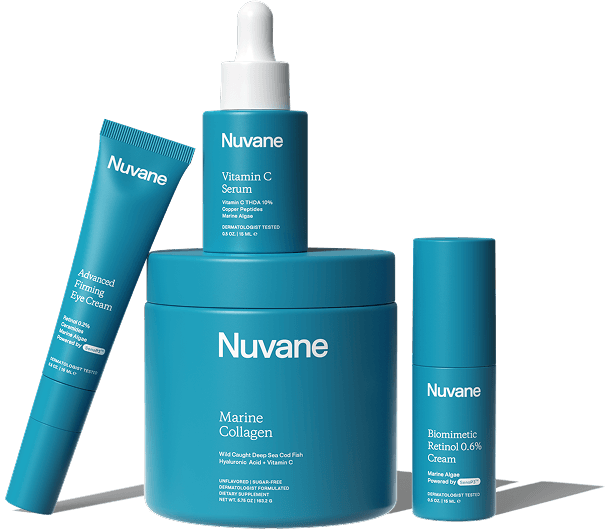

Does Nuvane's Firming Eye Cream really work on crow's feet and under-eye bags?

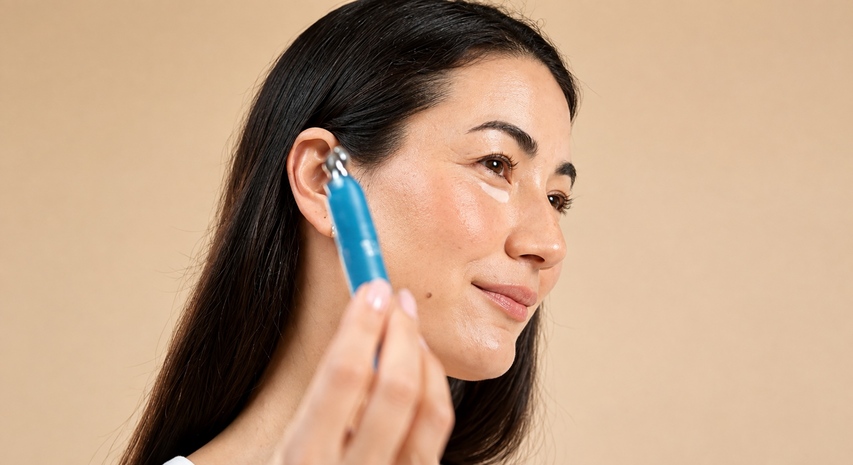
Quick Answer
Nuvane Advanced Firming Eye Cream works on two different timelines. Within minutes, a micro-firming gel network plus the cooling zinc alloy applicator creates a visible tightening and de-puffing effect. Over 8–12 weeks, 0.2% retinol and the SenoP3™ triple-peptide complex do the structural work — rebuilding collagen signaling, softening crow's feet, and thickening the look of thin periorbital skin. It is formulated at eye-appropriate strength, which is why it can be used daily without the irritation that face-strength retinol causes around the eyes.
Key Takeaways
- Eyelid skin is the thinnest on the entire face — the upper medial eyelid dermis measures roughly 759 µm versus about 1,969 µm at the nasal sidewall, which is why aging shows here first [1].
- Retinol is the most evidence-backed active for periorbital lines. A 12-week clinical trial of a retinoid eye cream showed a 33% improvement in lines and wrinkles, 41% reduction in under-eye darkness, and 55% reduction in puffiness [2].
- SenoP3™ combines three peptides with distinct jobs: Palmitoyl Tripeptide-38 (collagen and hyaluronic acid signaling), Copper Tripeptide-1/GHK-Cu (repair and antioxidant defense), and Acetyl Hexapeptide-8 (expression-line relaxation) [3][4][5].
- Caffeine addresses vascular, not pigment, darkness. It acts through vasoconstriction and improved microcirculation — useful for blue-purple circles and morning puffiness, not brown hyperpigmentation [6].
- No topical cream can fill a tear trough. Volume loss and hollowing are anatomical; creams smooth, plump, and firm, but they do not replace lost fat pad or bone support.
Why does the eye area age faster than the rest of your face?
This section explains the anatomy that makes periorbital skin uniquely fragile — and why it needs a dedicated formula rather than a dab of your face cream.
The skin around your eyes is not a slightly more delicate version of facial skin. It is structurally different. A comprehensive analysis of skin thickness across 39 facial regions found the upper medial eyelid has the thinnest dermis on the face at approximately 759 µm, compared with roughly 1,969 µm at the lower nasal sidewall [1]. That is a two-and-a-half-fold difference in the dermal scaffold that holds skin taut.
Thin dermis means less collagen and elastin in reserve. When collagen synthesis slows by roughly 1% per year from the mid-twenties onward, a region that started with a thinner scaffold reaches visible laxity far sooner. This is why crow's feet and crepey texture typically appear around the eyes five to ten years before comparable changes on the cheeks.
Three additional factors compound the problem:
- Mechanical load. The orbicularis oculi muscle contracts an estimated 10,000–15,000 times daily through blinking, squinting, and expression. Every contraction folds skin that has minimal structural padding.
- Almost no sebaceous glands. Periorbital skin produces very little sebum, so its lipid barrier is inherently weaker and transepidermal water loss is higher. Dry skin creases more readily and looks more textured.
- Superficial vasculature. Blood vessels sit close to a translucent surface. As skin thins with age, the bluish tone of that microvasculature becomes progressively more visible — which is why "dark circles" can worsen without any change in pigment at all.
Why can't you just use your regular retinol cream around the eyes?
Because dose tolerance is a function of skin thickness. A 0.3% or 0.6% retinol formulated for cheeks and forehead delivers more active than thin eyelid skin can process without inflammation. The result is stinging, scaling, and a compromised barrier — which paradoxically makes lines more visible while the skin is irritated. The correct approach is a lower concentration in a barrier-supportive base, applied to the orbital rim rather than the lid itself.
What are your "dark circles" actually made of?
This section covers the four distinct mechanisms behind under-eye darkness, because the right treatment depends entirely on which one you have.
Infraorbital darkness is a catch-all description for at least four separate problems, and they respond to completely different actives. A 12-week study of a multicorrective eye treatment in 40 women aged 35–60 documented improvement through reduced microvascular congestion and permeability, decreased melanin, and reduced hemoglobin-degradation pigmentation — three mechanisms in one region [7].
Vascular darkness (blue-purple)
Caused by visible microvasculature and blood pooling beneath thin skin. Worsens with fatigue, salt, alcohol, and allergy-related congestion. Responds to caffeine, cooling, and anything that lowers local inflammation.
Pigmented darkness (brown-gray)
True periorbital hyperpigmentation, more common in Fitzpatrick skin types III–VI and often familial. Responds to niacinamide, licorice extract, retinoids, and rigorous sun protection.
Structural shadowing
Hollowing at the tear trough creates a shadow that reads as darkness in overhead light. This is volume, not color. Creams improve the surrounding skin quality but cannot fill the depression.
Textural darkness
Fine crinkling and crepey texture scatter light rather than reflecting it, producing a dull, shadowed appearance. This is the most treatable category with topicals — retinol, peptides, humectants, and ceramides all contribute.
Most people over 40 have a combination of at least two. That is the argument for a multi-mechanism formula rather than a single-active product.
How does the SenoP3™ triple-peptide complex work in the eye area?
This section breaks down each peptide's mechanism and the published data behind it.
SenoP3™ is built on the principle that skin aging runs on several parallel pathways, so a single peptide cannot address it. Each of the three components signals through a different route.
Palmitoyl Tripeptide-38 — the matrix builder
This peptide mimics a fragment of a matrix protein and signals fibroblasts to upregulate multiple extracellular matrix components, including collagen I, III, and IV, fibronectin, laminin-5, and hyaluronic acid. In supplier-conducted in vivo testing, it has been associated with measurable reduction in wrinkle volume over roughly two months of twice-daily use. In the periorbital context, its relevance is straightforward: rebuilding matrix density in the region with the least matrix to begin with. Peptide-based matrix signaling is now well established in the dermatologic literature as a legitimate anti-aging mechanism [3][8].
Copper Tripeptide-1 (GHK-Cu) — the repair signal
GHK was first identified as a growth-modulating tripeptide in human plasma, and its copper complex was shown to stimulate collagen synthesis in fibroblast cultures [4][9]. GHK-Cu has three properties that matter for eye-area skin specifically: it promotes collagen and elastin synthesis, it supports wound-healing pathways, and it functions as an antioxidant and copper carrier. Since periorbital skin has a weaker barrier and higher baseline oxidative exposure, repair-directed signaling is more valuable here than on more robust facial skin.
Acetyl Hexapeptide-8 (Argireline) — the expression-line softener
This hexapeptide interferes with the SNAP-25 component of the SNARE protein complex, modestly reducing acetylcholine-mediated muscle contraction at the surface level. The original work reported roughly a 30% reduction in wrinkle depth after 30 days of twice-daily application of a 10% solution [5]. Its effect is far smaller than injectable neuromodulators and it does not restrict expression — but crow's feet are the most purely dynamic wrinkles on the face, which makes them the single best target for a topical peptide of this class.
An independent 8-week double-blind randomized trial in 21 women aged 26–55 compared acetylhexapeptide-3 cream, palmitoyl pentapeptide-4 cream, and placebo applied twice daily to the periorbital area. Both peptide creams improved crow's feet grading by 0.86 points on the static scale, though the study was small and several instrumental measures did not reach statistical significance [10]. The honest read: topical peptides produce real but moderate improvement in crow's feet, and they perform best alongside a retinoid rather than instead of one.
What does 0.2% retinol do around the eyes that peptides can't?
This section explains why retinol remains the anchor active in any serious eye treatment, and why the concentration matters more than the number suggests.
Retinoids remain the most rigorously validated topical class for photoaging. They bind nuclear retinoic acid receptors, increase keratinocyte turnover, inhibit matrix metalloproteinases that degrade collagen, and stimulate procollagen synthesis — a mechanism established across decades of controlled trials [11][12].
The clinical evidence in the eye area specifically is strong. A 12-week trial of a retinoid eye cream in 26 subjects with Fitzpatrick skin types III–VI, aged 35–65, reported at week 12:
- Lines and wrinkles improved 33% (P<.0001)
- Skin texture improved 37% (P<.0001)
- Under-eye darkness reduced 41% (P<.001)
- Puffiness decreased 55% (P<.0001)
- Dryness improved 94% (P<.0001)
Notably, subjects who added a peptide-rich eye cream to the regimen showed comparable wrinkle improvement with substantially better erythema reduction (68%, P=.001) — direct support for pairing retinol with peptides rather than using retinol alone [2].
0.2% retinol is the concentration point where meaningful receptor activity meets periorbital tolerability. Higher is not better here: irritation triggers inflammation, inflammation drives both erythema and post-inflammatory pigmentation, and pigmentation is the last thing you want in a region you are treating for darkness.
Does bakuchiol add anything if there's already retinol?
Yes — through a different route. Bakuchiol modulates several of the same gene expression pathways as retinoids without binding retinoic acid receptors, and it contributes meaningful antioxidant activity. In a low-dose eye formula, its role is additive support rather than replacement: extra renewal signaling and free-radical defense without adding to the retinoid load.
What's actually in Nuvane Advanced Firming Eye Cream, and why is each ingredient there?
This section maps the formula to the four mechanisms of eye-area aging described above.
Nuvane Advanced Firming Eye Cream is a 15 ml treatment designed around the specific vulnerabilities of periorbital skin rather than adapted from a face formula. Each component maps to one of the problems identified earlier.
Structural correction — the long game
- SenoP3™ triple-peptide complex (Palmitoyl Tripeptide-38, Copper Tripeptide-1, Acetyl Hexapeptide-8) for matrix rebuilding, repair signaling, and expression-line softening.
- Retinol 0.2% for turnover, collagen support, and texture refinement at an eye-appropriate dose.
- Bakuchiol and marine algae (Fucus vesiculosus) for complementary renewal and antioxidant defense.
Vascular and puffiness support — the visible-tomorrow layer
- Caffeine, which acts through vasoconstriction and improved microcirculation. Its use in reducing periorbital puffiness and vascular darkness is documented in the dermatologic and cosmetic literature [6].
- Arnica montana extract for soothing and the reduction of visible fatigue.
- Cooling zinc alloy applicator tip, which provides genuine thermal vasoconstriction at application. Zinc alloy conducts heat away from skin faster than ceramic, producing a stronger and longer-lasting cooling effect.
Tone and brightness — for the pigment component
- Niacinamide, which has documented effects on skin tone, barrier function, and the appearance of hyperpigmentation in controlled trials [13][14].
- Licorice (Glycyrrhiza uralensis) extract, a traditional pigment-pathway modulator with anti-inflammatory activity.
Barrier repair — the reason the retinol is tolerable
- Ceramide NP, replacing the lipid species that periorbital skin under-produces. Topical ceramides measurably improve barrier function and reduce transepidermal water loss [15].
- Sodium hyaluronate, glycerin, and trehalose for layered humectant hydration.
- Panthenol and allantoin for soothing and irritation control.
Immediate effect
- An instant micro-firming gel network that creates a visible tightening and smoothing effect on application. This is a real optical and mechanical effect, not a structural one — it is why the cream looks like it is working on day one while the retinol and peptides do the slower work underneath.
That architecture — instant smoothing over long-term firming — is deliberate. It solves the compliance problem that undermines most eye treatments: people abandon them at week three, well before the retinoid and peptide effects become visible.
How should you use it for maximum results and minimum irritation?
This section gives the practical application protocol, including the mistakes that cause most eye-cream irritation.
How much, and exactly where?
Use a rice-grain amount per eye, not a pea-sized amount for both. Apply along the orbital bone — the bony rim you can feel beneath your eye and out toward the temple — never on the mobile lid or the inner lash line. Product migrates upward and inward on its own with body heat and blinking; placing it close to the lash line guarantees it reaches the eye surface.
Tap it in with your ring finger or use the cooling applicator tip and work outward. Do not rub or drag.
How often should you start?
- Weeks 1–2: three nights per week, so you can identify sensitivity before it compounds.
- Weeks 3–4: every other night if there is no stinging or flaking.
- Week 5 onward: nightly, or once daily in the morning if you prefer it under makeup.
If irritation appears, reduce frequency rather than stopping. Barrier recovery takes days; restarting from zero costs you weeks.
What are the non-negotiables?
- Daily broad-spectrum SPF 30+ and sunglasses. UV exposure is the dominant driver of crow's feet, and retinol increases photosensitivity. Squinting in bright light is itself a mechanical wrinkle stimulus.
- Layer correctly. Eye cream goes on clean, dry skin before heavier facial moisturizer, so it is not diluted or blocked.
- Do not stack it with face-strength retinol in the same zone. If you are using Biomimetic Retinol on your face, stop at the orbital rim and let the eye cream cover that region.
What if you're using vitamin C, too?
Use Advanced Vitamin C Serum in the morning for antioxidant and photoprotective support, and the eye cream at night. THD ascorbate is well tolerated, but separating actives across the day reduces cumulative irritation in a region with almost no tolerance margin.
What results should you realistically expect, and when?
This section sets an honest timeline, separating what is optical from what is structural.
- Minutes: cooling-driven de-puffing and the micro-firming smoothing effect. Temporary, repeatable, and genuinely useful before an event.
- Days 3–14: improved hydration, softer surface texture, less makeup creasing. Barrier and humectant effects arrive first.
- Weeks 2–4: reduced morning puffiness with consistent use; slightly brighter appearance as texture improves and light reflects more evenly.
- Weeks 6–8: measurable softening of fine lines and crow's feet as retinoid turnover and peptide signaling accumulate.
- Weeks 8–12: the firming and tone changes people notice in photographs — better under-eye density, less crepiness, reduced darkness where the cause was vascular or textural. This matches the timeline in the published retinoid eye-cream data [2].
- Beyond 12 weeks: continued gradual improvement, plus a preventive effect. Results plateau if you stop.
What will not happen: a deep tear trough will not fill, a hereditary pigment pattern will not disappear entirely, and severe fat-pad herniation ("true" under-eye bags with a defined bulge) will not resolve. Those require procedural intervention. A cream that claims otherwise is misrepresenting anatomy.
Who is this eye cream right for — and who should skip it?
This section covers candidacy, including the specific situations where a different approach is better.
A strong fit if you have:
- Crow's feet, fine lines, or crepey under-eye texture
- Loss of firmness and density around the eyes, typically from the late thirties onward
- Blue-purple vascular circles or fluctuating morning puffiness
- Makeup that creases or gathers in fine under-eye lines
- Previously abandoned eye retinol because a face-strength product was too harsh
Consider a different approach if:
- You are pregnant or breastfeeding — topical retinol is generally avoided; the Biomimetic Bakuchiol Cream is the retinol-free alternative.
- Your primary concern is brown periorbital hyperpigmentation — a pigment-forward formula, plus the Regenerative Dark Spot Corrector on the surrounding zones, will be more targeted.
- You have active eyelid eczema, blepharitis, or ocular rosacea — treat the inflammatory condition first, with your dermatologist, before introducing a retinoid.
- Your concern is entirely structural hollowing — start with a consultation about volume, not skincare.
Does it help to support this from the inside?
Possibly, as an adjunct. Oral Marine Collagen Supplement with hyaluronic acid and vitamin C provides substrate for dermal matrix synthesis, and randomized trials of hydrolyzed collagen peptides have reported modest improvements in skin elasticity and hydration. Frame it as support for a topical regimen, not a substitute.
Key Takeaways
- Eye-area skin needs eye-area formulation. The thinnest dermis on the face, minimal sebaceous support, and 10,000+ daily muscle contractions make it a different treatment problem from cheeks or forehead.
- Retinol at 0.2% plus peptides outperforms either alone. The published data supports the combination specifically, including better tolerability [2].
- Identify your dark-circle type before you shop. Vascular responds to caffeine and cooling; pigment to niacinamide and licorice; texture to retinol and peptides; hollowing to none of the above.
- Apply on the orbital bone, a rice grain per eye, and build frequency over four weeks. Most eye-cream irritation is a placement and dose problem, not an ingredient problem.
- Sunscreen and sunglasses do more for crow's feet than any cream. Treat them as part of the protocol, not an afterthought.
- Expect two timelines: instant smoothing and de-puffing from day one, structural firming at 8–12 weeks. Judge the product on the second one.
FAQs
How long before I see results from Nuvane Advanced Firming Eye Cream?
You will see an immediate cooling and de-puffing effect and a visible smoothing from the micro-firming network on the first application. Hydration and texture improve within one to two weeks. Fine-line and firmness changes typically become clear between weeks 6 and 12, consistent with published retinoid eye-cream trial timelines [2].
Can I use it every day, or only at night?
Once daily is the recommended frequency. Most people prefer evening application, but morning use is fine as long as you follow with sunscreen. Start at three times weekly for the first two weeks and increase as your skin adapts.
Is 0.2% retinol strong enough to actually do anything?
Yes. Concentration should be matched to skin thickness, not maximized. Eyelid dermis is roughly two-and-a-half times thinner than skin elsewhere on the face [1], so 0.2% delivers meaningful receptor activity while staying within the region's tolerance. A higher percentage typically produces irritation and post-inflammatory darkening — the opposite of the goal.
Will it get rid of my under-eye bags?
It depends on the cause. Fluid-related puffiness that fluctuates with sleep and salt usually responds well to caffeine, cooling, and improved skin firmness. A fixed bulge from herniated orbital fat is anatomical and requires a procedural solution, not a topical.
Does caffeine in eye cream really work, or is it marketing?
It works within a defined scope. Caffeine causes local vasoconstriction and supports microcirculation, which reduces vascular darkness and fluid-related puffiness [6]. It does nothing for melanin-based brown pigmentation and nothing for structural hollowing. Effects are also temporary and depend on continued use.
Can I use this if I'm already using Nuvane Biomimetic Retinol on my face?
Yes — but do not overlap the zones. Apply the face retinol up to the orbital rim and let the eye cream handle everything inside it. Stacking two retinoids in the thinnest skin on your face is the most common cause of periorbital retinoid dermatitis.
Is it safe during pregnancy?
Topical retinol is generally avoided during pregnancy and breastfeeding. The Biomimetic Bakuchiol Cream provides peptide and antioxidant support without retinol; discuss any active with your obstetrician.
What's the difference between this and just using face cream around my eyes?
Concentration, texture, and additional actives. A face formula is dosed for thicker skin, is often too occlusive for the eye area (which promotes milia), and lacks the caffeine, arnica, and pigment-modulating components that address specifically periorbital problems.
Does the metal applicator actually matter?
For puffiness, yes — cooling produces genuine vasoconstriction, and zinc alloy conducts heat away from skin faster and stays cooler longer than ceramic. It also encourages gentle massage rather than rubbing, and it delivers product hygienically without finger contact. It does not change the formula's chemistry.
Will it help crow's feet if I already get neuromodulator injections?
Typically it complements them. Injectables address dynamic muscle contraction; retinol and peptides address the skin quality — texture, thickness, and static etched lines — that injections do not reach. Many patients report that their results look smoother and last better with consistent topical support. Coordinate timing with your injector.
References
- Chopra K, Calva D, Sosin M, et al. A comprehensive examination of topographic thickness of skin in the human face. Aesthet Surg J. 2015;35(8):1007–1013.
- Kaufman J, Callender VD, Young C, et al. Efficacy and tolerability of a retinoid eye cream for fine to moderate wrinkles of the periorbital region. J Drugs Dermatol. 2022;21(9):932–937.
- Lupo MP, Cole AL. Cosmeceutical peptides: mechanisms of action and clinical applications. Dermatol Ther. 2007;20(5):343–349.
- Pickart L, Thaler MM. Growth-modulating tripeptide (glycylhistidyllysine) and its copper complex. Proc Natl Acad Sci U S A. 1980;77(7):4586–4590.
- Blanes-Mira C, Clemente J, Jodas G, et al. A synthetic hexapeptide (Argireline) with antiwrinkle activity. Int J Cosmet Sci. 2002;24(5):303–310.
- Herman A, Herman AP. Caffeine's mechanisms of action and its cosmetic use. Skin Pharmacol Physiol. 2013;26(1):8–14.
- Rajabi-Estarabadi A, Hartman CL, Iglesia S, Kononov T, Zahr AS. Effectiveness and tolerance of multicorrective topical treatment for infraorbital dark circles and puffiness. J Cosmet Dermatol. 2024;23(2):486–495.
- Schagen SK. Topical peptide treatments with effective anti-aging results. Cosmetics. 2017;4(2):16.
- Maquart FX, Bellon G, Chaqour B, et al. Stimulation of collagen synthesis in fibroblast cultures by the tripeptide-copper complex glycyl-L-histidyl-L-lysine-Cu2+. FEBS Lett. 1993;238(2):343–346.
- Aruan RR, Hutabarat H, Widodo AA, et al. Double-blind, randomized trial on the effectiveness of acetylhexapeptide-3 cream and palmitoyl pentapeptide-4 cream for crow's feet. J Clin Aesthet Dermatol. 2023;16(2):37–43.
- Fisher GJ, Kang S, Varani J, et al. Mechanisms of photoaging and chronological skin aging. Arch Dermatol. 2002;138(11):1462–1470.
- Kang S, Voorhees JJ. Photoaging therapy with topical tretinoin: an evidence-based analysis. J Am Acad Dermatol. 1998;39(2 Pt 3):S55–S61.
- Bissett DL, Oblong JE, Berge CA. Niacinamide: a B vitamin that improves aging facial skin appearance. Dermatol Surg. 2005;31(7 Pt 2):860–865.
- Kafi R, Kwak HSR, Schumacher WE, et al. Improvement of naturally aged skin with vitamin A (retinol). Arch Dermatol. 2007;143(5):606–612.
- Coderch L, López O, de la Maza A, Parra JL. Ceramides and skin function. Am J Clin Dermatol. 2003;4(2):107–129.
Related Search Terms
best eye cream for crow's feet, retinol eye cream 0.2%, periorbital aging treatment, under-eye bags treatment, crepey under-eye skin, vascular dark circles vs pigment, caffeine eye cream puffiness, SenoP3 peptide complex, Acetyl Hexapeptide-8 crow's feet, Copper Tripeptide-1 eye cream, Palmitoyl Tripeptide-38 firming, cooling metal applicator eye cream, ceramide NP under-eye barrier, niacinamide dark circles, retinol around eyes safe, eye cream for women over 40, firming eye cream anti-aging
Find the most effective anti-aging products for you by taking the free skin assessment.
Recommended Read
- Best 10 ingredients to get rid of your under-eye bags
- Can topical Argireline really mimic Botox? read more
- Is SenoP3 the new topical solution for signs of skin aging?
- Remedy vs Nuvane: What's the best eye cream?
- What are the most asked questions about Nuvane ingredients?
Find the most effective anti-aging products for you by taking the free skin assessment.
Enjoyed this article? Add Nuvane as a preferred source on Google.