
New study: SenoP3™ AI regimen improves 13 signs of skin aging in 12 weeks

A new 12-week, IRB-supervised skin longevity clinical study , presented, May, 2026, at the conference of the European Academy of Dermatology and Venereology (EADV) evaluated whether an AI-personalized, multi-pathway regimen could deliver visible results across an ethnically diverse group of women aged 35–65. The Nuvane™ AI-Powered Personalized Skin Longevity Kit, built around the proprietary SenoP3™ peptide complex, produced responder rates of 81% to nearly 95% on the visible signs of aging women actually care about — fine lines, smoothness, firmness, elasticity, tone, dark circles, and overall radiance. The numbers below come from both expert dermatology grading and subject self-assessment, and they tell a consistent story: when AI matches the right multi-pathway actives to the right person, the majority of users improve, not just a few outliers.
Key Takeaways
- 94.7% of subjects were satisfied with their overall results at week 12 — the highest single number in the study.
- 92.1% reported improved overall skin condition and 92.1% reported improved smoothness on self-assessment.
- On expert grading, 86.8% of subjects showed visible improvement in global fine lines and 86.8% in tactile smoothness — the two parameters most associated with looking "fresh" rather than "tired."
- 91.2% of women with prior anti-aging experience rated the regimen superior or comparable to what they had used before — an unusually high benchmark in a category dominated by "tried everything" consumers.
- The regimen targets multiple hallmarks of skin aging at once — cellular senescence, inflammaging, dermal–epidermal junction decline, barrier dysfunction — through AI-matched retinol or bakuchiol, SenoP3™ peptides, THD vitamin C, and marine collagen, reflecting the multi-pathway "skin longevity" approach that has replaced single-ingredient anti-aging in 2026.
Which results crossed the 80% mark, and why does that matter?
In skincare trials, average % change tells you the magnitude — but responder rate tells you whether your skin is likely to be one of the ones that actually changes.
Skin longevity research has shifted away from reporting only group-level averages because consumers and clinicians alike want a more honest question answered: "What percentage of real people saw real improvement?" That number is called the responder rate, and it is the metric that most closely predicts whether you are likely to see a difference.
In this 12-week trial of the Nuvane regimen, responder rates crossed the 80% threshold on more than a dozen of the most clinically and cosmetically meaningful endpoints.
Expert-graded responders above 80%
A board-certified clinical grader, blinded to product assignment, evaluated each subject on a modified Griffiths 10-point scale across four facial zones. Three parameters crossed the 80% improvement-rate threshold at week 12:
- Fine lines — global face: 86.8% of subjects improved. No subject worsened. This is the parameter most strongly associated with how rested and rejuvenated a face appears.
- Smoothness, tactile — cheeks: 86.8% improved. This reflects the surface-texture work that retinoids, bakuchiol, and copper peptides are designed to do.
- Skin tone evenness — global: 81.6% improved. Even tone is the single biggest visual driver of perceived "skin health" in studies on facial attractiveness.
Together, these three parameters cover the visible, photograph-able signs of aging that people most often want to address — and an 80%+ responder rate means the regimen worked for the vast majority of women, across Fitzpatrick II through VI.
Self-assessed responders above 80%
When the same subjects rated their own skin on a 5-point Likert scale, an even broader set of parameters cleared the 80% threshold at week 12 — meaning subjects could see and feel the improvements for themselves, not just on a grader's scorecard:
- Overall satisfaction with results: 94.7% favorable.
- Overall skin improvement: 92.1% favorable.
- Smoothness: 92.1% favorable.
- Better than other anti-aging treatments tried before: 91.2% favorable (among n=34 with prior experience).
- Brightness / radiance: 84.2% favorable.
- Fine lines on the face: 84.2% favorable.
- Skin lift / firmness: 81.6% favorable.
- Elasticity: 81.6% favorable.
- Skin tone evenness: 81.6% favorable.
- Dark circles: 81.6% favorable.
That is ten separate parameters above 80% favorable, including the two most consequential outcomes for any cosmetic product: overall satisfaction and "better than what I used before."
What does a >80% responder rate actually mean for your skin?
It means the trial result was not driven by a handful of exceptional responders — the typical user improved.
A statistically significant average improvement of −12.7% in fine lines is reassuring, but it doesn't tell you whether half the room got dramatically better while half got nothing, or whether almost everyone got a moderate, visible win. Responder rate answers that second question.
In this study, the responder distribution skewed strongly toward the second pattern. For fine lines on the global face, 86.8% of subjects improved and 0% worsened at week 12. For tactile smoothness on the cheeks, 86.8% improved. For under-eye dark circles, 68.4% improved on expert grading — and 81.6% saw improvement on self-assessment. The pattern repeats across firmness, elasticity, and tone.
In plain terms: if you are a 35-to-65-year-old woman with mild-to-moderate photoaging, this trial suggests roughly a 4-in-5 to 19-in-20 chance that you will see visible improvement in the parameter you most care about — and a near-certainty that you'll be more satisfied overall than you were with whatever you were doing before.
Why "skin longevity" — not "anti-aging" — is the right framing in 2026
The trial was designed around the modern skin longevity model: targeting multiple hallmarks of cellular aging simultaneously.
The dominant search shift in 2026 is away from "anti-aging" and toward "skin longevity". The reason is scientific, not semantic. The current consensus framework recognizes that visible aging is downstream of multiple cellular hallmarks, including:
- Cellular senescence — the accumulation of "zombie cells" that stop dividing but stay metabolically active, secreting inflammatory signals.
- Inflammaging — the chronic, low-grade inflammation those senescent cells produce, which degrades collagen, elastin, and barrier function.
- Dermal–epidermal junction (DEJ) flattening — the thinning of the structural interface between dermis and epidermis that gives older skin its characteristic fragility.
- Mitochondrial decline — falling cellular energy output, which slows collagen synthesis and repair.
- Barrier dysfunction — the leaky stratum corneum that drives the dehydration, dullness, and reactivity many women describe as their skin "changing."
Single-ingredient routines target one of these pathways at a time. The Nuvane regimen, by design, hits several at once:
- Retinol or bakuchiol for collagen stimulation and cellular turnover.
- GHK-Cu (Copper Tripeptide-1) for matrix remodeling and antioxidant gene expression.
- Palmitoyl Tripeptide-38 for DEJ reinforcement.
- Acetyl Hexapeptide-8 (Argireline) for expression-line modulation.
- THD ascorbate vitamin C for oxidative defense and collagen co-factor support.
- Marine algae and ceramides for barrier repair.
- Oral hydrolyzed marine collagen for dermal scaffolding support from within.
This multi-pathway design is consistent with the 2026 dermatology view that skin longevity is a multi-target problem requiring a multi-target solution.
How did AI personalization drive the high responder rates?
The single biggest reason "off-the-shelf" anti-aging products underperform is that the wrong active ends up on the wrong skin. AI fixes that mismatch.
Before any product was dispensed, each subject completed an AI skin analysis: a structured questionnaire (skin concerns, sensitivities, environmental exposures, lifestyle) plus a facial selfie evaluated by a proprietary system for wrinkle severity, pigmentation, and texture. Within seconds, the algorithm generated a personalized regimen.
The most consequential AI decision was which of three night creams to assign:
- Cream A — 0.3% retinol + SenoP3™, for sensitive skin or early signs of aging.
- Cream B — 0.6% retinol + SenoP3™, for moderate photoaging with established retinoid tolerance.
- Cream C — bakuchiol + SenoP3™, for retinoid-sensitive skin or those seeking a plant-based option.
Of the 38 per-protocol subjects, the AI matched 27 to Cream B, 6 to Cream C, and 5 to Cream A — a distribution that reflects judgment about each subject's barrier status and retinoid suitability rather than a one-size assumption.
This matters because at the barrier-function level (measured by TEWL — trans-epidermal water loss), the three creams behaved differently. The bakuchiol group showed the largest hydration gain (+32.2%) with a favorable TEWL trend (−13.4%). The 0.3% retinol group showed a +27.2% hydration gain and a statistically significant 24.4% reduction in TEWL — the rare result of better hydration and a stronger barrier at the same time. The 0.6% retinol group showed strong hydration gains but no net TEWL improvement, consistent with the well-documented mild barrier disruption of higher-strength retinols.
The clinical takeaway is direct: for sensitive, retinoid-intolerant, or barrier-compromised skin, bakuchiol or 0.3% retinol may deliver comparable visible results with a friendlier barrier profile. AI gets that assignment right at the time of personalization — which is one major reason responder rates landed where they did.
What were the >80% improvements actually targeting biologically?
Each high-response parameter maps to a specific cellular driver of skin aging — and each is addressed by a different active in the kit.
The improvements that cleared the 80% threshold are not a random scatter. They map cleanly onto the hallmarks of skin aging the regimen was designed to address:
- Fine lines (86.8% improved by experts, 84.2% by self-report) — driven by collagen loss, DEJ flattening, and expression-muscle contraction. Addressed by retinol/bakuchiol (collagen induction), Palmitoyl Tripeptide-38 (DEJ reinforcement), and Acetyl Hexapeptide-8 (expression-line modulation).
- Smoothness (86.8% expert, 92.1% self-report) — driven by stratum-corneum turnover and surface microtexture. Addressed by retinol or bakuchiol turnover effects combined with ceramide- and algae-based barrier support.
- Tone evenness (81.6% expert, 81.6% self-report) — driven by sun-induced melanin dysregulation and oxidative damage. Addressed by THD ascorbate vitamin C, alpha arbutin (in the dark spot corrector), and niacinamide.
- Brightness and radiance (84.2% self-report) — driven by glycation, dullness, and mitochondrial decline. Addressed by antioxidants, peptides, and improved hydration.
- Firmness and elasticity (each 81.6% self-report) — driven by collagen and elastin loss. Addressed by GHK-Cu copper peptides (matrix synthesis), marine collagen supplementation, and retinoid- or bakuchiol-driven collagen stimulation.
- Dark circles (81.6% self-report) — driven by periorbital thinning, pigmentation, and microcirculation. Addressed by the eye cream's SenoP3™ + retinol 0.2% + caffeine combination.
When a regimen targets the upstream biology rather than chasing one symptom at a time, the visible outcomes show up across many parameters at once. That is exactly what the data shows.
How Nuvane's products implement the >80% responder regimen
The exact kit used in the trial is the line you can build a routine from today.
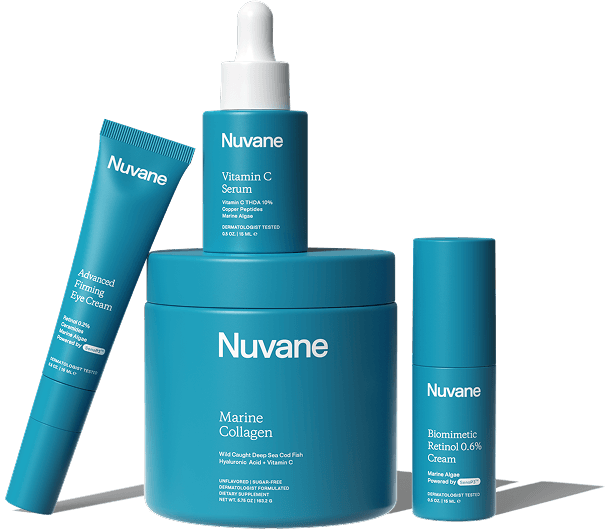
The kit used in the clinical study maps directly onto Nuvane's commercial range:
- Advanced Vitamin C Serum — the morning antioxidant step. Contains 10% THD ascorbate (tetrahexyldecyl ascorbate), a stable, lipid-soluble vitamin C, combined with copper peptides, ceramides, marine extracts, niacinamide, and hyaluronic acid. Designed for the tone and radiance pathway.
- Biomimetic Retinol Cream (0.3% or 0.6%) — the night cream the majority of trial subjects received. Combines stabilized retinol with SenoP3™, niacinamide, trehalose, marine algae, and hyaluronic acid. Two strengths allow AI matching to your tolerance.
- Biomimetic Bakuchiol Cream — the retinol-free option used by subjects assigned Cream C. Contains bakuchiol, SenoP3™, vitamin C derivative, Centella asiatica, and marine algae. Designed for sensitive, perimenopausal, or retinoid-intolerant skin.
- Firming Eye Cream — the eye step used in the trial. 0.2% retinol + SenoP3™ + caffeine + ceramides + soothing extracts. The product behind the periorbital and dark-circle improvements.
- Regenerative Dark Spot Corrector — pigmentation correction with alpha arbutin, retinol, SenoP3™, niacinamide, and marine algae.
- Oral Marine Collagen Supplement — Type I hydrolyzed marine collagen (wild-caught cod) with hyaluronic acid and vitamin C for inside-out dermal support.
When the AI builds your personalized kit at nuvane.com/quiz, it selects from this same set — the same actives, formulations, and combinations that produced the >80% responder rates in the trial.
What this means for your routine
A few practical takeaways that follow directly from the responder-rate data.
- High responder rates beat impressive averages. If a product improves the average user by a lot but only 30% of people respond, your odds are still poor. In this trial, the majority of users improved on the parameters that matter most, across multiple skin types and tones.
- Multi-pathway beats monotherapy. The fastest path to broad responder rates is to address several hallmarks of aging at once. Retinol alone cannot do for the DEJ what palmitoyl tripeptide-38 does. Vitamin C alone cannot do for matrix remodeling what GHK-Cu does. Stack the right actives — or let the AI do it for you.
- Sensitive skin is not excluded from skin longevity. The bakuchiol and 0.3% retinol subgroups produced the strongest hydration and barrier-function profiles in the study. "Gentle" and "effective" are no longer trade-offs.
- Personalization is the multiplier. The same six topicals and one supplement would not have produced these responder rates if every subject received an identical formula. The AI's job is to ensure the right person gets the right night cream — that is where the >80% rates come from.
- Skin longevity is a compounding game. Most parameters were already significantly improved at week 4, but additional gains continued through week 12 on firmness, dark circles, and tone — consistent with the broader skin longevity philosophy that consistency outperforms intensity.
Frequently Asked Questions
What is a "responder rate" in a skin longevity trial?
A responder rate is the percentage of subjects who showed improvement on a given parameter, as opposed to the average magnitude of improvement across the whole group. In this study, responder rates above 80% on parameters such as overall satisfaction (94.7%), smoothness (92.1%), and fine lines (86.8%) mean the vast majority of subjects — not a lucky few — saw visible benefit.
Why does the study emphasize skin longevity instead of anti-aging?
Skin longevity reflects the 2026 scientific consensus that visible aging is the downstream result of multiple cellular hallmarks — senescence, inflammaging, mitochondrial decline, DEJ flattening, barrier loss — that must be addressed together rather than masked. "Anti-aging" describes a goal; "skin longevity" describes a mechanism.
How does the regimen address inflammaging?
Inflammaging is the chronic, low-grade inflammation generated by senescent ("zombie") cells that erodes collagen and skin barrier function over time. The regimen addresses it through GHK-Cu copper peptides (which downregulate matrix-degrading enzymes), THD ascorbate vitamin C (which neutralizes reactive oxygen species), marine algae and ceramides (which restore barrier function and reduce trans-epidermal water loss), and SPF 30 (which prevents the UV-driven inflammation that fuels the cycle).
Is this a "prejuvenation" routine or a corrective routine?
Both. The 0.3% retinol and bakuchiol formulations are well suited to prejuvenation — preventative care for women in their 30s starting before deep wrinkles appear. The 0.6% retinol formulation is a stronger corrective option for established photoaging. The AI assigns the right one based on your actual skin profile, not your age alone.
Is the AI really replacing a dermatologist?
No — it augments dermatologic care. The AI delivers personalized daily-care decisions that consumers historically had to guess at, and was co-developed with a board-certified dermatology team. For diagnosis of skin disease, complex pigmentary disorders, suspicious lesions, or in-office procedures, you still want a dermatologist.
How quickly did subjects see results in the trial?
12 of 13 expert-graded parameters reached statistical significance by week 4, and Corneometer-measured hydration improved +14.6% by week 4 and +17.1% by week 12. In practice, most users should expect visible hydration and texture improvements within 2–4 weeks, with fine lines, firmness, and tone continuing to improve through 12 weeks and beyond.
Did the regimen work for women of color?
Yes. The study population spanned Fitzpatrick II through VI (50.0% White, 18.4% Hispanic, 15.8% Black, 7.9% Asian, 7.9% other). Improvements across the >80% responder parameters were observed across the full range. Because the AI personalizes per user, the regimen adapts to skin tone, sensitivity, and pigmentation profile.
How safe is it for sensitive or retinoid-intolerant skin?
No serious adverse events were reported in the trial. The five discontinuations were due to protocol non-compliance, not adverse reactions. 100% of subjects rated products comfortable during application. The AI specifically routes retinoid-sensitive profiles to bakuchiol + SenoP3™, which delivered the largest hydration gain of any subgroup.
What is SenoP3™ and why is it in every cream?
SenoP3™ is a triple-peptide complex combining Copper Tripeptide-1 (GHK-Cu) for matrix remodeling, Palmitoyl Tripeptide-38 for DEJ reinforcement and collagen/HA stimulation, and Acetyl Hexapeptide-8 (Argireline) for expression-line modulation. The three peptides act through independent, complementary pathways, which is why every night cream and eye cream in the kit contains the complex.
Will I keep improving past 12 weeks?
Most published skin longevity research shows that peptide- and retinoid-based regimens continue to deliver gains for 6–12 months with continued use. The 12-week trial captures the early-to-mid trajectory; consistent use beyond that is associated with continued improvement in firmness, elasticity, and tone, alongside ongoing maintenance of hydration and barrier function.
References
- Fisher GJ, Kang S, Varani J, et al. Mechanisms of photoaging and chronological skin aging. Arch Dermatol. 2002;138(11):1462–1470.
- Farage MA, Miller KW, Elsner P, Maibach HI. Intrinsic and extrinsic factors in skin ageing: a review. Int J Cosmet Sci. 2008;30(2):87–95.
- Franceschi C, Campisi J. Chronic inflammation (inflammaging) and its potential contribution to age-associated diseases. J Gerontol A Biol Sci Med Sci. 2014;69(Suppl 1):S4–S9.
- Mukherjee S, Date A, Patravale V, et al. Retinoids in the treatment of skin aging: an overview of clinical efficacy and safety. Clin Interv Aging. 2006;1(4):327–348.
- Kafi R, Kwak HS, Schumacher WE, et al. Improvement of naturally aged skin with vitamin A (retinol). Arch Dermatol. 2007;143(5):606–612.
- Zasada M, Budzisz E. Randomized parallel control trial checking the efficacy and impact of two concentrations of retinol in the original formula on the aging skin condition: pilot study. J Cosmet Dermatol. 2020;19(2):437–443.
- Dhaliwal S, Rybak I, Ellis SR, et al. Prospective, randomized, double-blind assessment of topical bakuchiol and retinol for facial photoageing. Br J Dermatol. 2019;180(2):289–296.
- Chaudhuri RK, Bojanowski K. Bakuchiol: a retinol-like functional compound revealed by gene expression profiling and clinically proven to have anti-aging effects. Int J Cosmet Sci. 2014;36(3):221–230.
- Pickart L, Margolina A. Regenerative and protective actions of the GHK-Cu peptide in the light of the new gene data. Int J Mol Sci. 2018;19(7):1987.
- Blanes-Mira C, Clemente J, Jodas G, et al. A synthetic hexapeptide (Argireline) with antiwrinkle activity. Int J Cosmet Sci. 2002;24(5):303–310.
- Al-Niaimi F, Chiang NYZ. Topical vitamin C and the skin: mechanisms of action and clinical applications. J Clin Aesthet Dermatol. 2017;10(7):14–17.
- de Miranda RB, Weimer P, Rossi RC. Effects of hydrolyzed collagen supplementation on skin aging: a systematic review and meta-analysis. Int J Dermatol. 2021;60(12):1449–1461.
- Verdier-Sevrain S, Bonte F. Skin hydration: a review on its molecular mechanisms. J Cosmet Dermatol. 2007;6(2):75–82.
- López-Otín C, Blasco MA, Partridge L, Serrano M, Kroemer G. Hallmarks of aging: an expanding universe. Cell. 2023;186(2):243–278.
- Omiye JA, Gui H, Daneshjou R, Cai ZR, Muralidharan V. Principles, applications, and future of artificial intelligence in dermatology. Front Med (Lausanne). 2023;10:1278232.
- Muhn C, Rosen N, Gribble J, et al. The use of artificial intelligence in skin care: a review. J Cosmet Dermatol. 2024;23(1):17–27.
Related Search Terms
skin longevity 2026, skin longevity vs anti-aging, prejuvenation routine, hallmarks of skin aging, cellular senescence skincare, zombie cells skin, inflammaging treatment, biological skin age, epigenetic skin age, senolytic peptides, senotherapeutic skincare, mitochondrial skin aging, multi-pathway anti-aging, AI personalized skincare clinical study, SenoP3 12-week trial, dermal-epidermal junction repair, GHK-Cu copper peptide results, palmitoyl tripeptide-38 fine lines, Argireline expression lines, THD ascorbate vitamin C, retinol vs bakuchiol sensitive skin, marine collagen hydration study, photoaging clinical trial responder rate, barrier repair retinol routine, hyper-personalized skincare 2026
Read more:
"Skin longevity vs. anti-aging"
Can skin longevity treatments outsmart senescence?
SenoP3™ — a breakthrough in skincare and longevity
AI-powered personalization in Nuvane's skin routine
Find the most effective anti-aging products for you by taking the free skin assessment.
Enjoyed this article? Add Nuvane as a preferred source on Google.