
The Best 10 Ingredients to get rid of your Wrinkles

Key Takeaways
- Retinol is the most extensively studied topical ingredient for reducing wrinkles and remains the gold standard — no other cosmetic active has more peer-reviewed support.
- Biomimetic peptides (Copper Tripeptide-1, Palmitoyl Tripeptide-38, Acetyl Hexapeptide-8) work alongside retinol to stimulate collagen, improve elasticity, and soften expression lines from multiple angles.
- Vitamin C (THD Ascorbate) neutralizes photoaging damage in real time and brightens skin tone while supporting collagen synthesis.
- Bakuchiol delivers retinol-like wrinkle reduction without the irritation — the best option for sensitive skin.
- Hyaluronic acid, niacinamide, marine collagen, and alpha arbutin complete a science-backed wrinkle-fighting routine that addresses hydration, barrier health, tone, and depth of lines simultaneously.
Why does the ingredient list matter more than the brand?
The cosmetics industry spends enormous energy on packaging, fragrance, and positioning — but the ingredient list is where the real story lives.
When it comes to reducing wrinkles, the science is not mysterious. Certain molecules have decades of clinical evidence showing they can visibly improve fine lines, deepen wrinkles, skin texture, and firmness. Others have compelling newer data. And some — the ones with the flashiest marketing — have almost none.
This list focuses on what actually works. Each ingredient is ranked by the weight of clinical evidence behind it, its mechanism of action, and how it performs in the context of real skin. When an ingredient appears in a Nuvane formula, that connection is worth noting — but the science comes first.
What are the 10 best ingredients for reducing wrinkles?
Here is a ranked breakdown of the most effective wrinkle-fighting ingredients in skincare today, starting with the most established.
#1 — Retinol
Retinol is the most clinically validated topical ingredient for reducing wrinkles. Full stop.
Retinol is a vitamin A derivative that works through several mechanisms simultaneously. It accelerates skin cell turnover, meaning older, dull surface cells shed faster and fresher ones appear sooner. It stimulates fibroblasts — the cells responsible for producing collagen and elastin — leading to measurable improvements in dermal thickness and skin density over time [1]. It also reduces the activity of matrix metalloproteinases (MMPs), enzymes that break down existing collagen and accelerate structural skin aging [2].
In clinical trials, topical retinol has been shown to visibly reduce fine lines, smooth rough texture, improve skin tone, and increase dermal collagen density within 12 weeks of regular use. The evidence spans more than four decades and includes both prescription-strength tretinoin and over-the-counter retinol concentrations.
The key variables are concentration, formulation stability, and how the skin is supported during the adjustment period. Starting at 0.3% and building gradually is widely considered the smart approach. Jumping straight to higher concentrations increases the risk of dryness, redness, and barrier disruption — which often leads people to abandon the ingredient before it has had a chance to work.
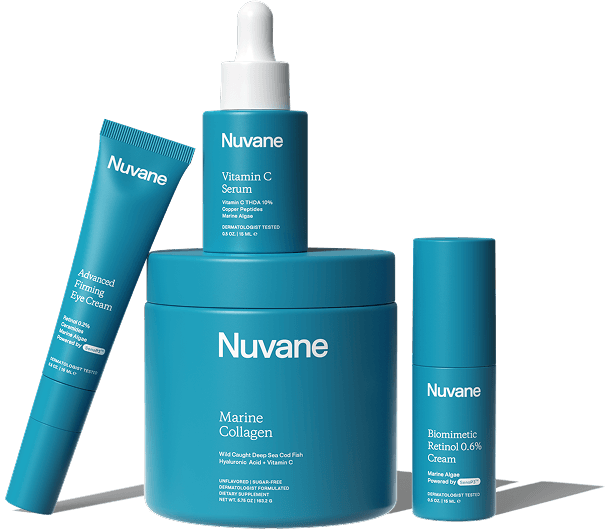
In Nuvane's lineup: The Biomimetic Retinol Cream 0.3% and Biomimetic Retinol Cream 0.6% both pair stabilized retinol with the SenoP3™ peptide complex, niacinamide, trehalose, sodium hyaluronate, and marine algae — creating a formula designed to deliver retinol's benefits with significantly less irritation than retinol alone. The Regenerative Dark Spot Corrector and Advanced Firming Eye Cream also contain retinol as a core active.
#2 — Copper Tripeptide-1 (GHK-Cu)
Copper Tripeptide-1 is one of the most biologically active anti-aging peptides discovered — and it becomes more relevant as skin ages.
GHK-Cu (glycine-histidine-lysine + copper) is a tripeptide naturally produced by the human body. Levels decline sharply with age — from around 200 ng/mL in young adults to approximately 80 ng/mL in the sixth decade of life. This decline correlates with reduced skin repair capacity, thinner skin, and increased visible aging [3].
Topically applied, Copper Tripeptide-1 has been shown to stimulate collagen and elastin synthesis, support the production of dermal glycosaminoglycans, improve skin firmness, and accelerate wound healing. It also exerts antioxidant activity by binding free copper ions that would otherwise catalyze oxidative damage. Studies have found it can increase dermal collagen content, improve skin density, and reduce the depth of wrinkles with consistent use [3].
GHK-Cu belongs to Nuvane's SenoP3™ complex, where it works alongside Palmitoyl Tripeptide-38 and Acetyl Hexapeptide-8 to address multiple drivers of visible skin aging at once. It appears in the Biomimetic Retinol Creams, Biomimetic Bakuchiol Cream, Advanced Firming Eye Cream, Regenerative Dark Spot Corrector, and Advanced Vitamin C Serum.
#3 — Palmitoyl Tripeptide-38 (Matrixyl Synthe'6™)
Palmitoyl Tripeptide-38 is a next-generation peptide that signals skin to rebuild its structural matrix — the framework responsible for firmness and volume.
This peptide works by stimulating the synthesis of six key components of the extracellular matrix: collagen I, collagen III, collagen IV, fibronectin, hyaluronic acid, and laminin-5. Clinical studies have shown it can increase skin density, reduce the depth of wrinkles, and improve overall skin plumpness with regular use [4]. Unlike many cosmetic peptides that have primarily in-vitro evidence, Palmitoyl Tripeptide-38 has been tested in controlled ex-vivo and clinical settings, showing measurable improvements within 2 months.
The mechanism is distinct from retinol — rather than accelerating turnover or blocking collagen-degrading enzymes, this peptide actively upregulates the biosynthetic pathways that lay down new structural protein. That complementary mechanism is exactly why combining peptides with retinol tends to produce better results than either alone.
Palmitoyl Tripeptide-38 is the second component of Nuvane's SenoP3™ complex and appears across the core treatment lineup.
#4 — Acetyl Hexapeptide-8 (Argireline)
Acetyl Hexapeptide-8 is the peptide that earned the nickname "topical Botox" — a simplification, but not without a basis in science.
Acetyl Hexapeptide-8 works by modulating neuromuscular signaling at the skin surface. It competes with the SNAP-25 protein in the SNARE complex, which is responsible for the calcium-dependent release of neurotransmitters that trigger muscle contractions. The result is a temporary softening of repetitive expression lines — crow's feet, forehead lines, and the dynamic creases that become permanent wrinkles over time [5].
Clinical studies have demonstrated visible reductions in the depth of expression lines with twice-daily use over 30 days [5]. Unlike botulinum toxin injections, the effect is local and gradual rather than paralytic — which makes it safer, more flexible, and suitable for daily cosmetic use.
Acetyl Hexapeptide-8 rounds out Nuvane's SenoP3™ triple-peptide complex, complementing the collagen-stimulating effects of GHK-Cu and Palmitoyl Tripeptide-38 with a targeted approach to dynamic wrinkle reduction.
#5 — Vitamin C (THD Ascorbate)
Vitamin C is the most important daytime wrinkle-prevention ingredient — and the form matters enormously.
Standard ascorbic acid (L-ascorbic acid) is unstable, oxidizes quickly, and requires a pH below 3.5 to penetrate the skin effectively — causing irritation in many people. THD Ascorbate (Tetrahexyldecyl Ascorbate) is a lipid-soluble vitamin C derivative that remains stable at room temperature, penetrates the skin more efficiently, and works across a wider pH range [6].
In the skin, vitamin C serves two critical functions. First, it is an essential cofactor for prolyl and lysyl hydroxylases — the enzymes that stabilize the collagen triple helix. Without adequate vitamin C, newly synthesized collagen is structurally weak and degrades more easily. Second, it is a powerful antioxidant that neutralizes free radicals generated by UV radiation and environmental pollution, directly slowing photoaging [6].
Clinical studies show topical vitamin C can increase collagen density, improve visible hyperpigmentation, reduce the appearance of fine lines, and brighten overall skin tone. Used consistently in the morning, it also amplifies the protective effect of sunscreen against UV-induced DNA damage.
In Nuvane's lineup: The Advanced Vitamin C Serum uses THD Ascorbate alongside copper peptides, ceramides, and marine extracts — a pairing designed to maximize stability, penetration, and tolerability.
#6 — Bakuchiol
Bakuchiol is the strongest natural alternative to retinol for wrinkle reduction — and it is the better choice for anyone whose skin does not tolerate vitamin A.
Derived from the seeds of Psoralea corylifolia, bakuchiol works through several overlapping mechanisms. It upregulates retinol-responsive genes in the skin — including genes involved in collagen synthesis and cell turnover — without binding retinoid receptors directly [7]. This gives it a functionally retinol-like profile with significantly less associated irritation, dryness, or photosensitivity.
In a landmark double-blind randomized trial, bakuchiol applied twice daily was found to be comparable to 0.5% retinol in reducing photodamage, wrinkles, and hyperpigmentation over 12 weeks — with significantly fewer side effects [8]. That makes bakuchiol not just a consolation prize for sensitive skin, but a genuinely effective option in its own right.
Bakuchiol also pairs well with retinol for those who want to combine actives. It does not increase irritation the way layering two retinoids might. For skin that finds retinol consistently too much — dry skin, reactive skin, or skin in its 60s and beyond — bakuchiol is often the more sustainable long-term choice.
In Nuvane's lineup: The Biomimetic Bakuchiol Cream combines bakuchiol with SenoP3™ peptides, niacinamide, centella asiatica, hyaluronic acid, and vitamin C derivative — building a complete anti-aging system around the bakuchiol core.
#7 — Hyaluronic Acid (Sodium Hyaluronate)
Hyaluronic acid does not eliminate wrinkles — it fills them from within, while creating the hydrated, plump environment collagen needs to form properly.
Hyaluronic acid (HA) is a naturally occurring polysaccharide found throughout the dermis and extracellular matrix. A single molecule can bind up to 1,000 times its weight in water, making it the skin's primary moisture reservoir. As HA levels decline with age — beginning in the mid-20s and accelerating significantly after 40 — skin loses its internal volume, elasticity, and resistance to creasing under repeated movement [9].
Topically applied low-molecular-weight sodium hyaluronate penetrates the superficial layers of the skin, temporarily increasing water content, plumping fine lines from below, and improving skin texture immediately. Over repeated use, it also supports the dermal environment in which collagen and elastin synthesis occurs — drier, more depleted skin produces structural proteins less efficiently.
Hyaluronic acid does not replace the need for active anti-aging ingredients. But it creates the right conditions for them to work. A retinol or peptide formula that also delivers deep hydration will outperform a dry, irritating formula delivering the same actives.
Hyaluronic acid (as sodium hyaluronate) appears throughout Nuvane's lineup, including in both retinol creams, the bakuchiol cream, the Firming Eye Cream, and the Marine Collagen supplement.
#8 — Niacinamide (Vitamin B3)
Niacinamide is one of the most versatile anti-aging ingredients available — it improves skin tone, barrier health, and fine lines simultaneously, with an excellent tolerability profile.
Niacinamide is a water-soluble form of vitamin B3 that works through multiple pathways relevant to wrinkle reduction. At concentrations of 4–5%, it has been shown in randomized controlled studies to reduce fine lines, improve skin elasticity, decrease hyperpigmentation, and strengthen the skin barrier [10]. It does this by boosting the production of key structural proteins in the epidermis — ceramides, involucrin, and collagen — and by inhibiting the transfer of melanosomes to keratinocytes (which reduces visible dark spots and uneven tone).
Critically, niacinamide also reduces transepidermal water loss (TEWL), which means skin loses less moisture over the course of the day. For aging skin — which already tends toward dryness — this barrier-strengthening effect compounds over time, helping the skin stay plumper and more resilient.
Niacinamide is also one of the best partners for retinol. It can buffer retinol's potential irritation, especially during the early weeks of a new regimen, without reducing retinol's efficacy. That combination is deliberately built into both of Nuvane's retinol creams.
#9 — Marine Collagen (Hydrolyzed)
Oral collagen supplementation is now backed by a growing body of clinical evidence — and the marine source matters for both bioavailability and sustainability.
Hydrolyzed marine collagen consists of small peptide fragments (primarily di- and tripeptides) derived from fish skin and scales. These fragments are absorbed through the gut and have been shown to reach the dermis, where they stimulate fibroblasts to increase their own collagen production — a process sometimes called the "fibroblast feedback loop" [11].
In a double-blind placebo-controlled trial, oral supplementation with 2.5–5g of specific collagen peptides daily for 8 weeks produced significant improvements in skin elasticity, dermal collagen density, and skin hydration [11]. Further research has shown reductions in the depth of eye wrinkles and improved skin firmness with consistent supplementation over 3 months.
Marine collagen (from fish) tends to have higher bioavailability than bovine or porcine sources due to the smaller average peptide size. When combined with vitamin C — which is required for collagen cross-linking — the effect is meaningfully enhanced.
In Nuvane's lineup: The Oral Marine Collagen Supplement combines hydrolyzed marine collagen with hyaluronic acid and vitamin C, specifically designed to support the collagen synthesis pathway from the inside out.
#10 — Alpha Arbutin
Alpha arbutin targets the dark spots and uneven tone that make wrinkles look deeper and more pronounced — making it an important finishing ingredient in any serious anti-aging routine.
Alpha arbutin is a stable, synthetic derivative of hydroquinone that inhibits tyrosinase — the enzyme responsible for melanin production in skin cells. Unlike hydroquinone (which carries risk of irritation and is restricted in several markets), alpha arbutin achieves reliable brightening with a significantly better safety and tolerability profile [12].
Wrinkles are rarely the only visible sign of skin aging. Uneven skin tone, post-inflammatory hyperpigmentation, and age spots routinely appear alongside fine lines, making the overall appearance of aging more pronounced. By targeting pigmentation simultaneously with the structural changes retinol and peptides address, alpha arbutin rounds out a complete multi-target approach to skin aging.
In Nuvane's Regenerative Dark Spot Corrector, alpha arbutin is paired with retinol and SenoP3™ — addressing both the surface discoloration and the underlying structural changes that cause skin to look aged.
Which Nuvane products contain the best wrinkle-reducing ingredients?
Each Nuvane formula is built around multiple actives working together — not a single ingredient doing all the work.
Nuvane's philosophy is that aging skin needs a multi-target approach. A single ingredient, however well studied, cannot simultaneously address cell turnover, collagen synthesis, expression line depth, hydration, barrier health, and pigmentation. The most effective regimens work on several of these pathways at once.
The SenoP3™ triple-peptide complex — combining Copper Tripeptide-1, Palmitoyl Tripeptide-38, and Acetyl Hexapeptide-8 — is Nuvane's signature system for this. Every product in the core treatment range carries it, meaning you get the full peptide profile regardless of which combination you use.
Here is how the ten ingredients map to Nuvane's product lineup:
- Retinol + SenoP3™ + niacinamide + hyaluronic acid: Biomimetic Retinol Cream 0.3% and 0.6%
- Bakuchiol + SenoP3™ + niacinamide + hyaluronic acid + centella asiatica: Biomimetic Bakuchiol Cream
- THD Ascorbate + copper peptides + ceramides: Advanced Vitamin C Serum
- Retinol + SenoP3™ + caffeine + ceramides: Advanced Firming Eye Cream
- Alpha arbutin + retinol + SenoP3™ + niacinamide: Regenerative Dark Spot Corrector
- Marine collagen + hyaluronic acid + vitamin C: Oral Marine Collagen Supplement
Which Nuvane products contain retinol?
If retinol is the ingredient you want to prioritize — and the evidence suggests it should be — these are the Nuvane products that deliver it:
- Biomimetic Retinol Cream 0.3% — The ideal starting point for first-time retinol users or anyone rebuilding a retinol routine. Gentle, effective, and formulated to minimize the classic retinol adjustment period.
- Biomimetic Retinol Cream 0.6% — Maximum-strength retinol for visible, transformative anti-aging results. Best for skin that already tolerates retinol well and wants a stronger push on wrinkles and texture.
- Regenerative Dark Spot Corrector — Combines retinol with alpha arbutin and SenoP3™ for targeted treatment of dark spots alongside broader anti-aging support.
- Advanced Firming Eye Cream — Retinol at 0.2% (appropriate for the delicate eye area) with SenoP3™ and caffeine. Designed for crow's feet, under-eye crepiness, and fine lines around the orbital area.
Key Takeaways: The Wrinkle-Fighting Ingredient Hierarchy
- Start with retinol. It is the most evidence-backed topical ingredient for reducing wrinkles and should be the foundation of any serious anti-aging routine.
- Add peptides. Copper Tripeptide-1, Palmitoyl Tripeptide-38, and Acetyl Hexapeptide-8 each address different aspects of structural aging — they amplify and complement what retinol does.
- Use vitamin C in the morning. THD Ascorbate provides antioxidant defense during the hours when UV and environmental exposure is highest, while also supporting collagen synthesis.
- Support from within. Marine collagen supplementation has credible clinical data supporting improvements in skin density and wrinkle depth — it fills the gap that topical-only routines cannot.
- Finish with niacinamide and hyaluronic acid. These are not glamorous, but they are essential. Barrier health and hydration determine how well every other active ingredient performs.
Frequently Asked Questions
What is the single most effective ingredient for wrinkles?
Retinol (and its prescription-strength form, tretinoin) has the most extensive and consistent clinical evidence of any topical anti-aging ingredient. Decades of randomized controlled studies show it reduces fine lines, deepens skin density, and improves visible photodamage. No other cosmetic active comes close to that evidence base.
How long does it take for retinol to reduce wrinkles?
Most people notice improvements in skin texture and smoothness within 4–8 weeks of consistent use. More significant reductions in the depth of established wrinkles typically require 3–6 months of regular application. Collagen remodeling is a slow process — patience and consistency are what drive results.
Are peptides as effective as retinol for wrinkles?
Peptides and retinol work differently. Retinol drives cell turnover and upregulates collagen synthesis broadly. Peptides like Copper Tripeptide-1 and Palmitoyl Tripeptide-38 signal specific biosynthetic pathways and are generally better tolerated. The strongest outcomes come from combining them — which is exactly why Nuvane formulates retinol and SenoP3™ together.
Can sensitive skin use wrinkle-reducing ingredients?
Yes. Bakuchiol, low-concentration retinol (0.3%), niacinamide, and peptides are all appropriate for sensitive skin. The key is formulation design: the ingredients surrounding the active matters as much as the active itself. A well-designed formula with bakuchiol or low-dose retinol will outperform an aggressive formula that your skin cannot tolerate consistently.
Does vitamin C actually reduce wrinkles or just brighten skin?
Both. THD Ascorbate and other stable vitamin C derivatives support collagen synthesis by acting as an essential cofactor in the enzymatic pathways that form collagen. They also neutralize the free radicals generated by UV exposure — the primary external driver of photoaging and wrinkle formation. The brightening effect is a bonus, not the main mechanism.
Do collagen supplements really reduce wrinkles?
Increasingly, yes. Multiple randomized controlled trials now show that oral supplementation with specific hydrolyzed collagen peptides — at doses of 2.5–5g per day over 8–12 weeks — can increase dermal collagen density, improve skin elasticity, and reduce the depth of eye wrinkles. Marine-sourced collagen tends to have higher bioavailability than bovine alternatives.
What is SenoP3™ and why does it appear in so many Nuvane products?
SenoP3™ is Nuvane's proprietary biomimetic peptide complex combining Copper Tripeptide-1 (collagen/elastin synthesis and antioxidant activity), Palmitoyl Tripeptide-38 (extracellular matrix rebuilding), and Acetyl Hexapeptide-8 (expression line relaxation). It is included across the treatment range because it targets three distinct mechanisms of structural aging simultaneously — something no single peptide can do alone.
Is alpha arbutin necessary for wrinkle reduction?
Not strictly — but pigmentation and wrinkles typically co-occur, and targeting both together produces better-looking skin overall. Alpha arbutin does not reduce wrinkle depth directly, but by improving uneven tone, post-inflammatory marks, and age spots, it makes the skin surface appear smoother, cleaner, and visibly younger.
Can I use retinol and vitamin C in the same routine?
Yes, but timing matters. Retinol is best applied at night. Vitamin C (especially THD Ascorbate) is most useful in the morning, where its antioxidant activity protects against UV-induced oxidative damage throughout the day. Separating them into morning and evening also reduces the risk of any irritation from stacking two active ingredients.
At what age should I start using wrinkle-reducing ingredients?
Prevention is more effective than repair. Most dermatologists recommend beginning a vitamin C serum and consistent sunscreen routine in your mid-to-late 20s, adding a low-concentration retinol (0.3%) in your early 30s, and incorporating peptides and collagen support by the mid-30s to 40s. The biology of collagen loss begins well before wrinkles are visible — starting earlier compounds the benefit.
References
[1] Griffiths CE, et al. "Restoration of collagen formation in photodamaged human skin by tretinoin (retinoic acid)." N Engl J Med. 1993;329(8):530–535.
[2] Fisher GJ, et al. "Molecular basis of sun-induced premature skin ageing and retinoid antagonism." Nature. 1996;379(6563):335–339.
[3] Pickart L, Margolina A. "Regenerative and Protective Actions of the GHK-Cu Peptide in Human Body Organs." Symmetry. 2018;10(7):290.
[4] Lintner K, Peschard O. "Biologically active peptides: From a laboratory bench curiosity to a functional skin care product." Int J Cosmet Sci. 2000;22(3):207–218.
[5] Blanes-Mira C, et al. "A synthetic hexapeptide (Argireline) with antiwrinkle activity." Int J Cosmet Sci. 2002;24(5):303–310.
[6] Sauermann K, et al. "Topically applied vitamin C increases the density of dermal papillae in aged human skin." BMC Dermatol. 2004;4:13.
[7] Chaudhuri RK, Bojanowski K. "Bakuchiol: a retinol-like functional compound revealed by gene expression profiling and clinically proven to have anti-aging effects." Int J Cosmet Sci. 2014;36(3):221–230.
[8] Dhaliwal S, et al. "Prospective, randomized, double-blind assessment of topical bakuchiol and retinol for facial photoageing." Br J Dermatol. 2019;180(2):289–296.
[9] Papakonstantinou E, Roth M, Karakiulakis G. "Hyaluronic acid: A key molecule in skin aging." Dermatoendocrinol. 2012;4(3):253–258.
[10] Bissett DL, Miyamoto K, Sun P, Li J, Berge CA. "Topical niacinamide reduces yellowing, wrinkling, red blotchiness, and hyperpigmented spots in aging facial skin." Int J Cosmet Sci. 2004;26(5):231–238.
[11] Proksch E, et al. "Oral supplementation of specific collagen peptides has beneficial effects on human skin physiology: A double-blind, placebo-controlled study." Skin Pharmacol Physiol. 2014;27(1):47–55.
[12] Chakraborty AK, et al. "Mechanistic study on the inhibitory effect of arbutin on melanogenesis in murine B16 cell culture." Dermatol Sci. 1998;18(3):184–188.
Related Search Terms
best ingredients for wrinkles, retinol for wrinkles, copper peptides anti-aging, palmitoyl tripeptide-38 wrinkles, vitamin C for skin aging, bakuchiol vs retinol wrinkles, hyaluronic acid fine lines, niacinamide anti-aging, marine collagen supplements skin, alpha arbutin wrinkles, SenoP3 peptides, best anti-aging skincare ingredients, acetyl hexapeptide-8 argireline, THD ascorbate vitamin C serum, wrinkle-fighting skincare routine
Find the most effective anti-aging products for you by taking the free skin assessment.
Recommended Read
- Retinol vs. Bakuchiol: which is best for your skin?
- The complete guide to skin longevity ingredients
- Best proven ways to actually get rid of wrinkles
- What works best with retinol: ingredient pairing guide
Find the most effective anti-aging products for you by taking the free skin assessment.
Enjoyed this article? Add Nuvane as a preferred source on Google.