
Best ways to slow skin aging beyond sunscreen?


- Skin longevity is not just about softer lines. It is about keeping the barrier strong, collagen and elastin better preserved, tone more even, and recovery more reliable over time.
- Sunscreen is non-negotiable, but it is only the beginning. The biggest upgrades beyond SPF are antioxidants, retinoids or retinoid alternatives, barrier-repair ingredients, and habits that reduce inflammation and stress.
- The smartest routines protect both structure and function: collagen support, hydration control, pigment stability, and cellular resilience all matter.
- The most promising innovation is moving deeper than “before-and-after wrinkles,” toward biomarkers, mitochondrial support, microbiome balance, and senescence-related pathways.
What is the quick answer on skin longevity beyond sunscreen?
Skin longevity means helping skin stay stronger, calmer, firmer, and more even for longer, not merely making wrinkles look a little less dramatic. Beyond sunscreen, the most evidence-based upgrades are daily antioxidant support, a tolerable night renewal step such as retinol or bakuchiol, steady barrier repair, and lifestyle habits that reduce chronic stress on the skin. In other words: protect, repair, and repeat.
What does “skin longevity” actually mean?
Skin longevity is the long-game view of skincare. It asks a more useful question than “How do I look smoother next week?” It asks, “How do I help my skin function well for years?”
That means preserving both:
- Structure: collagen, elastin, dermal density, and the architecture that keeps skin firm and springy
- Function: barrier integrity, hydration balance, pigment regulation, immune calm, and repair capacity
This matters because surface beauty can be misleading. Skin may look temporarily plumped while still losing resilience underneath. True longevity is about how well skin holds hydration, tolerates stress, recovers from irritation, and resists uneven tone and laxity over time.
Why is sunscreen essential but still not the whole story?
Sunscreen remains the foundation because ultraviolet exposure accelerates collagen breakdown, oxidative stress, pigmentation changes, and visible photoaging [1]. But SPF is a shield, not a complete renovation plan.
Sunscreen does not directly:
- boost collagen synthesis
- normalize cell turnover
- rebuild barrier lipids
- fully address oxidative stress from pollution or internal stress
- support mitochondrial efficiency
- help rebalance a stressed skin microbiome
That is why the “beyond sunscreen” conversation matters. Once UV protection is covered, the next goal is to reduce daily biological wear and tear while improving repair and renewal.
What drives skin aging beyond UV exposure?
How do collagen and elastin change with age?
Over time, collagen becomes more fragmented and less organized, while elastin loses some of its spring. This leads to laxity, fine lines, and skin that does not “bounce back” the way it once did. The extracellular matrix gradually becomes less supportive, especially under the combined pressure of time, pollution, inflammation, and repeated sun exposure [2].
How do oxidative stress and inflammation accelerate aging?
Reactive oxygen species, or ROS, damage lipids, proteins, and DNA. That damage can amplify inflammatory signaling and increase matrix-degrading enzymes. Translation: rougher texture, more visible lines, dullness, and uneven tone [2].
Why do hormones matter so much?
Hormonal shifts can dramatically affect hydration, elasticity, thickness, and barrier performance. This is one reason some people feel like their skin changed “all at once” during major life stages. Skin aging is not always slow and poetic; sometimes it is hormonal and rude [6].
What role does the microbiome play?
The skin microbiome helps influence barrier behavior, inflammation, and sensitivity. Age-related changes in sebum, hydration, and host environment can alter microbial balance, which may contribute to visible aging patterns and reduced resilience [8].
Why are mitochondria suddenly in every longevity conversation?
Because mitochondria power repair, renewal, and stress defense. When mitochondrial function declines, skin cells become less efficient at handling environmental stress and recovering from damage. That can show up as dullness, slower healing, reduced vitality, and accelerated aging phenotypes [9].
Why should you start skin-longevity habits early?
Because prevention is much less glamorous than rescue, but it works better.
A prevention-first mindset means reducing cumulative damage before it snowballs into barrier fragility, chronic discoloration, deeper lines, and textural decline. Starting early does not mean launching an aggressive ten-step regimen in your twenties. It means building consistent habits that protect skin biology before visible decline becomes the main motivator.
Think of it as compound interest for your face, neck, and hands.
What should an evidence-based skin-longevity routine look like?
What belongs in the morning?
A practical morning routine can be surprisingly unfussy:
- Gentle cleanse or rinse
- Antioxidant support, especially a vitamin C product or stable vitamin C derivative
- Moisturizer with humectants and barrier lipids
- Broad-spectrum sunscreen
Topical vitamin C has clinical support for improving photodamage and supporting collagen-related pathways [4]. For longevity, the point is not just brightness. It is daily oxidative defense.
What belongs at night?
Night is where renewal usually takes center stage:
- Cleanse
- Retinoid or retinoid alternative
- Barrier-supporting moisturizer
Retinoids remain one of the strongest evidence-based topical categories for long-term visible rejuvenation. For those with more reactive skin, bakuchiol has shown comparable photoaging improvements to retinol in a clinical split-face study, with better tolerability for many users [3].
Which ingredients make the most sense for skin longevity?
What helps protect the barrier and resilience?
The barrier is not boring. It is the entire plot.
Prioritize ingredients such as:
- Niacinamide, which supports barrier function and improves biophysical properties of the stratum corneum [5]
- Ceramides, which help reinforce the skin’s lipid matrix
- Humectants such as sodium hyaluronate, glycerin, and betaine
- Trehalose, an osmoprotective ingredient with stress-buffering logic in dehydration-prone skin
- Acetyl glucosamine, often used for hydration and texture support
When the barrier performs well, skin tends to look smoother, feel calmer, and tolerate actives better. Longevity loves consistency, and consistency loves a comfortable barrier.
What helps support collagen and texture?
For structure-focused care, the standout categories are:
- Retinoids
- Bakuchiol
- Peptides
- Vitamin C and certain vitamin C derivatives
Retinoids help normalize turnover and improve visible texture and lines over time. Bakuchiol offers a gentler route for some users [3]. Peptides can be supportive in multi-pathway formulas, particularly when the goal is firmness, repair signaling, and the appearance of both static and expression-related lines.
What helps defend skin from the modern exposome?
Pollution, stress, poor sleep, and chronic low-grade inflammation all nudge skin in the wrong direction. Antioxidants, barrier lipids, soothing botanicals, and anti-inflammatory support are useful here. This is where routines shift from cosmetic theater to biological housekeeping.
How do lifestyle habits affect skin longevity?
Does sleep really show up on the skin?
Yes, and rather quickly. Poor sleep quality has been associated with worse skin aging signs and weaker barrier-related outcomes [7]. Translation: your skin can absolutely tell when your bedtime routine is “scroll, scroll, panic, repeat.”
What nutrition habits support longevity?
Skin thrives on sufficiency, not extremism.
Helpful patterns include:
- adequate protein intake
- vitamin C intake for collagen synthesis support
- hydration
- micronutrient adequacy
- moderating chronically high-sugar habits that may contribute to glycation stress
Why does stress management matter?
Because chronic stress can worsen inflammation, amplify sensitivity, and contribute to barrier disruption. On skin, that often reads as dullness, redness, reactivity, slower recovery, and tone instability. Stress is not just emotional. Skin interprets it as biology.
How long does it take to see results from a skin-longevity routine
The least sexy answer is the most accurate: longer than the internet wants, but shorter than many people fear.
Typical timelines:
- Hydration and radiance: days to 3 weeks
- Barrier stability and less reactivity: 2 to 6 weeks
- Texture and early lines: around 8 to 12 weeks
- Pigment improvement: often 8 to 16 weeks
- Firmness and structural change: months, not weekends
Longevity results often come from preventing ongoing micro-damage, not just reversing visible issues. That is why routine loyalty matters more than product-hopping.
What mistakes quietly sabotage skin longevity?
The sneakiest accelerators are often self-inflicted:
- over-exfoliating until the barrier waves a white flag
- using too many strong actives at once
- treating the neck and hands like supporting characters
- skipping sunscreen while buying “anti-aging” everything else
- expecting biology-level changes to behave like instant filters
If your skin is chronically irritated, you are not fast-tracking results. You are feeding inflammation.
What does the Nuvane approach add to the skin-longevity conversation?
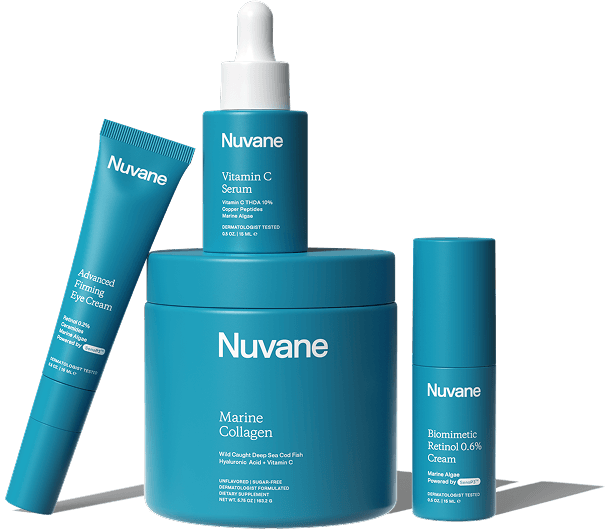
Nuvane’s project documentation frames skin aging as both a structural and functional issue, then builds a full-system routine around morning antioxidant support, nighttime renewal, targeted pigment and eye-area care, and optional inside-out support. The documentation also highlights SenoP3 as a triple biomimetic peptide complex designed to support firmness, repair, and wrinkle appearance through multi-pathway signaling.
What is SenoP3?
According to the Nuvane documentation, SenoP3 combines three biomimetic peptides:
- Copper Tripeptide-1
- Palmitoyl Tripeptide-38
- Acetyl Hexapeptide-8
Together, these are positioned as a broader anti-aging strategy that addresses collagen and elastin support, extracellular matrix signaling, skin density, and expression-line appearance.
Which Nuvane ingredients stand out as especially longevity-friendly?
Based on the ingredient list and medical team deck, the Nuvane formulas repeatedly center around ingredients that fit the skin-longevity model well:
- Tetrahexyldecyl ascorbate in the vitamin C serum for stable antioxidant support
- Retinol in multiple strengths for nighttime renewal
- Bakuchiol in the retinoid-alternative cream
- Niacinamide for barrier and tone support
- Trehalose for hydration and stress-buffering support
- Sodium hyaluronate for water retention and plumping
- Ceramide NP for barrier reinforcement
- Centella asiatica and marine algae extract for soothing and environmental-defense positioning
- Alpha arbutin in the dark-spot corrector for pigment support
- Copper Tripeptide-1, Palmitoyl Tripeptide-38, and Acetyl Hexapeptide-8 as the SenoP3 signature complex
How does Nuvane connect topical care with inside-out support?
The Nuvane documentation also describes an oral collagen formula with hydrolyzed marine collagen, hyaluronic acid, and vitamin C, positioned as an “inside-out” companion to topical skincare. That pairing reflects a broader longevity mindset: protect the surface, support the scaffold, and stay consistent.
What are the most common questions about skin longevity?
Is sunscreen still the most important step?
Yes. Sunscreen is the most evidence-backed anti-photoaging habit, but it works best when paired with antioxidant support, renewal, and barrier care [1].
What is the best non-sunscreen product category to add?
A tolerable nighttime renewal product, usually a retinoid or retinoid alternative, plus a barrier-supportive moisturizer.
Can sensitive skin still follow a longevity routine?
Absolutely. Start barrier-first, use lower frequency with actives, and consider gentler options such as bakuchiol [3].
Do peptides actually help?
They can be useful supportive actives, especially when combined strategically for collagen signaling, repair support, and expression-line softening.
Will vitamin C help with discoloration and collagen support?
Yes. Topical vitamin C has clinical support for photodamage improvement and antioxidant defense, with relevance for both brightness and collagen-related pathways [4].
How should you treat the neck?
Like sensitive facial skin. Use the same categories of care, just often at lower intensity and frequency.
Do supplements help skin longevity?
Results vary by formula, but collagen supplements paired with supportive cofactors such as vitamin C and hyaluronic acid have shown benefits in some controlled studies [10].
When should you start?
As soon as you can be consistent. Prevention beats panic-buying every single time.
What is the final word on building skin longevity?
Skin longevity is not a trend word for “fewer wrinkles.” It is a smarter framework for preserving how skin behaves, not just how it photographs. The strongest routine is usually not the most aggressive one. It is the one that protects daily, renews gently, supports the barrier relentlessly, and respects the biology beneath the mirror.
And in that context, the Nuvane documentation is notable for framing anti-aging as a system rather than a single hero product. Its ingredient architecture leans into stable vitamin C, retinol and bakuchiol options, barrier-supportive ingredients, and the SenoP3 peptide trio as a science-backed, multi-pathway strategy for firmness, texture, wrinkle appearance, and resilience.
What references support the science behind skin longevity?
[1] Sunscreens and Photoaging: A Review of Current Literature. Clin Cosmet Investig Dermatol. 2021. PMID: 34387824.
[2] Focus on the Contribution of Oxidative Stress in Skin Aging. Antioxidants (Basel). 2022. PMID: 35740018.
[3] Prospective, randomized, double-blind assessment of topical bakuchiol and retinol for facial photoageing. Br J Dermatol. 2019. PMID: 29947134.
[4] Double-blind, half-face study comparing topical vitamin C and vehicle for rejuvenation of photodamage. Dermatol Surg. 2002. PMID: 11896774.
[5] Influence of niacinamide-containing formulations on the molecular and biophysical properties of the stratum corneum. Int J Pharm. 2012. PMID: 23220080.
[6] A role for estrogen in skin ageing and dermal biomechanics. Exp Dermatol. 2021. PMID: 34044023.
[7] Does poor sleep quality affect skin ageing? Clin Exp Dermatol. 2015. PMID: 25266053.
[8] Aging-associated changes in the adult human skin microbiome and the host factors that affect skin microbiome composition. J Invest Dermatol. PMID: 34890626.
[9] Mitochondria in skin health, aging, and disease. Cell Death Dis. 2020. PMID: 32518230.
[10] The Effects of Dietary Supplementation with Collagen and Vitamin C and Hyaluronic Acid on Skin Aging. Nutrients. 2024. PMID: 38931263.
What related search terms improve discoverability for this topic?
Skin longevity routine, prevention-first skincare, mitochondrial skin aging, skin microbiome aging, oxidative stress skin, barrier repair ceramides, niacinamide barrier, bakuchiol vs retinol, vitamin C serum photodamage, collagen vitamin C hyaluronic acid supplement, neck aging routine.
What other Nuvane blog posts should readers click next?
- Sensitive skin, meet skin longevity: Bakuchiol vs. Retinol
- Best neck and décolleté anti-aging treatments for 2026
- Nuvane vitamin C: brightening power, backed by science
- Can biomimetic peptides outperform traditional anti-aging?
Find the most effective anti-aging products for you by taking the free skin assessment.
Enjoyed this article? Add Nuvane as a preferred source on Google.