
What is your skin's biological age—and why has it become beauty's new status symbol?


Quick Answer: Your skin's biological age is a measure of how old your skin actually behaves at the cellular level—based on markers like senescent cell burden, mitochondrial function, and DNA methylation patterns—rather than how many candles were on your last birthday cake. In 2026, this number is quietly replacing "anti-aging" as the industry's central story: luxury brands and science-led challengers alike are shifting from selling ingredients to selling proof of mechanism, and biological age is becoming the metric that proof is measured against.
Key Takeaways
- Biological age is not chronological age. Two 50-year-olds can have skin behaving 10 years apart, depending on senescent cell load, oxidative burden, and repair capacity.
- Consumer-facing skin epigenetic clocks are arriving. Tape-strip biological age tests are moving from research labs toward at-home accessibility, giving people a trackable number for the first time.
- Cellular senescence is the mechanism getting the most attention. "Zombie cells" that refuse to die keep secreting inflammatory signals that age the tissue around them.
- NAD⁺ decline is the thread connecting DNA repair, mitochondrial energy, and skin biological age—and it drops measurably with chronological age.
- The shift from ingredients to mechanisms is reshaping how skincare brands talk. Instead of "rare flower extract," the story is now "reduces senescent cell burden" or "restores mitochondrial efficiency."
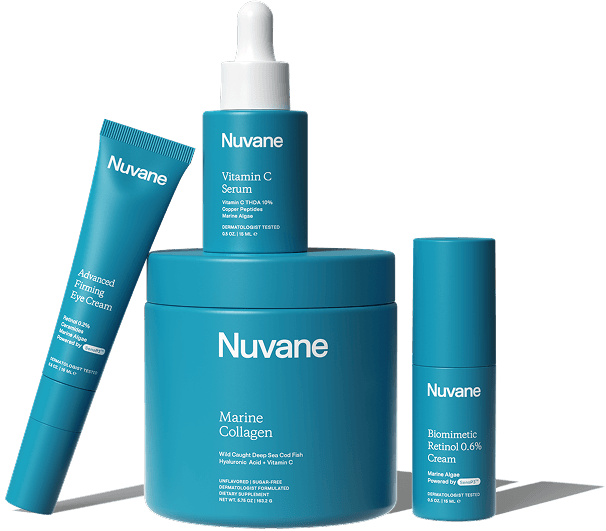
- Nuvane's SenoP3™ complex was built around this framework, targeting the repair and senescence pathway that governs how fast the others run.
Why is "biological age" replacing "anti-aging" as skincare's defining idea?
Skin biological age is replacing anti-aging because it measures the biology inside skin cells rather than the visible signs on the surface.
For most of the last century, skincare marketing spoke in the language of appearance: fewer lines, brighter tone, firmer touch. That language is still around, but a parallel conversation has taken over the more serious end of the industry—one that speaks in senescent cells, epigenetic clocks, and mitochondrial function instead of jars and rare botanicals.
This isn't just a trend in messaging. It reflects a real shift in geroscience. Research on epigenetic clocks has established that the gap between chronological and biological age captures something clinically meaningful: a 2026 multi-cohort study found that lifestyle factors like smoking, elevated glucose, and blood pressure accelerate biological aging as measured by DNA methylation tools, while physical activity and diet quality slow it [1]. Skin, being the body's largest and most accessible organ, turned out to be an unusually convenient place to measure this. A 2026 study out of a major skincare research lab validated periorbital skin features—wrinkles, pigmentation, and morphology around the eyes—as a biomarker that correlates not just with chronological age but with underlying disease history [2].
The practical result is that "biological age" is no longer an abstract wellness concept borrowed from longevity clinics. It's becoming something skincare brands can point to as an outcome, not just a claim. And outcomes, unlike adjectives, can be measured before and after.
What is cellular senescence, and why are dermatologists calling these "zombie cells"?
Cellular senescence is the mechanism most directly linked to your skin's biological age.
Cellular senescence is what happens when a skin cell sustains damage it can't repair. Instead of dying, it enters a permanent, non-dividing state—alive but non-functional. These senescent cells don't sit quietly. They secrete a mix of inflammatory cytokines, growth factors, and collagen-degrading enzymes known as the senescence-associated secretory phenotype (SASP) [3]. A senescent fibroblast stops producing collagen and simultaneously starts breaking down the collagen around it, while nudging nearby healthy cells toward senescence too.
This is the biological basis of the "zombie cell" description that's become common in longevity science. The cells aren't dead, but they behave like a slow leak that never gets patched—and the leak accelerates over time, because SASP signaling recruits more cells into the same state.
Two therapeutic strategies have emerged in response: senolytics, which selectively clear senescent cells, and senomorphics, which suppress the inflammatory SASP output without necessarily killing the cell [4]. Early dermatologic research on topical senotherapeutics is promising—one randomized, double-blinded 12-week clinical trial of a senotherapeutic peptide in women aged 60–90 found significant improvements in skin barrier function and reductions in circulating inflammatory markers compared to a standard moisturizer [5]. The clinical evidence is still early-stage compared to decades of retinoid research, but the direction is consistent: reducing senescent burden appears to move real, measurable outcomes, not just subjective ones.
How it shows on skin: the frustrating plateau—a routine that used to work and suddenly doesn't, slower recovery from procedures or irritation, generalized dullness, and loss of density that doesn't track with any obvious new sun exposure or lifestyle change.
How does NAD⁺ decline connect DNA repair, mitochondrial energy, and biological age?
NAD⁺ decline is what links failing DNA repair, falling mitochondrial energy, and rising skin biological age.
Nicotinamide adenine dinucleotide (NAD⁺) is a coenzyme every cell needs to run basic metabolic processes: transferring electrons for energy production, and fueling enzymes involved in DNA repair and cellular housekeeping. NAD⁺ levels decline measurably with chronological age, and that decline has downstream consequences specific to skin.
Two of those consequences matter most. First, DNA repair is NAD⁺-dependent. PARP enzymes, which detect and coordinate repair of UV-induced DNA damage, consume NAD⁺ to do their job—so as NAD⁺ falls, the same sun damage that a 25-year-old repairs efficiently sits unrepaired longer in older skin [6]. Second, NAD⁺ is essential for mitochondrial function. Aging mitochondria become progressively less efficient at producing energy while leaking more reactive oxygen species, a cycle that worsens as NAD⁺-dependent repair enzymes (sirtuins) lose fuel [7].
Both systemic and topical approaches to raising NAD⁺ are under active study. Nicotinamide (vitamin B3) is the most clinically established NAD⁺ precursor for skin specifically—it's the only topical agent with randomized trial evidence for reducing actinic keratosis and non-melanoma skin cancer incidence in high-risk patients, and it has documented ability to enhance repair of UV-induced DNA damage in human keratinocytes [8]. Newer precursors like nicotinamide mononucleotide (NMN) show encouraging effects on fibroblast gene expression and senescence markers in vitro, though dermatology-specific human trials remain limited [9]. Direct topical NAD⁺ delivery is an even newer area of study, with early work suggesting synergistic effects when NAD⁺ is combined with inhibitors of the enzymes that otherwise consume it [10].
The honest state of the science: the mechanism connecting NAD⁺ to skin biological age is well established. The clinical proof for specific topical delivery methods is still catching up, which is exactly why credible brands lean on nicotinamide—the precursor with the deepest evidence base—rather than newer, less-studied NAD⁺ derivatives.
Can you actually measure your skin's biological age right now?
Skin biological age can now be measured outside a lab, using epigenetic clocks and AI-based facial imaging.
Until recently, "biological age" was something researchers measured in a lab, not something a consumer could check at home. That's shifting quickly. Non-invasive skin epigenetic clocks—trained on DNA methylation patterns from tape-strip samples of the epidermis—have been validated with predictive accuracy within roughly four years of chronological age in peer-reviewed research, and consumer-accessible versions are moving toward market [11].
Facial imaging is advancing in parallel. Researchers have used line-field confocal optical coherence tomography (LC-OCT) to extract depth-resolved biomarkers—layer thickness, collagen network organization, cellular density—that predict skin's functional age from its microstructure rather than its surface appearance [12]. AI-derived digital phenotyping, which translates photos into quantitative aging scores, is being proposed as a scalable complement to these deeper diagnostic layers [13].
What does this mean practically? A single biological age reading is interesting but not especially actionable—genetics, sun history, and geography all shape a baseline number that isn't fully within your control. The more useful application, and the one geroscience researchers themselves emphasize, is tracking change over time: a baseline reading followed by repeat testing at 6 and 12 months tells you whether a given routine or protocol is actually shifting the underlying biology, rather than just producing a temporary glow.
How does Nuvane build a routine around skin biological age, not just wrinkles?
Nuvane builds routines around aging mechanisms—senescence, NAD⁺ decline, barrier repair—rather than around a single hero ingredient.
Most skincare routines are still organized around a hero ingredient—retinol for renewal, vitamin C for brightness. That approach maps to a single visible outcome, which is exactly why routines plateau: they leave the deeper mechanisms driving biological age untouched.
Nuvane's formulations are built around the SenoP3™ triple-peptide complex, named specifically for its role in the senescence pathway that governs how fast the others run:
- Copper Tripeptide-1 (GHK-Cu) restores a signaling peptide whose plasma level falls with age, upregulating collagen and elastin synthesis while contributing independent antioxidant activity relevant to the oxidative-stress side of skin biological age [14].
- Palmitoyl Tripeptide-38 signals fibroblasts to synthesize collagen I, III, and IV along with hyaluronic acid—addressing the protein-synthesis decline that compounds as senescent cells accumulate and stop producing structural proteins.
- Acetyl Hexapeptide-8 reduces the repetitive micro-contraction that mechanically stresses newly formed collagen, supporting the structural side of the equation rather than only the biochemical one.
Alongside SenoP3™, niacinamide—present in the Biomimetic Retinol Cream and Regenerative Dark Spot Corrector—functions as an NAD⁺ precursor, supporting the DNA-repair pathway most directly tied to biological age. Trehalose activates autophagy, the cellular clean-up process that declines with age and, when restored, helps clear the damaged material that would otherwise push cells toward senescence. The Advanced Vitamin C Serum, built on stable THD ascorbate, targets the oxidative stress that both damages cells directly and accelerates their path toward senescence.
The point isn't that any single Nuvane product reverses biological age on its own—no cosmetic product does, and any claim to the contrary should be treated with skepticism. The point is that the formulation logic tracks the mechanisms, rather than the visible symptoms, that geroscience has identified as driving skin aging. That's the same shift luxury and science-led brands across the industry are making: building the story around proof of mechanism, and letting the visible result follow from it.
Key takeaways
- Biological age measures how your skin behaves, not how long you've been alive—and it's becoming skincare's new headline metric, replacing purely visual "anti-aging" claims.
- Senescent "zombie cells" are a central driver. They stop functioning but keep secreting inflammatory signals (SASP) that accelerate aging in the tissue around them.
- NAD⁺ decline connects DNA repair and mitochondrial energy production, and nicotinamide remains the most clinically validated way to support that pathway topically.
- Diagnostics are catching up to the science. Tape-strip epigenetic clocks and AI-driven imaging are moving skin biological age from a lab concept toward a trackable consumer metric.
- Track change, not a single number. A one-time biological age reading is less useful than repeat measurement against a consistent protocol.
- Mechanism-first formulation, like Nuvane's SenoP3™ approach, is the throughline connecting senescence, oxidative stress, and protein synthesis rather than treating them as separate problems.
Frequently asked questions
What is skin biological age, exactly?
Skin biological age is an estimate of how "old" your skin is functioning at a cellular level, based on markers such as senescent cell burden, DNA methylation patterns, oxidative damage, and mitochondrial efficiency—rather than the number of years since you were born.
Can I lower my skin's biological age?
You can influence the biological processes that drive it—reducing senescent cell burden, supporting NAD⁺-dependent repair, and lowering oxidative stress through sun protection, consistent skincare, and lifestyle factors like sleep and diet. There's no single product or procedure that resets biological age wholesale.
Is skin biological age testing available to consumers yet?
Tape-strip skin epigenetic clocks have been validated in peer-reviewed research and are moving toward consumer accessibility. Availability and accuracy vary by provider, so it's worth checking the underlying validation data before relying on any single test.
What are senolytics and senomorphics?
Senolytics are compounds designed to selectively clear senescent cells; senomorphics suppress the inflammatory signals (SASP) those cells secrete without necessarily eliminating them. Both are active areas of dermatologic research, though most human clinical evidence in skin specifically is still early-stage.
Does niacinamide really affect DNA repair?
Yes. Niacinamide is a precursor to NAD⁺, the cofactor DNA-repair enzymes require to function, and it has randomized trial evidence for reducing precancerous skin lesions in high-risk patients—one of the more clinically established claims in this space.
Is this the same as "anti-aging" skincare with a new name?
Not entirely. Traditional anti-aging skincare targets visible signs directly. The biological-age framework targets the cellular mechanisms—senescence, oxidative stress, mitochondrial function—that produce those visible signs, with the goal of changing the trajectory rather than just the appearance.
How long does it take to see changes in skin biological age markers?
Visible skin changes from mechanism-targeted routines typically appear on a similar timeline to other skincare: barrier and hydration improvements in weeks, firmness and texture changes over 8–12 weeks. Measurable shifts in biological age markers themselves would require repeat testing, which is still an emerging capability for most consumers.
References
- "Epigenetic clocks: advancing biological age measures towards meaningful clinical use." eBioMedicine, 2026.
- Gu KN, Leem S, Kim H, et al. "Periorbital skin index as a biomarker for biological aging and health status." Frontiers in Aging, 2026;7.
- Wang AS, Dreesen O. "Biomarkers of Cellular Senescence and Skin Aging." Frontiers in Genetics, 2018;9:247.
- "Targeting cellular senescence in dermatology: senolytic and senomorphic strategies." GeroScience, 2026.
- Zonari A, Brace LE, Buhrer LB, et al. "OS-01 Peptide Topical Formulation Improves Skin Barrier Function and Reduces Systemic Inflammation Markers: A Pilot 12-Week Clinical Trial." Journal of Cosmetic Dermatology, 2025.
- Surjana D, Halliday GM, Damian DL. "Nicotinamide enhances repair of ultraviolet radiation-induced DNA damage in human keratinocytes and ex vivo skin." Carcinogenesis, 2013;34(5):1144–1149.
- "The Role of NAD+ in Regenerative Medicine." PMC, National Institutes of Health.
- Damian DL. "Nicotinamide for skin cancer chemoprevention." Australasian Journal of Dermatology, 2017;58(3):174–180.
- "Distinctive Gene Expression Profiles and Biological Responses of Skin Fibroblasts to Nicotinamide Mononucleotide: Implications for Longevity Effects on Skin." 2026.
- "Novel Approach to Skin Anti-Aging: Boosting Pharmacological Effects of Exogenous NAD+ by Synergistic Inhibition of CD38 Expression." 2024.
- "The 12 Hallmarks of Skin Aging: The Cellular Framework for At-Home Anti-Aging in 2026." Vazquez et al., npj Aging, 2025;11:100.
- "Facial aging biomarkers and LC-OCT imaging of cutaneous aging architecture." Frontiers in Medicine, 2026.
- "AI-derived digital phenotyping and digital biomarkers of skin and facial aging." Frontiers in Medicine, 2026.
- Pickart L, Margolina A. "Regenerative and Protective Actions of the GHK-Cu Peptide in the Light of the New Gene Data." International Journal of Molecular Sciences, 2018;19(7):1987.
Related search terms
skin biological age, epigenetic clock skincare, senescent cells skin aging, zombie cells skin, senolytics skincare, senomorphics SASP, NAD+ skin repair, mitochondrial function skin aging, biological age test at home, longevity skincare science, cellular senescence anti-aging, SenoP3 peptide complex, inflammaging biomarkers, skin epigenetic testing, niacinamide DNA repair evidence, luxury longevity skincare, skin longevity diagnostics
Find the most effective anti-aging products for you by taking the free skin assessment.
Recommended Read
How senescent cells drive skin aging?
How is mitochondrial health crucial to your skin's longevity
What actually causes skin aging? The 5 biological pathways behind every wrinkle
Best ways to diagnose and treat inflammaging
Find the most effective anti-aging products for you by taking the free skin assessment.
Enjoyed this article? Add Nuvane as a preferred source on Google.