
Why does Asian skin age differently?

- Asian skin doesn’t need “more steps” — it needs smarter steps: barrier-first + pigment-safe actives + consistency.
- K-beauty is brilliant for hydration, glow, and calming (think essences, gentle layers), but it can underdeliver on collagen remodeling unless you intentionally add proven anti-aging actives.
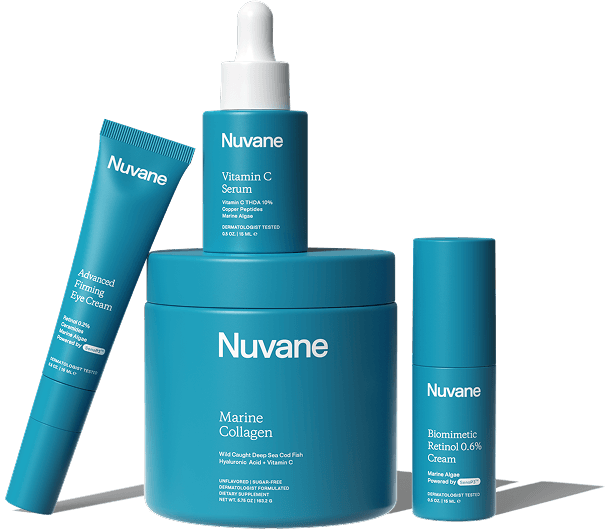
- Nuvane is built as a results-driven system: retinol options (0.3% or 0.6%), a sensitive-skin bakuchiol path, stabilized vitamin C, targeted pigment care — all anchored by SenoP3™ peptides.
- If you’re prone to irritation or post-inflammatory hyperpigmentation (PIH), the winning move is low-and-slow retinoids + niacinamide + strict sunscreen — not aggressive exfoliation.
What’s the quick answer on K-beauty vs Nuvane for Asian-skin anti-aging?
If you want comfortable, dewy, barrier-happy skin, K-beauty routines can be a dream. If you want faster visible improvement in wrinkles, firmness, and discoloration (the “photoaging trio” that shows up on many Asian skin tones as pigmentation + fine lines + texture), Nuvane is engineered as a high-efficacy routine built around retinol/bakuchiol + stabilized vitamin C + pigment support + SenoP3™ peptides.
What makes Asian skin unique when we talk anti-aging?
Goal: Choose actives that improve collagen and tone without triggering irritation → inflammation → PIH.
Many people with Asian skin report (and clinicians discuss) practical challenges like retinoid irritation anxiety and pigment rebound when the barrier is stressed. Guidance on retinoid use in Asian populations emphasizes gradual introduction, moisturization strategies, and adherence to reduce dermatitis and dropout.
What does “anti-aging” usually look like on Asian skin?
- Pigmentation first: sun spots, uneven tone, PIH after breakouts or irritation.
- Texture + pores: roughness and loss of smoothness can read as “aged” even before deep lines.
- Fine lines + firmness: often later than pigment shifts, but absolutely on the menu with time + UV.
Why does K-beauty work so well for glow and comfort?
Goal: Understand K-beauty’s strengths so you keep them (and stop expecting them to do everything).
K-beauty is famous for:
- Barrier-friendly hydration layering (toners/essences/ampoules)
- Soothing and recovery (especially after sensitivity phases)
- Daily habit-building (the underrated secret of long-term results)
That’s not “less scientific.” It’s skin behavior design: consistent hydration and barrier support can reduce irritation risk and make stronger actives more tolerable.
Where can K-beauty fall short for firming and wrinkle change?
If the routine leans heavily on “comfort steps” but skips true remodeling actives, the results may plateau at:
- “My skin looks nicer… but the lines are still here.”
- “My tone is calmer… but the spots keep coming back.”
For collagen and wrinkle depth change, the best-supported topical category remains retinoids (irritation managed correctly).
What is Nuvane’s approach, and why can it be more efficient for anti-aging?
Goal: Compare philosophy: “layering for feel” vs “system for outcomes.”
Nuvane is positioned as a customized, comprehensive anti-aging system anchored by a proprietary complex (SenoP3™) and classic high-evidence categories (retinoids, vitamin C derivatives, brighteners, barrier helpers).
What is SenoP3™ in plain language?
A triple-peptide complex:
- Palmitoyl Tripeptide-38 (matrix-support signaling)
- Copper Tripeptide-1 (GHK-Cu) (repair + collagen/elastin support)
- Acetyl Hexapeptide-8 (expression-line softening via neurotransmitter pathway
And yes — peptides can be “fluffy marketing” in some products. Here, the point is stacking complementary mechanisms rather than sprinkling fairy dust.
How do the hero actives compare for Asian-skin cs Pick the right anti-aging route for your pigment + tolerance profile.
What does retinol do well (and what’s the catch)?
Retinoids improve signnding texture and fine lines, but they can cause retinoid dermatitis if rushed.
Nuvane includes retinol night creams at 0.3% and 0.6% to match tolerance and goals.
What does bakuchiol do well for sensitive or pigment-prone skin?
A randomized double-blind 12-week clinical study found bakuchiol produced improvements in wrinkles and pigmentation comparable to retinol (with different dosing schedules) and tends to be discussed as a better-tolerated option for some users. ut cream is positioned as the retinol-free path (especially for sensitive users), while still pairing it with SenoP3™ and supportive ingredients.
Why does niacinamide show up everywhere (and why should you care)?
Because it’s a pigment + barrier MVP:
- Supports barrier resilience and can reduce inflammation-driven issues (important for PIH risk).
- Has evidence for reducing hyperpigmentation via melanosome transfer inhibition in classic dermatology literature.
Nuvane includ r ingredient lists).
Is vitamin C worth it for Asian skin discoloration and aging?
Topical vitamin C derivatives are widely used for antioxidant support + brightness. Evidence quality varies by derivative and formulation stability; there are also newer clinical studies using tetrahexyldecyl ascorbate (THD/THDC) in photoaging-focused protocols.
Nuvane’s vitamin C serum uses Tetrahexyldecyl Ascorbate (plus supportive ingredients like ceramides and centella listed in the formula).
Which routine style usually wins: “10-step K-beauty” or “targeted Nuvane system”?
When does K-beauty win?
- You’re easily irritated
- Your biggest goal is hydration, glow, and calm
- You love the ritual (and will actually do it)
When does Nuvane win?
- You want a more direct anti-aging engine: retinol/bakuchiol + peptides + stabilized antioxidant support
- You’re fighting spots + texture + early sagging
- You want fewer decisions and more “just tell me what to do” structure
How can Asian skin use Nuvane like a pro (without trigg*inimize inflammation.
What’s the smartest retinol ramp for beginners?
- Start with lower strength (0.3%) and use 2–3 nights/week.
- Increase frequency only when your skin stays calm.
- This “slow on-ramp” mirrors common retinoid optimization guidance aimed at improving tolerability and adherence.
- Nuvane’s routine guidance aligns with this gradual approach.
What if you’re sensitive, dry, or “I turn red when I blink”?
Choose the bakuchiol pathway instead of forcing retinol, and keep the routine boring (in the best way): cleanse, treat, moi
What should you avoid if pigmentation is your #1 fear?
- Over-exfoliating while starting retinoids
- Stacking too many “strong” steps at once
- Because irritation → inflammation can increase PIH risk in darker skin types.
What are the most common questions people ask before choosing K-beauty or Nuvane?
How long until I see anti-aging results?
Expect early texture/glow shifts in 2–4 weeks, pigment and fine-line improvements more commonly in 8–12 weeks with consistent use (especially with retinoid-cla
Can I combine K-beauty steps with Nuvane?
Yes — keep the K-beauty layers supportive (hydrating/soothing) and let Nuvane be the active treatment core.
Is Nuvane better for pigmentation than K-beauty?
It can be, because it’s structured aroundives like niacinamide, retinol/bakuchiol options, vitamin C derivative, and alpha-arbutin (in the dark spot corrector).
Will retinol make my skin darker?
Retinol itself doesn’t “darken” skin, but irritation can trigger PIH in pigment-prone skin. That’s why pacing + barrier support + SPF is non-negotiable.
Is bakuchiol safer than retinol for sensitive skin?
It’s often discussed as better tolerated and has clinical data showing comparable improvements vs retinol in one 12-week trial, but “safer” still depends on your skin and the full formula.
What if I already do a full K-beauty routine and still have spots?
That’s your sign to add (or upgrade) pigment-targeted actives and reduce irritation triggers. Hydration helps; targeted actives change the scoreboard.
Do peptides actually work, or is it skincare poetry?
Some peptides have mechanistic and clinical support; the key is using the right ones at meaningful design intent, ideally in a system. SenoP3™ is explicitly built as a synergistic trio asmoothing).
What’s the #1 anti-aging product no one wants to hear about?
Sunscreen. Every day. Because pigment + collagen loss are deeply UV-fueled, especially in photoaging pathways.
What does the Nuvane documentation and ingredient list reveal about its “science-backed” edge?
Goal: Call out what’s actually inside (and why it matters), using Nuvane project documentation.
From the Nuvane project materials, the system centers on: AI-driven customization, a SenoP3™ multi-peptide complex, and a routine that includes morning vitamin C, custom night treatment (retinol 0.3%, retinol 0.6%, or bakuchiol), plus targeted add-ons like eye and dark-spot care.
Which ingredients show up repeatedly because they’re strategic for Asian-skin aging?
- SenoP3™ peptides (Palmitoyl Tripeptide-38, Copper Tripeptide-1, Acetyl Hexapeptide-8) for multi-pathway firming + smoothing.
- Retinol (0.3% / 0.6%) to push collagen/texture change with a tolerance-based ladder. sensitive-skin “retinol alternative” lane.
- Niacinamide + acetyl glucosamine + alpha-arbutin (in specific products) to support tone and discoloration-prone concerns.
- Tetrahexyldecyl Ascorbate (vitamin C derivative) for antioxidant/brightening support designed for daily use.
- Fucus vesiculosus (marine algae / fucoidan-rich source) for soothing + anti-inflammatory support themes (evidence exists for fucoidan anti-inflammatory activity, though extracts vary).
In other words: Nuvane isn’t “K-beauty but pricier.” It’s a tight, outcomes-driven actives stack designed to hit wrinkles, pigment, and resilience
What related search terms should you use to find more answers fast?
Asian skin retinol irritation • post-inflammatory hyperpigmentation PIH prevention • niacinamide melanohal study • tetrahexyldecyl ascorbate photoaging • copper peptide GHK-Cu skin elasticity • palmatrix support • acetyl hexapeptide-8 expression lines
Whabehind the claims?
[1] Optimizing the Use of Topical Retinoids in Asian Acne Patients. J Dermatol (guidance overview).
[2] Racial Differences in Tolerability of Topical Retinoids: 15-Year ReJAAD Int* (2024).
[3] Why Topical Retinoids Are Mainstay of Therapy for Acne (barrier/irritationTher* (PMC).
[4] Topical Tretinoin Improves Photoaged Skin (randomized, double-blind vehicle-controlled). JAMA (1988).
[5] Treatment of Photodamaged Facial Skin With Topical Tretinoin (vehicle-controlled trial). JAAD (1989). f Niacinamide on Reducing Cutaneous Pigmentation and Suppression of Melanosome Transfer. Br J Dermatol (2002); PMID: 12100180.
[7] Niacinamide Reduces Inflammatory Response Due to Skin Barrier Disruption (PIH/sensitive-sk.
[8] Prospective Randomized Double-Blind Assessment of Topical Bakuchiol and Retinol for Facial Photoageing. Br J Dermatol (2018); PMID: 29947134.
[9] Prospective Randomized Double-Blind Study of Acetyl Zingerone + Tetrahexyldecyl Ascorbate vs THD Ascorbate Alone on Photoaging. J Cosmet Dermatol (2024).
[10] Tetrahexyldecyl Ascorbate Stability/Degradation Under Oxidative Conditions (formulation considerations). Int J Mol Sci (2021).
Which other Nuvane reads should you click next?
- How to Start Retinol Without Irritation
- Bakuchiol for Sensitive Skin: The Smart Retinol Alternative?
- Dark Spots and PIH: A Practical Routine That Actually Helps
- Vitamin C in Real Life: How to Get Glow Without the Sting
Find the most effective anti-aging products for you by taking the free skin assessment.
Enjoyed this article? Add Nuvane as a preferred source on Google.